Applied Thermoelectric Solutions Founder Invited to Present Peltier Supercooling Research at the 232nd ECS Meeting
INVITED PRESENTATION · 232ND ECS MEETING · NATIONAL HARBOR, MARYLAND
Originally published August 24, 2017 · Updated August 11, 2026
Alfred Piggott, founder and CTO of Applied Thermoelectric Solutions, was invited to present research on transient Peltier supercooling at the 232nd Meeting of The Electrochemical Society (ECS) in National Harbor, Maryland.
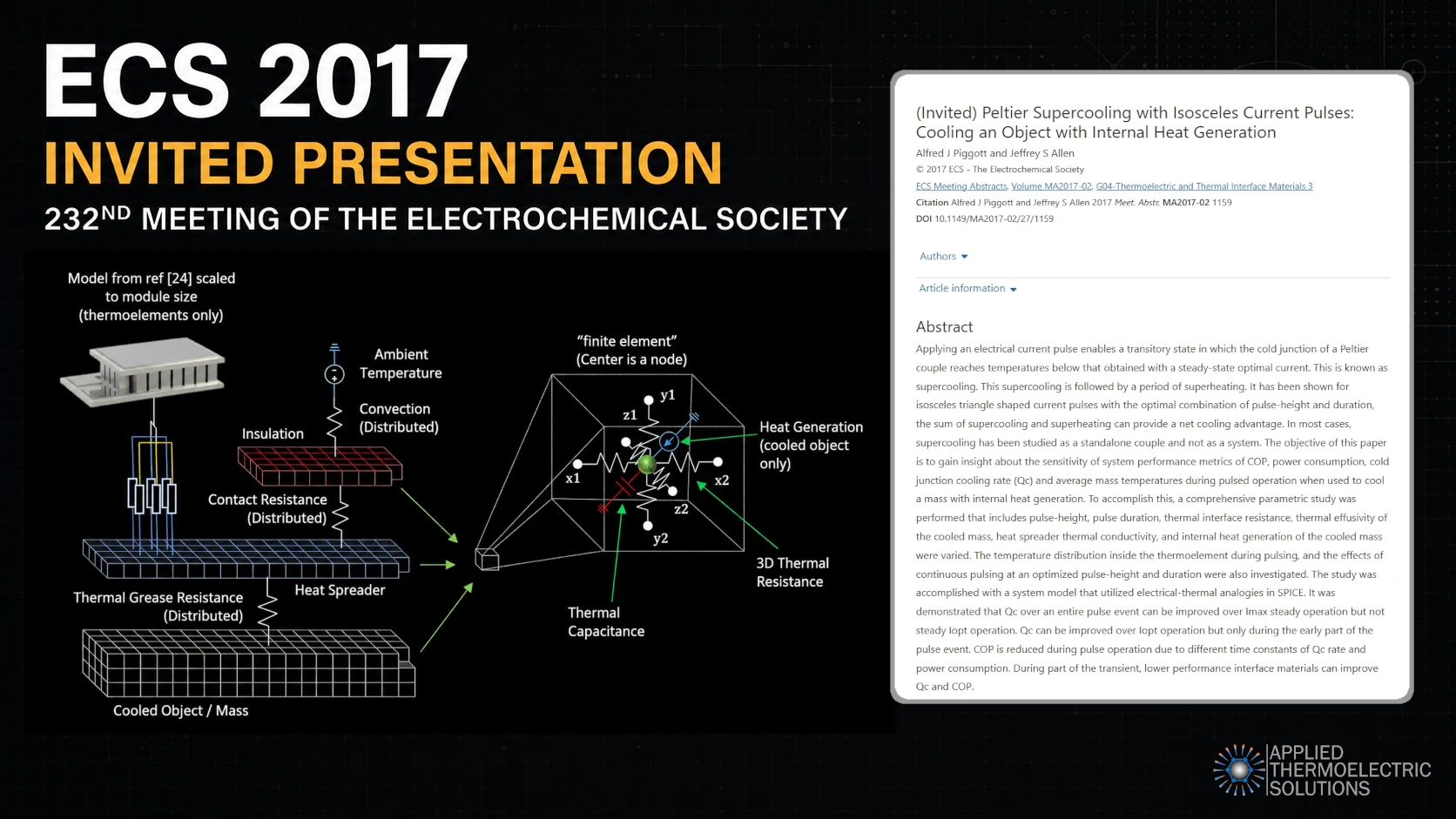
The presentation, “Peltier Supercooling with Isosceles Current Pulses: Cooling an Object with Internal Heat Generation,” examined thermoelectric pulse cooling from a system-level perspective rather than considering the thermoelectric device in isolation. The ECS meeting record designates the presentation as “Invited” and identifies Piggott with Applied Thermoelectric Solutions.
Invited Presentation at the 232nd ECS Meeting
Meeting: 232nd Meeting of The Electrochemical Society
Location: National Harbor, Maryland
Meeting dates: October 1–5, 2017
Symposium: Thermoelectric and Thermal Interface Materials 3
Presentation designation: Invited
Presenter: Alfred J. Piggott
Affiliation: Applied Thermoelectric Solutions LLC
Co-author: Jeffrey S. Allen
ECS program number: G04-1159
Presentation: Peltier Supercooling with Isosceles Current Pulses: Cooling an Object with Internal Heat Generation
The official ECS meeting program lists Piggott under program number G04-1159 in the Thermoelectric and Thermal Interface Materials 3 symposium.
What the “Invited” Designation Means
The ECS meeting record specifically designates the presentation “Invited,” distinguishing it from a standard contributed presentation.
ECS guidance to symposium organizers provides useful context for this designation: invited speakers are selected as part of building a technical program around subjects the organizers want represented. ECS has also encouraged organizers to invite leaders in relevant fields when developing symposium programs.
That context helps explain the significance of the designation, although it does not establish the specific criteria the 2017 organizers used in selecting this presentation. The invitation should also not be interpreted as an award or as an ECS endorsement of the research conclusions.
About the 232nd ECS Meeting
The Electrochemical Society brings together scientists, engineers, and industry participants working in electrochemistry and solid-state science and technology.
The 232nd ECS Meeting was held October 1–5, 2017 at the Gaylord National Resort & Convention Center in National Harbor, Maryland. Nearly 2,400 attendees from 54 countries participated in a technical program consisting of 49 symposia, more than 1,250 oral presentations, and nearly 570 posters.
The Peltier supercooling research was presented within Thermoelectric and Thermal Interface Materials 3, a symposium specifically focused on thermoelectric and thermal-interface research.
What Applied Thermoelectric Solutions Presented
The research examined Peltier supercooling of a heat-generating object using shaped electrical-current pulses.
Peltier supercooling uses transient electrical excitation to temporarily change the cooling behavior of a thermoelectric device beyond its conventional steady-state response. Because the effect is transient, its practical value depends on more than the lowest temperature reached. Electrical power, cooling rate, thermal mass, heat generation, interfaces, pulse timing, and subsequent heating all influence the complete system response.
The research therefore extended earlier pulse-optimization work toward a more representative thermoelectric cooling system containing an object that generates heat.
A comprehensive parametric analysis used electrical-thermal analogies implemented in SPICE to investigate variables and performance measures including:
- cooling rate
- electrical power consumption
- coefficient of performance (COP)
- temperature of the cooled object
- thermal-interface behavior
- internal heat generation
- pulse timing
- transient thermal response
What the Modeling Showed
The analysis demonstrated why transient thermoelectric performance cannot be judged only by the minimum temperature reached during a pulse.
Cooling rate could temporarily exceed steady-state performance during portions of the transient response, while COP generally declined during the current pulse because electrical power increased faster than useful cooling. Delayed Joule heating and other thermoelectric effects also influenced the system response.
The modeling also showed that thermal-interface behavior under transient operation could differ from steady-state expectations. This reinforced the importance of treating interfaces, electrical drive conditions, thermal mass, heat generation, and timing as parts of the complete thermoelectric system rather than evaluating the module independently.
Invited Presentation, Proceedings, and Peer-Reviewed Publication
The research is documented through multiple ECS publication records.
A proceedings version appeared in ECS Transactions, Volume 80, Issue 5, pages 3–46, as part of the Thermoelectric and Thermal Interface Materials 3 symposium proceedings. The publication carries the invited designation.
A peer-reviewed journal version was subsequently published in the ECS Journal of Solid State Science and Technology, Volume 6, Issue 12, pages N250–N259.
The journal publication also identifies the work as Paper 1159 presented at the Society’s National Harbor meeting, October 1–5, 2017, providing a direct documentary connection between the conference presentation and the published research.
Building on Earlier Peltier Supercooling Research
The invited ECS presentation continued an earlier investigation of transient thermoelectric pulse cooling.
Earlier in 2017, Applied Thermoelectric Solutions-associated research titled “Peltier Supercooling with Isosceles Current Pulses: A Response Surface Perspective” was presented as an oral presentation at the 36th International Conference on Thermoelectrics in Pasadena, California.
That work focused primarily on the relationship between current-pulse height, pulse duration, and transient cooling response.
The ECS research extended the investigation toward the behavior of a complete cooling system with internal heat generation, incorporating additional thermal, electrical, and system-design variables.
Together, the two presentations document a progression from pulse optimization toward system-level transient thermoelectric modeling.
A Documented Example of System-Level Thermoelectric Modeling
The ECS research illustrates an engineering principle that remains important in thermoelectric system development: module performance alone does not determine system performance.
Electrical drive conditions, thermal interfaces, heat rejection, thermal mass, heat generation, controls, transient response, and operating strategy can interact in ways that are difficult to predict from steady-state module specifications alone.
Applied Thermoelectric Solutions uses physics-based modeling and system-level engineering to evaluate these interactions when developing thermoelectric cooling, heating, power-generation, and thermal-management systems.
Developing a Thermoelectric System?
Applied Thermoelectric Solutions provides thermoelectric modeling, simulation, design, engineering, and R&D support for organizations developing thermoelectric and thermal-management systems.
Links that May Interest You
- Custom Thermoelectric Solutions
- Thermoelectric Design and Simulation Services
- Thermoelectric System Development
- Our Thermoelectric Cooling and Generator Work
- Thermoelectric Cooling Prototype Case Study
- Solar Thermoelectric Generator Case Study
- How Thermoelectric Cooling Works
- How Thermoelectric Generators Work
- ParaThermic® Battery Thermal Management Technology
- VoltaTherm® Battery Thermal Management System (BTMS)
- PowerBeam™ Wireless Power Transfer Technology
- Battery Thermal Management | After Immersion Cooling