
Peltier Supercooling with Isosceles Current Pulses: Cooling an Object with Internal Heat Generation
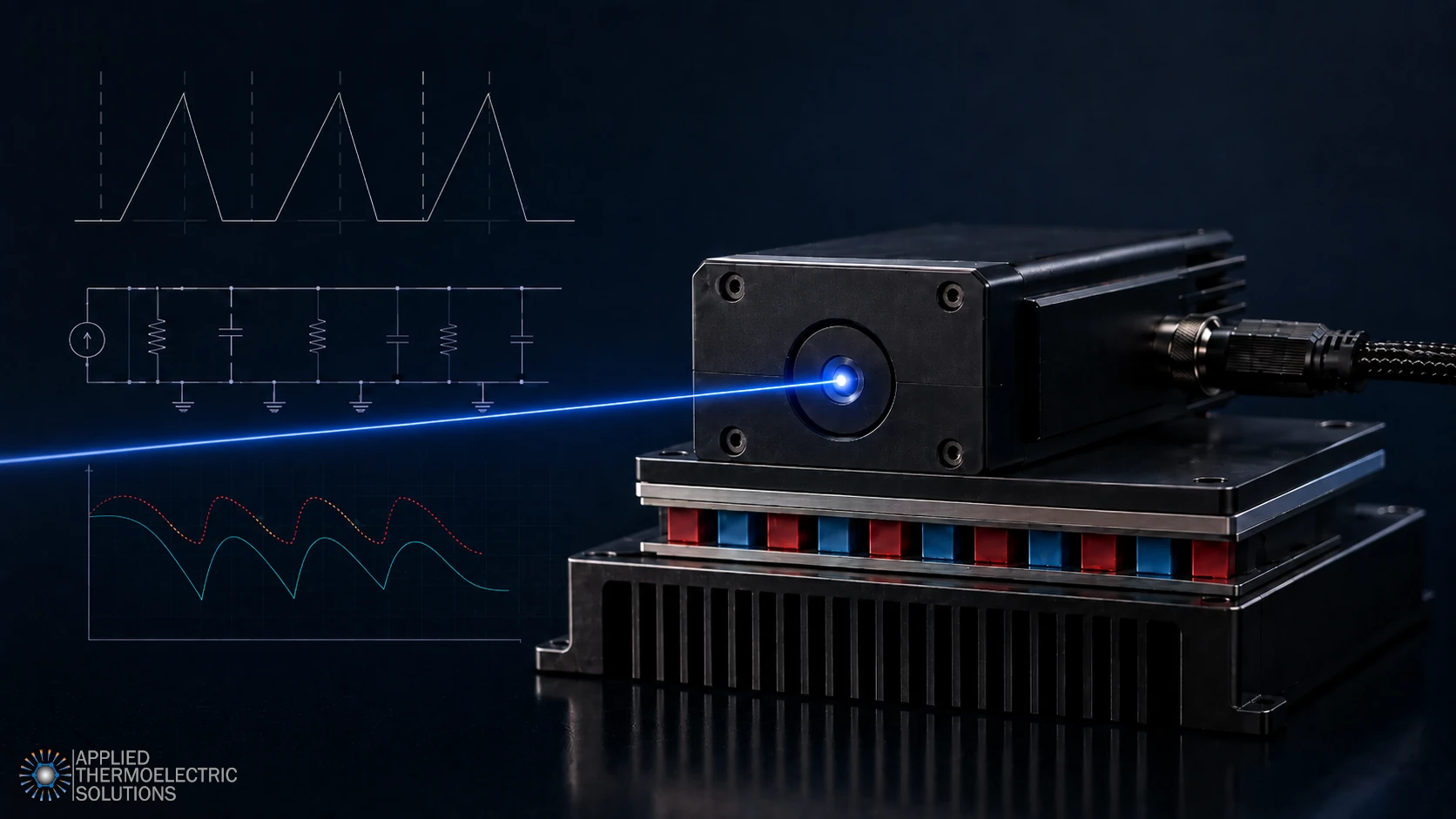
This page summarizes peer-reviewed research by Alfred J. Piggott, Founder and CTO of Applied Thermoelectric Solutions, and Jeffrey S. Allen of Michigan Technological University on transient Peltier cooling of a heat-generating object.
The study extended earlier work on thermoelectric current-pulse optimization by moving beyond an isolated thermoelectric couple and evaluating a more realistic cooling system. The model included a thermoelectric module, thermal interfaces, a heat spreader, and an object with internal heat generation.
The objective was not simply to determine whether a current pulse could temporarily reduce temperature. The study examined how pulse cooling affected cold-side heat transfer, electrical power consumption, coefficient of performance, and the temperature of the cooled object.
Why Study Pulse Cooling of a Heat-Generating Object?

Transient thermoelectric supercooling is often studied by examining the cold junction of an individual thermoelectric couple. That approach is useful for understanding the underlying physics, but a real cooling application includes much more than the thermoelectric material itself.
A practical system may include:
- A heat-generating object
- Thermal interface materials
- A heat spreader
- Thermal mass
- Spatial temperature gradients
- A hot-side heat rejection system
- Electrical power and control hardware
These components affect how quickly cooling reaches the object, how heat is distributed, and whether the additional electrical power produces a useful system-level benefit.
This study was designed to evaluate pulse cooling in that broader context.
From Thermoelectric Couple Behavior to System Performance

Applying a current pulse can temporarily increase the Peltier cooling effect at the cold junction. The Peltier effect responds quickly to the change in electrical current, while Joule heat generated throughout the thermoelectric elements takes longer to diffuse toward the cold side.
This difference in response time can create a short period of increased cooling.
However, the cooled object does not respond instantly. Heat must move through the thermoelectric module, ceramic layers, thermal interface materials, and heat spreader before the temperature of the object changes.
As a result, a current pulse that produces strong cooling at the thermoelectric junction may not produce the same proportional benefit at the cooled object.
The complete thermal path must therefore be included when evaluating pulse performance.
What the Study Investigated
A detailed electrical-thermal analogy model was developed and solved in SPICE. The model represented the thermoelectric cooling system and its time-dependent thermal response.
The study examined the effect of several pulse and system variables, including:
- Current-pulse height
- Current-pulse duration
- Starting steady-state current
- Thermal interface resistance
- Thermal effusivity of the cooled object
- Heat-spreader thermal conductivity
- Internal heat generation within the cooled object
- Temperature distribution within the thermoelectric elements
- Spacing and behavior of consecutive current pulses
The primary performance metrics were cold-side cooling rate, electrical power consumption, coefficient of performance, and average cooled-object temperature.
Isosceles Current Pulses
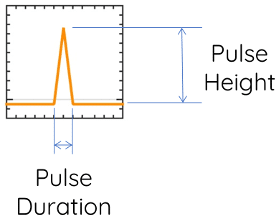
The study used isosceles triangular current pulses.
During an isosceles pulse, current rises linearly from the initial steady-state current to a peak and then decreases linearly back to the starting current. The increasing and decreasing portions of the pulse have equal duration.
This pulse shape avoids an abrupt current step and allows pulse height and duration to be evaluated systematically.
The earlier response-surface study identified combinations of pulse height and pulse duration that could produce a positive net transient advantage under the modeled conditions. This follow-on study used that research as the foundation for evaluating pulse cooling in a more complete thermal system.
Starting Current: Imax and Iopt
The study compared pulses beginning from two important steady-state operating currents.
I_{\max} is the current associated with the maximum steady-state temperature difference.
I_{\mathrm{opt}} is the current associated with the maximum steady-state cooling capacity.
These starting conditions provide different baselines.
A pulse beginning from I_{\max} can be compared with operation intended to maximize temperature difference. A pulse beginning from I_{\mathrm{opt}} must be compared with steady current that already produces the highest steady-state cooling rate for the modeled system.
This distinction is important because a current pulse may appear to provide a large improvement relative to one baseline while offering little or no overall improvement relative to another.
Cold-Side Cooling Rate
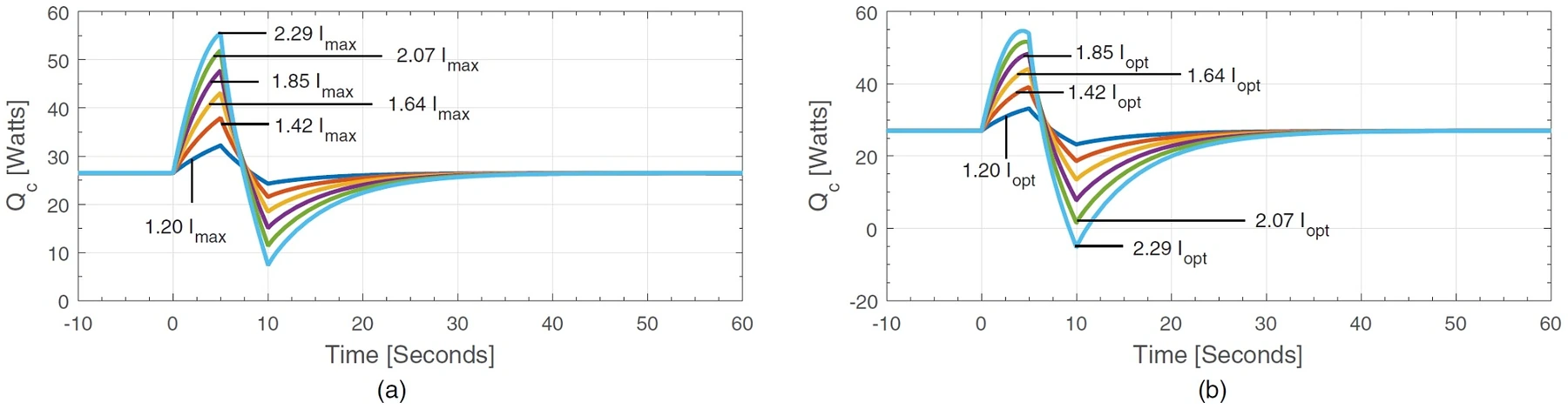
The cold-side heat transfer rate is represented by \dot{Q}_{c}.
A current pulse can initially increase \dot{Q}_{c} because the Peltier cooling term responds rapidly to the increased current.
The study found that cooling over the complete pulse event could be improved relative to steady operation at I_{\max}.
However, cooling over the entire pulse event was not improved relative to steady operation at I_{\mathrm{opt}}.
A pulse could temporarily produce a higher cooling rate than steady I_{\mathrm{opt}} operation during the early portion of the pulse, but that advantage did not continue throughout the complete event.
This finding illustrates why transient performance must be compared with the correct steady-state baseline.
A Higher Peak Cooling Rate Is Not the Same as More Total Cooling
The highest instantaneous cooling rate does not necessarily correspond to the greatest useful cooling over the complete operating period.
A larger pulse can increase the immediate Peltier cooling effect. It also increases:
• Electrical input power
• Joule heat generation
• Heat that must eventually reach the hot or cold side
• Hot-side heat rejection requirements
• The possibility of a delayed thermal penalty
Because Joule heat generation increases strongly with current, an aggressive pulse may create an impressive initial cooling rate while providing little improvement in total cooling.
The timing of the heat load and the required cooling window therefore matter as much as the peak value of \dot{Q}_{c}.
Coefficient of Performance During a Pulse

Thermoelectric cooling coefficient of performance can be expressed as:
\mathrm{COP}=\frac{\dot{Q}_{c}}{P_{\mathrm{in}}}
where \dot{Q}_{c} is the cold-side heat transfer rate and P_{\mathrm{in}} is the electrical input power.
During a current pulse, electrical power consumption increases almost immediately. The cold-side cooling rate does not necessarily increase at the same rate because the thermal system responds more slowly.
The study found that COP was reduced during most current-pulse cases.
This reduction occurred because:
• Electrical power responded faster than useful cold-side heat transfer
• Joule heat was generated throughout the thermoelectric elements
• Joule heat reached the cold side after a delay
• The changing temperature difference altered Seebeck voltage
• The cooled object and thermal interfaces introduced additional time delays
The pulse could therefore increase short-duration cooling capacity while simultaneously reducing the efficiency with which electrical power was converted into useful cooling.
Why Power and Cooling Respond at Different Rates
Electrical power consumption changes rapidly when current changes.
Thermal response is slower because heat must propagate through materials with thermal resistance and thermal capacitance. The thermoelectric elements, ceramics, interfaces, heat spreader, and cooled object each introduce a time-dependent response.
During the beginning of a pulse, the cooling rate may rise quickly. However, power consumption can rise even faster.
Later in the pulse, delayed Joule heat and the changing Seebeck contribution further reduce COP.
This is why pulse cooling cannot be evaluated using current magnitude alone. The electrical and thermal time constants must be considered together.
The Effect of Thermal Interface Resistance
One of the more counterintuitive findings involved thermal interface resistance.
Under steady-state conditions, lower interface resistance is normally preferred because it improves heat transfer between the cooled object and the thermoelectric module.
During part of the transient pulse, however, a higher-resistance interface could temporarily improve both cold-side heat transfer rate and COP.
The additional interface resistance changed where the cold junction drew heat from during the transient event. For a limited period, the cold junction could draw a greater portion of heat from the thermoelectric element rather than from the heat-generating object.
This altered the measured cold-side heat transfer and COP during that portion of the pulse.
This result does not mean that higher interface resistance is generally better for thermoelectric cooling. It shows that transient measurements can behave differently from steady-state expectations and that the location, timing, and definition of heat flow matter.
An interface that appears beneficial during a brief portion of a pulse may still produce poorer object cooling or worse long-term performance.
Internal Heat Generation
The cooled object was modeled with different levels of internal heat generation.
Internal heat generation affects:
• The temperature difference across the thermoelectric system
• Seebeck voltage
• Cold-side heat transfer
• The rate of object temperature change
• The balance between cooling and electrical power
• The point at which Joule heating becomes dominant
For some modeled conditions, COP increased briefly during the first portion of the pulse. This improvement was temporary.
As the pulse continued, increasing power input and delayed Joule heat caused COP to decline.
At higher object heat-generation rates, Seebeck-related effects contributed to the COP reduction earlier in the pulse. At lower heat-generation rates, delayed Joule heating became increasingly important later in the event.
The result demonstrates that the same current pulse can perform differently when applied to objects with different heat-generation profiles.
Heat Spreader and Object Properties
The thermal conductivity of the heat spreader and the thermal properties of the cooled object influence how quickly the pulse affects object temperature.
A highly conductive heat spreader can reduce localized temperature gradients and distribute cooling over a larger area. However, it also changes the effective thermal mass seen by the thermoelectric cooler.
The thermal effusivity of the cooled object affects how readily the object exchanges heat with the thermoelectric system. Objects with different conductivity, density, and heat capacity can respond very differently to the same pulse.
These system properties determine whether the transient cooling remains localized near the module or produces a meaningful reduction in average object temperature.
Average Cooled-Object Temperature
A reduction in cold-junction temperature does not automatically produce the same reduction in average object temperature.
The cooled object has finite thermal mass and internal thermal resistance. It takes time for the cooling effect to spread through the object.
For applications involving localized hot spots, the temperature at the critical location may be more important than the average temperature.
For other applications, average object temperature may be the primary design requirement.
A practical model should therefore evaluate the temperature metric that matters to the application rather than relying only on thermoelectric junction temperature.
Consecutive Current Pulses

The study also examined repeating current pulses.
Consecutive pulses have been proposed as a way to obtain increased cooling over longer operating periods. However, repeated pulsing changes the thermal baseline from which each new pulse begins.
Heat from earlier pulses may remain within the thermoelectric elements, interfaces, heat spreader, or cooled object when the next pulse begins.
The study found that repeating pulses could increase cooling rate relative to steady-state operation under some conditions. However, COP was generally reduced because of the added electrical power and accumulated transient heat.
Pulse spacing is therefore important. If pulses occur too close together, the system may not have enough time to recover from delayed Joule heating and hot-side temperature rise.
A repeating pulse strategy must be evaluated as a complete duty cycle, not as a series of independent pulse events.
Principal Findings
The principal findings of the study were:
• Current pulses can increase cold-side cooling rate during the early portion of a transient event.
• Cooling over the complete pulse event can exceed steady operation at I_{\max}.
• Cooling over the complete event did not exceed steady operation at I_{\mathrm{opt}} in the modeled cases.
• Cooling rate can briefly exceed steady I_{\mathrm{opt}} operation during the beginning of a pulse.
• COP was reduced during most pulse cases.
• Electrical power increased more quickly than useful cold-side heat transfer.
• Delayed Joule heat and Seebeck voltage contributed to further COP reduction.
• Interface resistance could temporarily improve measured cold-side heat transfer and COP during part of the transient.
• Internal heat generation, heat spreading, thermal mass, and object properties changed the system response.
• Consecutive pulses could increase cooling rate, but generally at the cost of lower COP.
Engineering Significance
The study shows that transient thermoelectric pulse cooling should be evaluated as a system-level design problem.
The most useful operating strategy depends on the application objective.
A pulse may be valuable when the goal is:
• Maximum cooling during a short critical time window
• Suppression of a localized thermal peak
• Faster response to a temporary heat load
• Delaying the temperature rise of a heat-generating object
• Reaching a lower temperature briefly
• Synchronizing cooling with a laser, sensor, processor, or electronic load
A pulse may be less attractive when the primary goal is maximum average energy efficiency or maximum total heat removal over a long operating period.
The correct question is not simply whether a pulse creates supercooling. The correct question is whether the timing, magnitude, and duration of the additional cooling provide a useful system benefit relative to the additional power, delayed heat, and module constraints.
For a broader explanation of applications, operating limits, module constraints, and pulse-current design, see Transient Thermoelectric Pulse Cooling:
Relationship to the Response-Surface Study

This research followed Peltier Supercooling with Isosceles Current Pulses: A Response Surface Perspective.
The response-surface paper investigated how pulse height and pulse duration interacted when applied to a modeled thermoelectric couple. It identified operating regions in which a pulse could produce a positive net transient advantage.
The heat-generating-object paper extended that work by adding:
• A cooled thermal mass
• Internal heat generation
• Thermal interfaces
• A heat spreader
• System-level cooling rate
• Electrical power
• COP
• Average object temperature
• Repeating pulse operation
Together, the two papers show the progression from optimizing thermoelectric-junction behavior to evaluating the performance of a more realistic cooling system.
Relationship to the Foundational Research
The modeling methods used in both published papers were developed through broader research on transient thermoelectric supercooling.
That foundational work included electrical-thermal analogy modeling, distributed thermoelectric elements, thermal interfaces, internal heat generation, heat spreading, cooled-object temperature distribution, and consecutive pulsing.
Publication Information
Paper title: Peltier Supercooling with Isosceles Current Pulses: Cooling an Object with Internal Heat Generation
Authors: Alfred J. Piggott and Jeffrey S. Allen
Journal: ECS Journal of Solid State Science and Technology
Volume and issue: Volume 6, Issue 12
Pages: N250-N259
Publication year: 2017
DOI: 10.1149/2.0391712jss
The work was also presented at the 232nd Electrochemical Society Meeting in National Harbor, Maryland.
Thermoelectric Modeling and Engineering Support

Applied Thermoelectric Solutions provides thermoelectric design and simulation services for steady-state and transient cooling systems.
For a transient pulse-cooling application, system analysis may include:
• Thermoelectric module behavior
• Pulse shape, height, and duration
• Starting current
• Cold-side cooling rate
• Electrical power and COP
• Delayed Joule heating
• Seebeck voltage
• Thermal interface resistance
• Heat-spreader design
• Heat-source timing
• Object thermal mass and internal heat generation
• Hot-side heat rejection
• Module solder-temperature limits
• Post-pulse recovery
• Repeating pulse schedules
The objective is to determine whether a pulse produces a useful cooling benefit in the required time window without exceeding the thermal, electrical, or reliability limits of the module and surrounding system.
Frequently Asked Custom Thermoelectric Questions
What is Peltier supercooling?
Peltier supercooling is a temporary reduction in cold-side temperature created by applying a controlled electrical current pulse to a thermoelectric cooler. The Peltier cooling effect responds rapidly, while Joule heat takes longer to diffuse through the thermoelectric elements.
What was different about this study?
Earlier pulse-cooling studies often focused on an individual thermoelectric couple or cold junction. This study modeled a more complete system that included a thermoelectric module, thermal interfaces, a heat spreader, and an object with internal heat generation.
Can a current pulse increase cooling capacity?
Yes. A current pulse can temporarily increase cold-side cooling rate. In the modeled system, the cooling rate could exceed steady operation at the current associated with maximum cooling capacity during the early portion of the pulse.
Did pulse cooling remove more heat than steady Iopt operation?
Not over the complete pulse event in the modeled cases. The pulse could briefly exceed the steady I_{\mathrm{opt}} cooling rate, but total cooling over the complete event did not exceed steady operation at I_{\mathrm{opt}}.
Why did COP decrease during most pulses?
Electrical power increased faster than useful cold-side heat transfer. Delayed Joule heat and the changing Seebeck voltage further reduced COP as the pulse progressed.
Does higher thermal interface resistance improve pulse cooling?
It can temporarily increase measured cold-side heat transfer and COP during part of a transient event by changing where heat is drawn from. This does not mean that higher interface resistance is generally better. Its effect on the actual cooled-object temperature and total system performance must also be evaluated.
Can repeating current pulses improve long-term cooling?
Repeating pulses can increase cooling rate under some conditions, but they generally require more electrical power and can reduce COP. Pulse spacing must allow for delayed heat and thermal recovery.
What applications may benefit from this approach?
Potential applications include systems that require short bursts of increased cooling, such as pulsed laser sensors, localized electronic hot spots, photonics, pulsed power electronics, and other devices with brief or synchronized heat loads.
Can the published pulse settings be applied directly to a commercial module?
No. The useful pulse depends on the actual module construction, electrical limits, solder limits, thermal interfaces, heat sink, cooled object, starting temperature, ambient conditions, and heat-load timing. A commercial system should be modeled using its own properties and constraints.
Can Applied Thermoelectric Solutions evaluate a pulse-cooling application?
Yes. Applied Thermoelectric Solutions can model the thermoelectric module and complete thermal system, evaluate pulse-current strategies, estimate cold-side cooling and COP, identify module constraints, and determine whether transient pulse cooling is practical for a specific product or application.
Links that May Interest You
- Custom Thermoelectric Solutions
- Thermoelectric Design and Simulation Services
- Thermoelectric System Development
- Our Thermoelectric Cooling and Generator Work
- Thermoelectric Cooling Prototype Case Study
- Solar Thermoelectric Generator Case Study
- How Thermoelectric Cooling Works
- How Thermoelectric Generators Work
- ParaThermic® Battery Thermal Management Technology
- VoltaTherm® Battery Thermal Management System (BTMS)
- PowerBeam™ Wireless Power Transfer Technology
- Battery Thermal Management | After Immersion Cooling
2 Responses
Thanks for the article Alfred. It’s a keeper!
Bruce, Thank you for the comment and for your interest!