Peltier Supercooling with Isosceles Current Pulses: A Response Surface Perspective
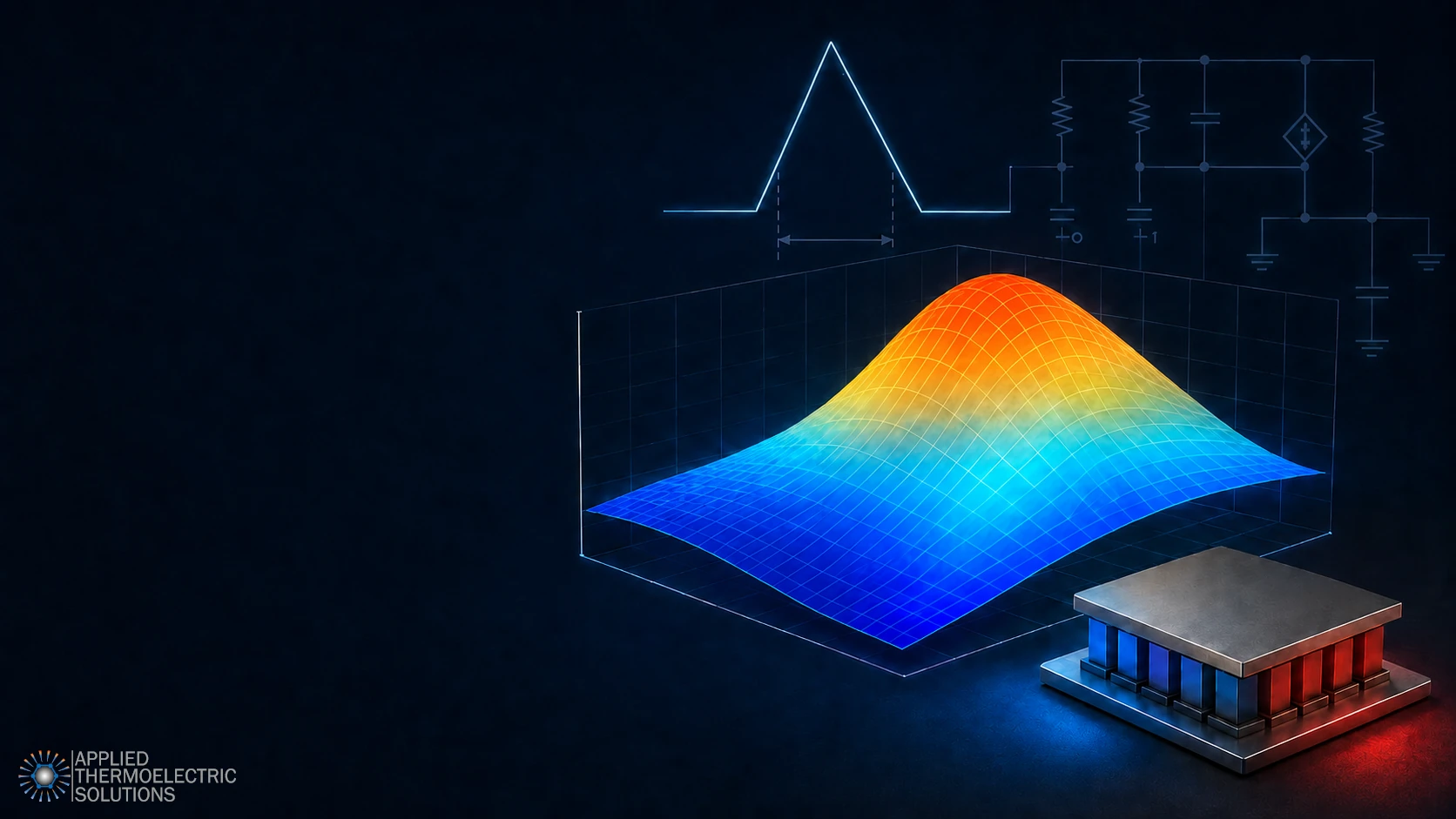
This page summarizes peer-reviewed research by Alfred Piggott, Founder and CTO of Applied Thermoelectric Solutions, and Jeffrey S. Allen of Michigan Technological University on the use of isosceles current pulses to produce transient thermoelectric supercooling.
The study used SPICE-based electrical-thermal analogy modeling and response-surface analysis to evaluate how pulse height and pulse duration affect the transient temperature response of a thermoelectric couple.
The objective was not simply to identify the current pulse that produced the lowest instantaneous cold-side temperature. The research examined whether pulse height and duration could be selected to maximize useful transient cooling while accounting for the delayed temperature rise that can follow the pulse.
The paper was published in the ECS Journal of Solid State Science and Technology in 2017 as part of a focus issue on thermoelectric materials, devices, and thermal transport.
Why Transient Peltier Supercooling Was Studied
A thermoelectric cooler is normally evaluated using steady-state operating conditions. Current is applied, the temperature distribution settles, and performance is characterized using values such as cooling capacity, temperature difference, electrical power consumption, and coefficient of performance.
Some thermal problems, however, occur over a much shorter period.
A controlled current pulse can temporarily increase Peltier cooling at the cold-side junction. The Peltier cooling effect responds quickly to current, while the additional Joule heat generated throughout the thermoelectric elements takes more time to diffuse toward the cold side.
This difference in response time can cause the cold-side temperature to temporarily fall below the temperature produced by the original steady current. This temporary temperature reduction is known as transient thermoelectric supercooling.
The benefit is followed in many cases by a delayed period of reduced cooling or temperature rise as the additional Joule heat reaches the cold side. The engineering problem is therefore not limited to creating a lower temperature. The complete pulse and recovery period must be considered.
What the Study Investigated
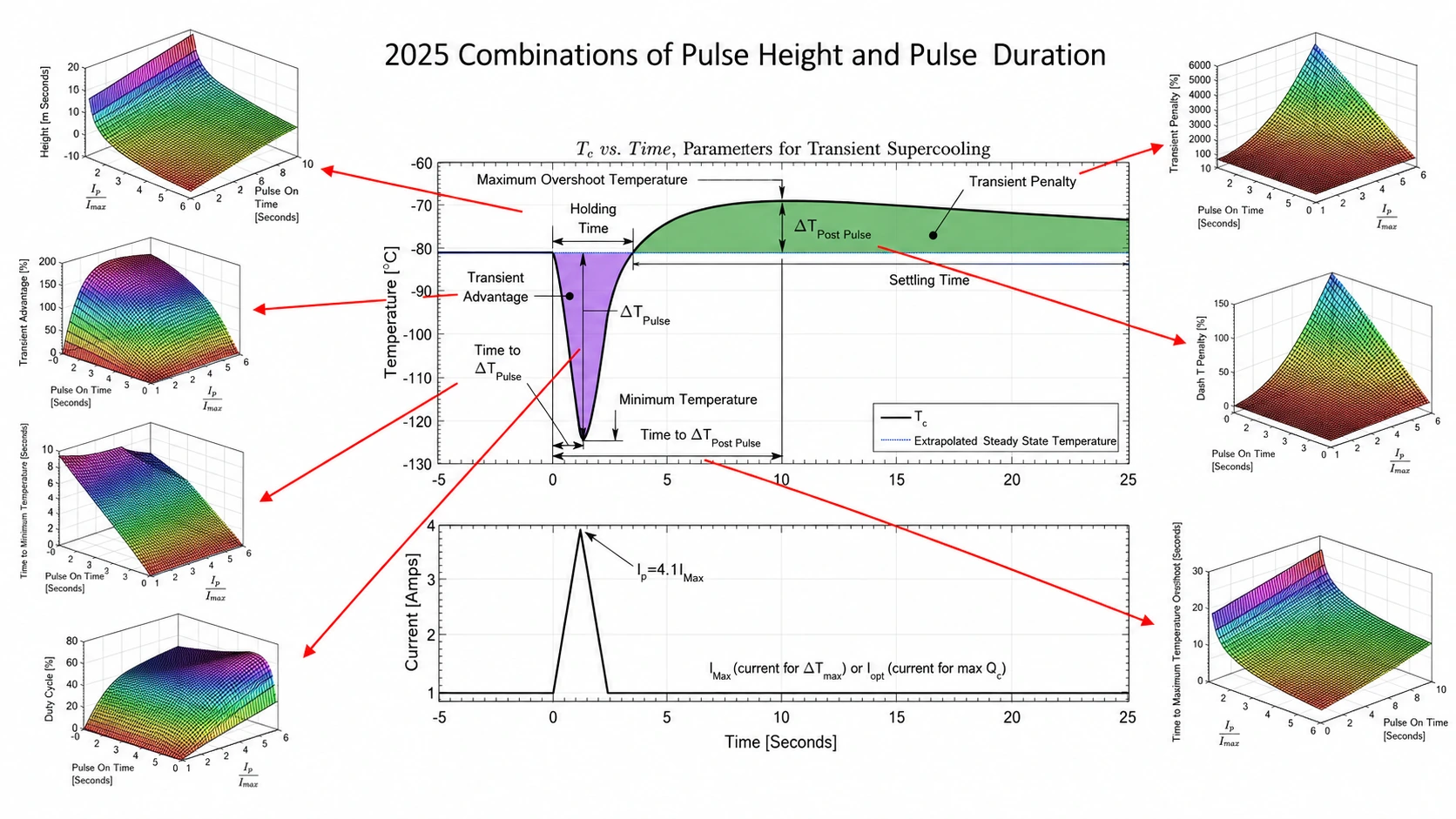
The research examined the interaction between two variables that can be controlled for a selected pulse shape:
- Pulse height
- Pulse duration
The study evaluated how these variables affected:
- Minimum cold-side temperature
- Pulse cooling enhancement
- Time required to reach minimum temperature
- Holding time below the original steady-state temperature
- Maximum post-pulse temperature
- Time required to reach maximum temperature
- Settling time
- Transient advantage
- Transient penalty
- Net transient advantage
Rather than changing one variable at a time, the research used response surfaces to show how pulse height and duration interacted across a broad range of operating conditions.
This approach made it possible to identify useful operating regions and tradeoffs that would be difficult to recognize from a small number of isolated simulations or tests.
Isosceles Current-Pulse Shape
The study used an isosceles triangular current pulse.
Current increased linearly from the starting steady current to a peak value and then decreased linearly back to the starting current. The increasing and decreasing sides of the pulse had the same duration, producing the isosceles shape.
The peak of the triangle defined the pulse height, while the width of the triangle defined the pulse duration.
This pulse shape was selected because earlier research indicated that an isosceles pulse could produce a transient cooling advantage greater than the subsequent temperature penalty under some operating conditions.
The study expanded on that finding by investigating a much wider range of pulse heights and durations to determine where a positive net result occurred and where it could be maximized.
Pulse Height and Duration Range
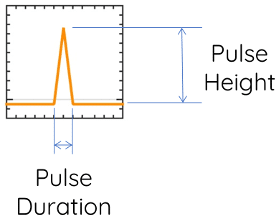
The study evaluated:
- Pulse durations from 0.1 to 10 seconds
- Pulse heights from 1.01 to 6 times the starting steady current
- Pulses beginning from the current associated with maximum steady-state temperature difference, (I_{\max})
- Pulses beginning from the current associated with maximum steady-state cooling capacity, (I_{\mathrm{opt}})
For each response surface, 2,025 combinations of pulse height and pulse duration were simulated.
Automated current-profile generation, SPICE simulation, data export, and post-processing were used because manually creating and evaluating that number of pulse combinations would have been impractical.
SPICE-Based Electrical-Thermal Modeling

The transient thermoelectric model was created using electrical-thermal analogies and solved in SPICE.
In this modeling approach:
- Temperature is represented by voltage
- Heat flow is represented by electrical current
- Thermal resistance is represented by electrical resistance
- Thermal mass is represented by electrical capacitance
- Peltier cooling and heating are represented by controlled current sources
- Joule heating is represented by heat generation distributed through the thermoelectric elements
- Seebeck voltage and electrical resistance are coupled to the thermal model
The thermoelectric elements were divided into distributed sections similar to finite elements. Each section included thermal mass, thermal resistance, electrical resistance, and internal Joule heat generation.
This distributed approach was important because transient supercooling depends on how heat moves through the thermoelectric material over time. A simple steady-state equation cannot reproduce the time delay between Peltier cooling at the junction and Joule heat diffusion through the thermoelectric elements.
The model was compared with previously published analytical and SPICE models and with available experimental results. The comparisons showed that the model reproduced the characteristic transient supercooling and post-pulse temperature response.
Response-Surface Analysis
A response surface is a three-dimensional representation showing how an output changes as two input variables are varied.
For this research, pulse height and pulse duration were the independent variables. A separate response surface was generated for each transient performance metric.
This allowed the research to show, for example, that the pulse producing the largest temperature drop did not necessarily produce:
- The longest useful cooling duration
- The smallest post-pulse temperature rise
- The lowest transient penalty
- The greatest net transient advantage
The response surfaces also showed that pulse height and duration did not affect every performance metric in the same way.
Increasing pulse current strengthened the immediate Peltier cooling effect, but it also increased Joule heat generation. Because Joule heat increases with the square of current, large pulse-height increases could produce rapidly increasing post-pulse penalties.
Longer pulse durations could extend or increase some aspects of the cooling response, but they also allowed more Joule heat to be generated and eventually reach the cold side.
The best pulse therefore depended on the performance objective being optimized.
Transient Advantage

Transient advantage represents the useful cooling portion of the pulse event.
It accounts for both:
- How far the cold-side temperature falls below its original steady-state path
- How long that additional cooling lasts
A pulse that produces a very low minimum temperature for only a very brief time may have a different transient advantage from a pulse that produces a smaller temperature reduction over a longer period.
The response surfaces showed how transient advantage changed with pulse height and pulse duration for pulses beginning from both I_{\max} and I_{\mathrm{opt}}.
Transient Penalty
Transient penalty represents the post-pulse temperature increase caused primarily by delayed Joule heat.
It accounts for:
- The magnitude of the post-pulse temperature rise
- The duration of the temperature rise before the system returns to its steady-state path
The study found that transient penalty increased approximately linearly with pulse duration and much more rapidly with pulse height.
This result follows from the underlying thermoelectric behavior. Increasing pulse duration adds heat for a longer period, while increasing current raises Joule heat generation as a function of current squared.
A pulse that creates more initial cooling can therefore also produce a much larger delayed penalty.
Net Transient Advantage

Net transient advantage was used to compare the useful cooling portion of the event with the subsequent thermal penalty.
\text{Net transient advantage}=\text{Transient advantage}-\text{Transient penalty}
A positive result indicates that the useful transient cooling advantage is larger than the delayed penalty. A negative result indicates that the pulse produces a net thermal penalty relative to the steady-state temperature path.
The response surfaces showed that positive net transient advantage was not produced across the full pulse-height and pulse-duration range.
For pulses beginning from I_{\max}, a positive net transient advantage was identified within a limited pulse-height range, approximately between 1 and 2 times I_{\max} in the modeled system.
Pulses beginning from I_{\mathrm{opt}} did not produce the same positive net transient advantage over the evaluated range. This is an important distinction because I_{\mathrm{opt}} already represents the steady current that produces maximum cooling capacity.
Increasing current above I_{\mathrm{opt}} increases Joule heat faster than it increases Peltier cooling, making a net improvement over that operating condition more difficult.
Principal Findings
The research produced several important findings:
- Pulse height and pulse duration must be evaluated together.
- The largest current pulse did not produce the best net result.
- The pulse that produced the lowest instantaneous temperature was not necessarily the pulse that produced the greatest net transient advantage.
- Transient penalty increased strongly with pulse height because Joule heat generation increases with current squared.
- Longer pulse duration increased the amount of heat added during the pulse and generally increased the delayed penalty.
- A positive net transient advantage was found for a limited operating region when pulses began from I_{\max}.
- The same pulse-height range beginning from I_{\mathrm{opt}} produced a net penalty rather than a net advantage.
- Different performance objectives produced different optimum combinations of pulse height and duration.
- Response-surface analysis provided a more systematic optimization method than changing one pulse variable at a time.
The results do not indicate that pulsed current universally improves thermoelectric cooling.
They show that a useful transient advantage is possible under selected operating conditions and that identifying those conditions requires time-dependent modeling of the full pulse and recovery event.
Why the Starting Current Matters

Two steady-state currents were evaluated before the pulse was applied.
I_{\max}
I_{\max} is the current associated with the maximum steady-state temperature difference between the hot and cold sides under the defined model conditions.
It is not necessarily the current that provides maximum heat pumping.
A properly designed pulse beginning from I_{\max} can temporarily increase cooling and, under selected conditions, produce a positive net transient advantage.
I_{\mathrm{opt}}
I_{\mathrm{opt}} is the steady current associated with maximum cooling capacity.
Once the thermoelectric device is operating at that current, increasing current further causes Joule heating to grow more rapidly than Peltier cooling.
The study found that pulses beginning from I_{\mathrm{opt}} could still create a short-duration temperature reduction, but they did not produce the same positive net transient advantage found for selected pulses beginning from I_{\max}.
This distinction demonstrates why pulse cooling must be compared with the correct steady-state reference condition.
Engineering Significance
The study established a systematic way to identify combinations of pulse height and duration that create useful transient cooling while accounting for the delayed thermal penalty.
For a real product, however, the thermoelectric couple is only one part of the system.
A practical pulse-cooling design must also consider:
- Full thermoelectric module construction
- Hot-side temperature and solder-temperature limits
- Thermal interfaces
- Heat spreaders
- Heat sinks or liquid cooling hardware
- Thermal mass of the cooled object
- Internal heat generation
- Power-supply capability
- Current-control strategy
- Required cooling magnitude and duration
- Post-pulse recovery requirements
- Reliability and module life
The pulse conditions from this paper should therefore not be applied directly to a commercial module without system-specific modeling.
For a broader explanation of current pulse cooling, practical applications, PWM comparison, module limits, and system-level engineering considerations, see our guide to transient thermoelectric pulse cooling.
Relationship to the Foundational Thesis
This paper developed from broader modeling work documented in Alfred Piggott’s graduate research at Michigan Technological University.
The thesis includes additional information on:
- Development of the thermoelectric couple model
- Electrical-thermal analogy circuits
- Automated pulse generation and simulation
- Heat-generating objects
- Thermal-interface resistance
- Heat spreading
- Internal heat generation
- Cooling capacity
- Electrical power consumption
- Coefficient of performance
- Repeated pulse operation
Follow-On Research: Cooling a Heat-Generating Object

The response-surface paper focused on a freestanding thermoelectric couple and the interaction between pulse height and pulse duration.
A follow-on paper extended the research to a more realistic system containing a complete thermoelectric module, thermal interfaces, a heat spreader, and a heat-generating object.
That study evaluated transient cooling from the perspective of cooling capacity, electrical power consumption, coefficient of performance, internal heat generation, and repeated pulse operation.
Publication Information
Title: Peltier Supercooling with Isosceles Current Pulses: A Response Surface Perspective
Authors: Alfred J. Piggott and Jeffrey S. Allen
Journal: ECS Journal of Solid State Science and Technology
Volume and issue: Volume 6, Issue 3
Pages: N3045-N3054
Published: January 14, 2017
DOI: 10.1149/2.0061703jss
Citation:
Piggott, A. J., and Allen, J. S., “Peltier Supercooling with Isosceles Current Pulses: A Response Surface Perspective,” ECS Journal of Solid State Science and Technology, 6(3), N3045-N3054, 2017.
Thermoelectric Modeling and Engineering Support

Applied Thermoelectric Solutions provides model-based engineering for steady-state and transient thermoelectric cooling systems.
For pulse-cooling applications, this can include evaluation of:
- Thermoelectric module behavior
- Starting current
- Pulse magnitude
- Pulse duration
- Pulse shape
- Cold-side temperature response
- Joule heat diffusion
- Hot-side temperature
- Solder-temperature constraints
- Thermal interfaces
- Heat spreading
- Heat rejection
- Thermal mass
- Heat-load timing
- Post-pulse recovery
- Module and system reliability
The objective is to determine whether a pulse-current strategy can provide the required cooling response within the practical limits of the thermoelectric module and the surrounding system.
Frequently Asked Custom Thermoelectric Questions
What is an isosceles current pulse?
An isosceles current pulse is a triangular electrical-current profile in which current rises linearly from a starting value to a peak and then decreases linearly back to the starting value. The increasing and decreasing sides of the pulse have equal duration.
What variables were optimized in the research?
The independent variables were pulse height and pulse duration. Pulse durations ranged from 0.1 to 10 seconds, and pulse heights ranged from 1.01 to 6 times the starting steady current.
What is net transient advantage?
Net transient advantage is the transient cooling advantage minus the subsequent transient penalty. A positive value indicates that the useful cooling portion of the pulse event is larger than the delayed post-pulse temperature penalty.
Did the largest pulse produce the best result?
No. Increasing pulse height strengthened the immediate Peltier cooling effect, but it also increased Joule heat generation. Because Joule heating increases with current squared, larger pulses could create disproportionately larger post-pulse penalties.
Why were response surfaces used?
Response surfaces made it possible to show how pulse height and pulse duration interacted across a broad operating range. This revealed useful operating regions and tradeoffs that would not be apparent from changing one variable at a time.
Did pulses beginning from I_{\mathrm{opt}} improve net cooling?
The modeled pulses beginning from I_{\mathrm{opt}} created a temporary temperature reduction, but they did not produce the same positive net transient advantage found for a limited range of pulses beginning from I_{\max}. I_{\mathrm{opt}} already represents the current that produces maximum steady-state cooling capacity.
Can these pulse conditions be applied directly to a commercial thermoelectric module?
No. The results were produced for the modeled thermoelectric couple and operating conditions used in the study. A commercial system must be evaluated using its actual module construction, material properties, thermal interfaces, heat rejection, electrical limits, solder-temperature limits, thermal mass, and heat-load timing.
Links that May Interest You
- Custom Thermoelectric Solutions
- Thermoelectric Design and Simulation Services
- Thermoelectric System Development
- Our Thermoelectric Cooling and Generator Work
- Thermoelectric Cooling Prototype Case Study
- Solar Thermoelectric Generator Case Study
- How Thermoelectric Cooling Works
- How Thermoelectric Generators Work
- ParaThermic® Battery Thermal Management Technology
- VoltaTherm® Battery Thermal Management System (BTMS)
- PowerBeam™ Wireless Power Transfer Technology
- Battery Thermal Management | After Immersion Cooling