Solar Thermoelectric Generator Case Study
Key Takeaways
- Thermoelectric generators enable solid-state solar power without photovoltaics:
Metallic solar thermoelectric generators convert solar heat directly into electricity using the Seebeck effect, enabling solid-state power generation without, moving parts, or fragile photovoltaic panels. - System-level efficiency can exceed device-level electrical efficiency through CHP:
While the electrical conversion efficiency of thermoelectric generators is lower than that of photovoltaic cells, M-STEG systems can achieve higher system-level efficiency by enabling combined heat and power (CHP), increasing total energy utilization. - Cost per watt and manufacturability are primary economic drivers:
Low material costs, simple manufacturing, and modular architectures allow M-STEG systems to achieve competitive cost-per-watt economics in applications where durability, scalability, and lifecycle cost matter. - Material selection improves sustainability and supply-chain resilience:
Metallic thermoelectric materials offer recyclability, reduced environmental impact, and lower exposure to constrained global supply chains compared to many conventional solar technologies. - Modular scalability enables flexible deployment across applications:
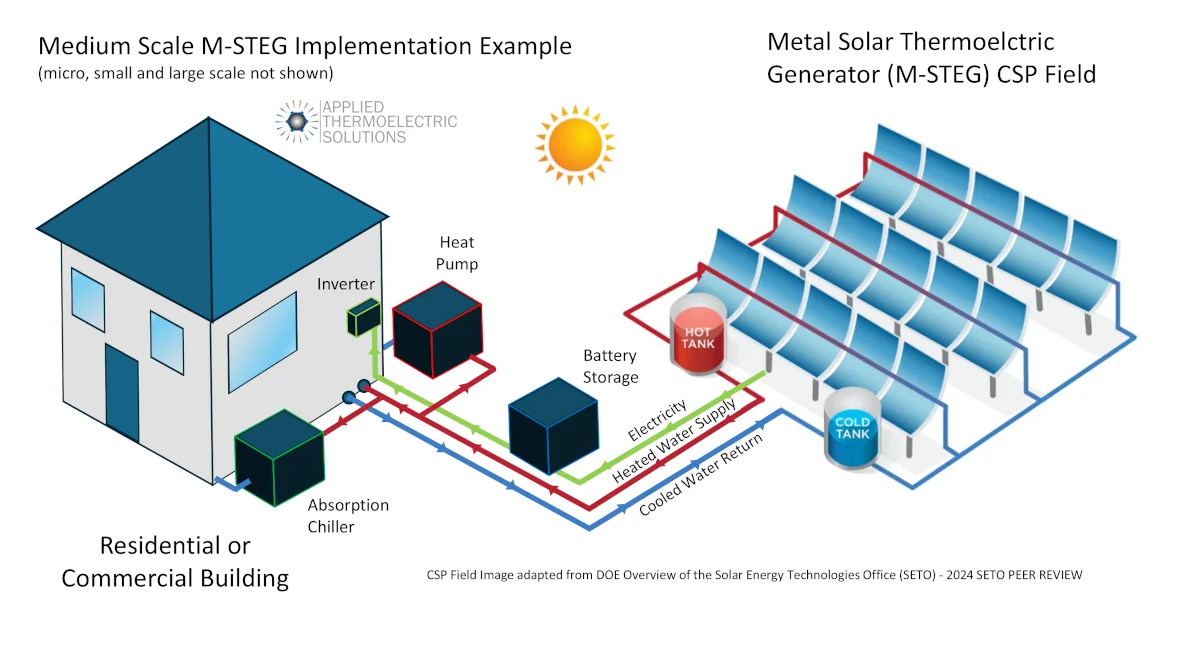
M-STEG systems can recover both electrical power and usable thermal energy from high-temperature radiant heat sources, including industrial equipment such as furnaces or hot steel, as well as from parabolic trough collectors that deliver concentrated solar radiation.
Turning solar heat into electricity without photovoltaics
Applied Thermoelectric Solutions was engaged by STEMero to evaluate whether a metallic solar thermoelectric generator could provide a commercially viable non-photovoltaic approach to solar power generation.
This case study summarizes the thermoelectric generator modeling, trade-space evaluation, and system-level feasibility work performed to assess that opportunity.
Rather than focusing only on electrical conversion efficiency, the study examined the factors that often matter most in real-world deployment: cost per watt, manufacturability, scalability, durability, recyclability, cooling requirements, and combined heat and power potential.
That broader perspective was important because a solar energy system does not need to outperform photovoltaics on electrical efficiency alone to create value in the right application.
The concept evaluated in this work used metallic thermoelectric materials rather than the semiconductor materials more commonly associated with thermoelectric generators today.
While semiconductor devices generally offer higher electrical conversion efficiency, metallic thermoelectric generators can offer important advantages in material cost, robustness, recyclability, supply-chain resilience, and system-level practicality.
This case study shows how thermoelectric generator technology, often viewed as niche, can become commercially relevant when evaluated through system-level economics, total energy utilization, and deployment considerations rather than electrical efficiency alone.
Technical Background
While this article focuses on system-level feasibility and commercial considerations, a separate overview explains the fundamental operating principles, material behavior, and performance tradeoffs of thermoelectric generators in greater detail.
Who This Case Study May Be Relevant To
This case study may be relevant to organizations evaluating non-photovoltaic
solar power concepts or thermoelectric generator applications where
system-level economics matter alongside electrical efficiency. That includes:
- solar thermal or concentrated solar power teams
- companies exploring combined heat and power opportunities
- organizations evaluating waste heat recovery concepts
- remote or off-grid power developers
- R&D teams evaluating TEG feasibility
Organizations evaluating similar concepts can also explore our thermoelectric system development services.
The commercial problem with conventional solar power
Traditional solar photovoltaic systems achieve relatively high electrical conversion efficiency, but they rely on complex semiconductor manufacturing, fragile global supply chains, and materials that are difficult to recycle. In addition, PV systems generate electricity only, rejecting a large fraction of incoming solar energy as waste heat.
For many industrial, infrastructure, and utility-scale applications, cost per installed watt, system durability, supply-chain security, and total usable energy matter more than peak electrical efficiency.
These constraints create an opportunity for thermoelectric power generators that convert heat directly into electricity using solid-state materials and the Seebeck effect, while simultaneously enabling the recovery of useful thermal energy.
Project objective
The objective of this feasibility study was not to compete directly with photovoltaic systems on electrical conversion efficiency. Instead, the goal was to determine whether metallic thermoelectric generators integrated with concentrated solar power (CSP) could:
- Deliver competitive cost per watt
- Scale from small systems to utility-relevant power levels
- Use abundant, recyclable metallic materials
- Reduce supply-chain and geopolitical risk
- Enable combined heat and power (CHP) operation
- Compete favorably with PV at the system level
Study approach

The project was conducted in two structured phases.
Phase 1: Technology landscape and material evaluation
A broad landscape study was performed across metallic thermoelectric materials and conductor geometries used to form thermoelectric junctions.
In this context, wire geometry refers to the diameter, length, and arrangement of metallic conductors that determine electrical resistance, current density, heat flow, and manufacturability.
Key parameters evaluated included power output, voltage, material cost, electrical current, cooling requirements, and environmental impact. This phase identified promising material and geometry combinations while revealing practical challenges associated with extreme operating points.
Phase 2: Application of real-world engineering constraints
The second phase applied practical limits related to:
- Electrical current levels
- Cooling heat-flux capability
- Available solar heat flux from realistic concentration systems
- Cost-per-watt benchmarks comparable to commercial photovoltaic systems
Configurations requiring extreme electrical currents, impractical cooling approaches, or unrealistic solar concentration were eliminated or deprioritized.
This shifted the optimal design space toward conductor geometries that balance performance, cost, manufacturability, and system complexity rather than simply
minimizing material cost per watt.
Key findings with commercial relevance
Lower efficiency does not imply lower value
While metallic solar thermoelectric generators exhibit lower electrical conversion efficiency than photovoltaic panels, material costs per watt were shown to be highly competitive. When evaluated as a solid-state power generation system, rather than a single-metric efficiency device, M-STEGs demonstrated strong commercial potential.
Chromel-Constantan emerged as a leading candidate
Among the metallic thermoelectric materials evaluated, Chromel-Constantan provided the most favorable balance of voltage output, cost, manufacturability, and scalability. Other metal pairs were found to require substantially higher thermal concentration or cooling area expansion, increasing overall system complexity.
System design dominates economics
The study demonstrated that the lowest material cost-per-watt geometries often impose the highest demands on cooling performance, solar concentration, and electrical infrastructure. In many cases, selecting slightly higher material cost-per-watt geometries results in lower total system cost, improved reliability, and reduced parasitic losses.
Sustainability and supply-chain advantages
Metallic thermoelectric generators use recyclable, widely available materials and avoid many of the environmental and end-of-life challenges associated with photovoltaic panels. The reliance on metals rather than specialized semiconductors significantly reduces supply-chain risk.
Client Perspective
“As the CEO of STEMero, I conceived the idea of evaluating metallic solar thermoelectric generators as an alternative solar power pathway and worked with Applied Thermoelectric Solutions on a feasibility study to assess its technical and commercial viability. ATS helped frame the critical technical and economic questions, assess material cost and system-level performance, and identify realistic pathways toward prototype development and external funding. Their ability to integrate engineering analysis with commercial considerations was essential in moving this concept from an initial idea to actionable next steps.”
— Diane Mero, CEO, STEMero
Reframing efficiency: electrical efficiency vs system efficiency
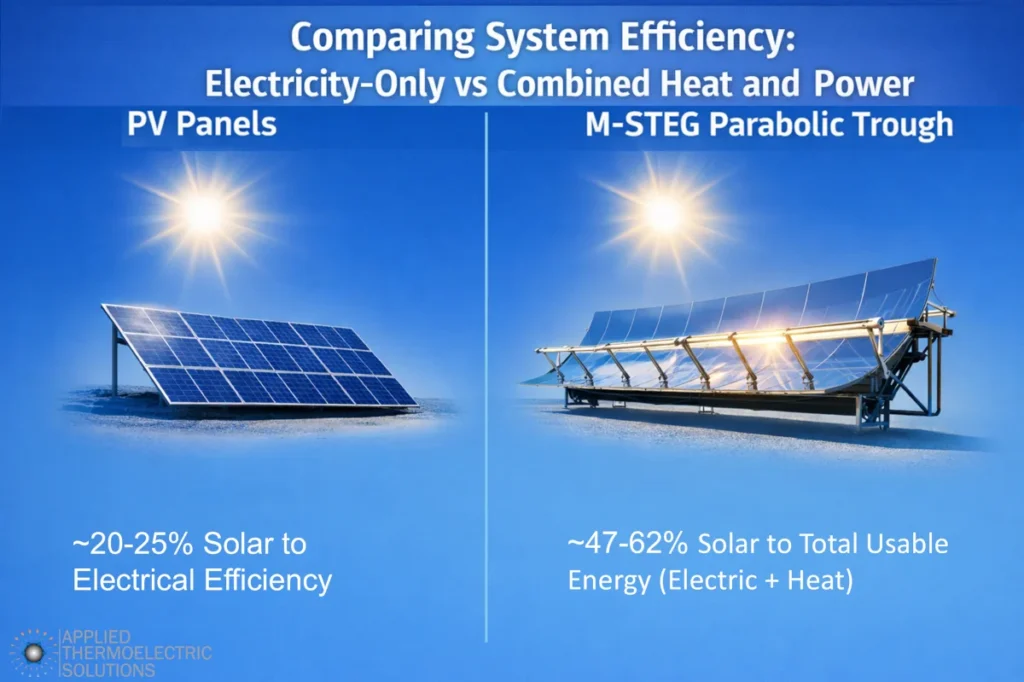
It is important to clarify how efficiency is evaluated when comparing metallic solar thermoelectric generators to photovoltaic systems.
From a pure electrical conversion standpoint, photovoltaic panels convert a higher fraction of solar irradiance into electricity. This study did not attempt to compete with PV on that metric alone.
Instead, the focus was on overall system efficiency and energy utilization.
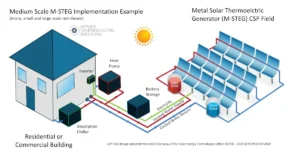
Metallic solar thermoelectric generators inherently operate as combined heat and power (CHP) systems. In addition to generating electricity through the Seebeck effect, M-STEG systems simultaneously produce useful thermal energy in the form of heated water or steam. When both electrical output and recovered thermal energy are considered, the total usable energy extracted from the solar resource can exceed that of photovoltaic systems, which discard most thermal energy as waste heat.
This distinction is critical in applications where thermal energy has value, such as industrial processes, district heating, absorption cooling, hybrid heat-pump systems, and commercial or off-grid greenhouses.
Strategic impact

This feasibility study demonstrates that metallic solar thermoelectric generators should not be evaluated solely as electrical power devices. When viewed as solid-state combined heat and power systems, M-STEG technology offers a compelling alternative in applications where durability, sustainability, and total energy utilization outweigh peak electrical efficiency.
The results indicate strong potential for deployment in:
- Concentrated solar thermal installations
- Industrial facilities requiring both heat and electricity
- Regions facing PV supply-chain or recycling constraints
- Infrastructure applications where reliability and long service life are critical
Next steps toward commercialization
Based on the results of this study, the next phase of development will focus on:
- Refining M-STEG designs for manufacturability
- System-level optimization of thermal concentration and cooling
- Prototype development and pilot-scale validation
- Identification of early-adopter markets and strategic partners
The findings from this feasibility analysis provide a solid technical and commercial foundation for advancing metallic solar thermoelectric generators from modeling to deployable energy systems.
Why this matters
Thermoelectric generators are no longer limited to niche or laboratory applications. When applied strategically, metallic solar thermoelectric generators offer a durable, scalable, and supply-resilient approach to renewable energy generation that complements, rather than replaces, conventional solar technologies.
For organizations exploring thermal energy harvesting, solid-state power generation, solid-state cooling, high-heat transfer technologies, or combined heat and power solutions, this case study demonstrates a credible and commercially grounded pathway forward.
This case study is intended for organizations evaluating non-photovoltaic solar power technologies at the system level.
Explore Whether a Thermoelectric Generator Makes Sense for Your Application
Work with Applied Thermoelectric Solutions to evaluate system-level efficiency, energy utilization, cost-per-watt tradeoffs, and integration pathways for your specific application.
Related Work
Explore additional thermoelectric generator, thermal management, and energy system projects completed by Applied Thermoelectric Solutions.
Frequently Asked Questions
How does a thermoelectric generator differ from a photovoltaic solar panel?
A thermoelectric generator converts heat directly into electricity using the Seebeck effect, while photovoltaic panels convert light into electricity. Thermoelectric systems are solid-state, can utilize heat rather than direct sunlight, and can enable combined heat and power configurations.
Why consider thermoelectric generators if their electrical efficiency is lower than PV?
While device-level electrical efficiency is lower, thermoelectric generator systems can achieve higher system-level efficiency when both electrical output and useful thermal energy are captured through combined heat and power (CHP).
What applications are best suited for thermoelectric generators?
Thermoelectric generators are well suited for applications where heat is already available or valuable, such as solar thermal systems, industrial waste heat recovery, remote power generation, and infrastructure requiring durable, low-maintenance power sources.
Are metallic thermoelectric generators commercially viable today?
Thermoelectric generators can be commercially viable when one or more of their inherent advantages align with the requirements of a specific application. These advantages can include solid-state reliability with no moving parts, long operational life, quiet operation, wide fuel flexibility, scalability across a broad power range, and the ability to operate in demanding environments such as extreme temperatures, high-G, or zero-G conditions. In such cases, simplicity, durability, and system-level value, rather than peak electrical efficiency alone, determine whether a thermoelectric generator represents a viable product.
How does Applied Thermoelectric Solutions support thermoelectric generator projects?
Applied Thermoelectric Solutions provides feasibility studies, system-level modeling, design optimization, and commercialization support to help organizations evaluate, design, and deploy thermoelectric generator systems tailored to their specific applications.
Why consider thermoelectric generators if their electrical efficiency is lower than PV?
Thermoelectric generators can still be attractive when system-level value matters more than electrical efficiency alone. Unlike photovoltaic systems, thermoelectric generators can convert heat directly into electricity while also supporting combined heat and power (CHP), allowing useful thermal energy to be recovered instead of discarded. In the right application, factors such as cost per watt, durability, recyclability, supply-chain resilience, manufacturability, and total energy utilization can make thermoelectric generators commercially relevant even when their electrical conversion efficiency is lower than PV.
Are metallic thermoelectric generators commercially viable today?
That depends on the application and how viability is defined. Metallic thermoelectric generators are generally not expected to outperform photovoltaic systems on electrical efficiency alone. However, this case study showed that they may offer meaningful commercial potential when evaluated through cost per watt, scalability, material cost, recyclability, supply-chain resilience, and combined heat and power capability. In applications where durability, useful thermal output, and system-level economics matter, metallic thermoelectric generators may represent a viable pathway worth evaluating further.
What applications are best suited for thermoelectric generators?
Thermoelectric generators are best suited for applications where a usable heat source is already available and where solid-state operation, reliability, or system simplicity provide value. Examples include waste heat recovery, combined heat and power systems, remote or off-grid power applications, solar thermal systems, and industrial processes with sustained high-temperature heat sources. They can be especially attractive when maintenance, durability, scalability, or recovery of both electrical and thermal energy are important design considerations.
The Author – Founder and CTO

Alfred Piggott is the Founder and CTO of Applied Thermoelectric Solutions, where he specializes in thermoelectrics, battery thermal management, and energy conversion. With more than 30 years of engineering experience, he develops advanced cooling, power generation, and thermal system technologies and shares practical insights from ongoing modeling, system development, and prototype work.
Links that May Interest You
- Custom Thermoelectric Solutions
- Thermoelectric Design and Simulation Services
- Thermoelectric System Development
- Our Thermoelectric Cooling and Generator Work
- Thermoelectric Cooling Prototype Case Study
- Solar Thermoelectric Generator Case Study
- How Thermoelectric Cooling Works
- How Thermoelectric Generators Work
- ParaThermic® Battery Thermal Management Technology
- VoltaTherm® Battery Thermal Management System (BTMS)
- PowerBeam™ Wireless Power Transfer Technology
- Battery Thermal Management | After Immersion Cooling
Questions or Feedback?
If you have a question, comment, or suggestion related to this post, feel free to leave a comment below. If you would like to discuss a product, application, or technical challenge directly, contact Applied Thermoelectric Solutions.