Applied Thermoelectric Solutions Awarded U.S. Patent for VoltaTherm® Battery Thermal Management Technology
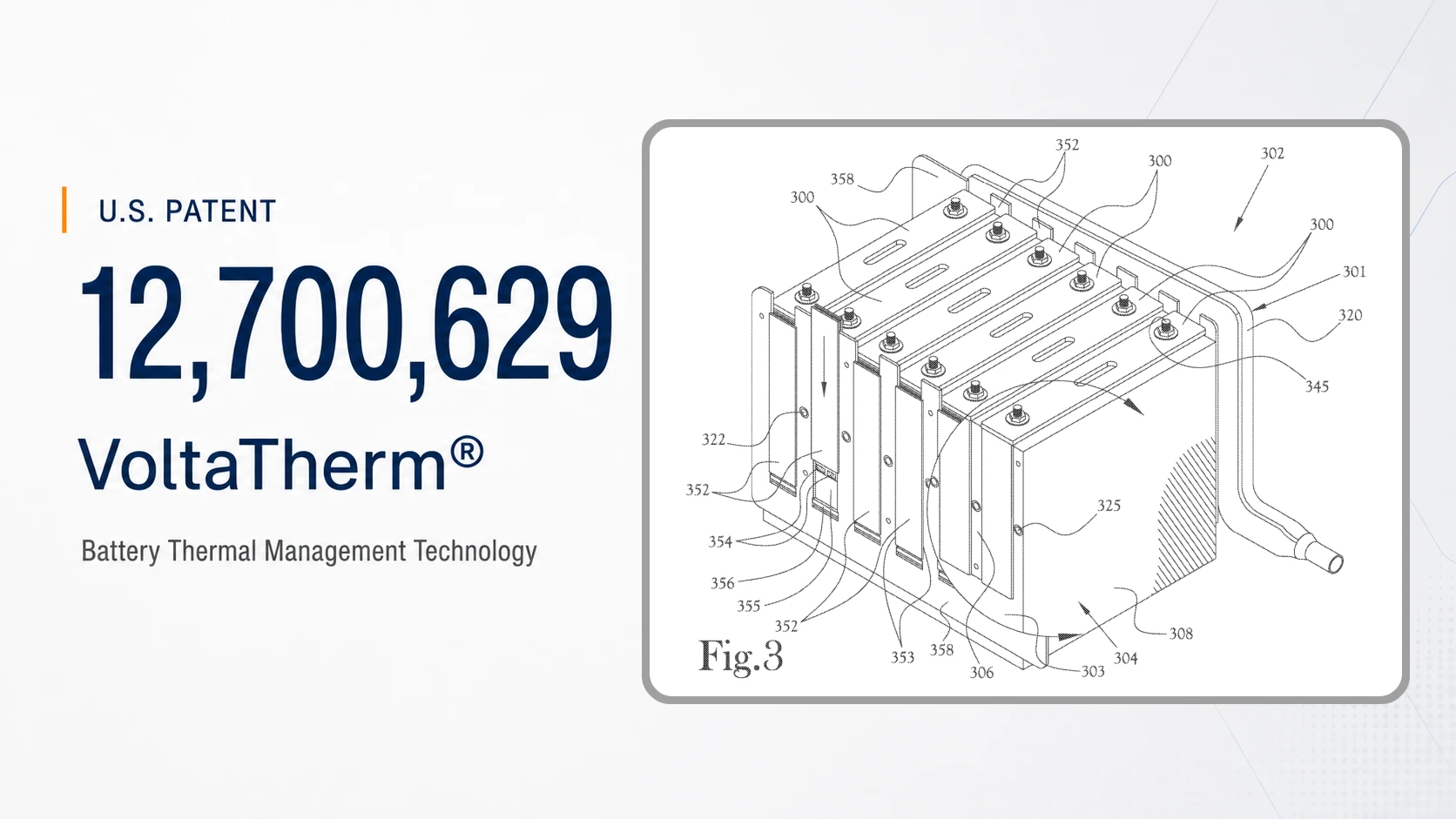
Applied Thermoelectric Solutions has been awarded U.S. Patent No. 12,700,629 B2, titled Electrically Insulative and Thermally Conductive Parallel Battery Cooling and Temperature Control System. The patent issued on August 4, 2026 and adds issued U.S. claims covering technologies incorporated into or relevant to the VoltaTherm® battery thermal management platform.
The patent addresses several elements of advanced battery thermal management, including thermoelectric heating and cooling at individual battery interfaces, independent temperature monitoring and control, coordinated heat rejection, and certain internal battery heat-transfer structures.
These concepts support the broader VoltaTherm® objective: moving beyond treating an entire battery pack as a single thermal zone and enabling active thermal control where it is needed at individual batteries.
U.S. Patent 12,700,629 at a Glance
- Patent: U.S. Patent No. 12,700,629 B2
- Title: Electrically Insulative and Thermally Conductive Parallel Battery Cooling and Temperature Control System
- Issue date: August 4, 2026
- Inventor: Alfred J. Piggott, Founder and CTO, Applied Thermoelectric Solutions
- Assignee: Applied Thermoelectric Solutions LLC
- Application: 18/139,450
- Filing date: April 26, 2023
- Earliest priority date: April 1, 2019
- Issued claims: 29
- Patent family: Divisional of U.S. Application 16/835,816, which issued as U.S. Patent No. 11,670,813
- Current VoltaTherm® system readiness: TRL 2, advancing toward experimental proof of concept
What the Issued Patent Covers
The issued claims address multiple parts of a battery thermal-management system rather than a single cooling component.
Individual-Battery Thermoelectric Heating and Cooling
The patent includes claims involving multiple batteries with thermoelectric devices in thermal communication with substantial areas of their battery cases.
This architecture creates the ability to apply heating or cooling locally rather than relying exclusively on a common pack-level thermal condition.
The issued claims also include control circuitry configured to monitor and control battery temperatures individually, including an embodiment in which one battery can be heated while another is cooled.
This capability is directly relevant to the VoltaTherm® concept of individual-battery thermal control.
Independent Temperature Monitoring and Control
Cells within the same battery system do not necessarily experience identical conditions. Differences can develop from electrical loading, internal resistance, state of charge, aging, manufacturing variation, local cooling conditions, and ambient exposure.
Monitoring those differences is useful. Being able to actively respond to them provides an additional level of control.
Thermoelectric devices can reverse the direction of heat pumping when electrical polarity is reversed. The same solid-state device can therefore provide either heating or cooling at the battery interface.
This creates a path toward coordinating thermal actuation with changing battery conditions rather than applying the same thermal response throughout the pack.
Separate Thermal and High-Current Electrical Pathways
Another important concept addressed by the patent is reducing dependence on the battery’s high-current electrical terminals as the primary thermal-management pathway.
Battery posts, tabs, bus bars, and related structures are primarily required to conduct electrical current. Their thermal performance can be constrained by electrical, mechanical, packaging, and manufacturing requirements.
The patented configurations include thermoelectric devices thermally coupled to battery cases, creating greater freedom to optimize the electrical and thermal pathways for their respective functions.
The issued claims also include circuit-board structures that can retain and electrically connect thermoelectric devices while allowing thermal contact with individual batteries.
Integrated Heat Rejection
Removing heat from the battery interface does not complete the thermal-management problem. That heat must ultimately be transferred through the rest of the system and rejected to the environment or another thermal sink.
The patent includes claimed configurations involving radiators in conductive thermal communication with thermoelectric devices, as well as heat-transfer-fluid arrangements and control of fluid flow through portions of the heat-rejection system.
This reflects a central principle of Applied Thermoelectric Solutions’ engineering approach: thermoelectric performance cannot be evaluated from the thermoelectric device alone.
The complete thermal path matters:
Battery → thermal interface → thermoelectric device → heat-rejection interface → radiator or heat sink → environment
VoltaTherm® development therefore considers the thermal, electrical, mechanical, controls, and heat-rejection systems together.
Current Technology Readiness: System TRL 2
VoltaTherm® is currently at system Technology Readiness Level 2 (TRL 2).
The system architecture has been formulated and modeled, but an integrated VoltaTherm® proof of concept has not yet been built and experimentally demonstrated.
The distinction between the maturity of the complete system and its underlying components is important.
VoltaTherm® combines established technologies including:
- Commercial thermoelectric devices
- Battery cells
- Temperature sensing
- Power electronics
- Electronic controls
- Thermal interfaces
- Heat exchangers
- Liquid or other heat-rejection systems
The development challenge is therefore not to establish whether these individual technologies work. The next step is to experimentally demonstrate and validate their integration within the VoltaTherm® architecture.
The next major development milestone is an integrated laboratory proof of concept designed to demonstrate critical functions and compare measured performance with engineering-model predictions. This work would support advancement toward TRL 3.
The issuance of a patent establishes intellectual-property rights around claimed aspects of the technology. It does not by itself establish technology readiness or experimental validation.
Connecting VoltaTherm® and ParaThermic®
U.S. Patent No. 12,700,629 also includes a claim involving internal battery heat-transfer structures associated with internal electrodes and the battery case.
This creates an important connection between two Applied Thermoelectric Solutions battery technologies that address different portions of the thermal pathway.
ParaThermic® addresses heat transfer inside the battery. It is being developed to reduce internal thermal resistance between heat-generating regions and the intended external thermal-management interface.
VoltaTherm® addresses active thermal control at the battery interface, using thermoelectric devices to add or remove heat.
When used together, the thermal pathway can be represented as:
Battery interior → ParaThermic® low-resistance internal pathway → VoltaTherm® thermoelectric interface → heat-rejection system
The technologies do not depend on one another. ParaThermic® can be integrated with air, liquid, refrigerant, immersion, thermoelectric, and other external thermal-management approaches. VoltaTherm® can also be evaluated with conventional battery designs that provide a suitable thermal interface.
Part of a Continuing Battery Thermal Management Patent Portfolio
U.S. Patent No. 12,700,629 issued from a divisional application in an earlier Applied Thermoelectric Solutions battery thermal-management patent family.
The patent claims priority to April 1, 2019 and identifies U.S. Application 16/835,816, which issued as U.S. Patent No. 11,670,813, as its parent application.
Pursuing the divisional application allowed claims of different scope to be examined while maintaining the relationship to the earlier patent family.
The resulting patents form part of Applied Thermoelectric Solutions’ continuing intellectual-property development in battery heat transfer, thermoelectric heating and cooling, individual battery temperature control, thermal-system integration, and related battery architectures.
Why This Patent Matters to VoltaTherm® Today
The issued claims address several engineering concepts that remain central to current VoltaTherm® development, including individual battery heating and cooling, independent temperature control, direct thermal coupling, separation of primary electrical and thermal pathways, integrated heat rejection, and coordination of multiple batteries within one thermal system.
U.S. Patent No. 12,700,629 therefore documents part of the technical progression from the original patented architecture to the current VoltaTherm® battery thermal-management platform.
The main VoltaTherm® technology page describes the current system architecture, engineering rationale, development status, potential applications, and opportunities for application-specific development and licensing.
Explore VoltaTherm® Battery Thermal Management Technology
Learn how VoltaTherm® is being developed to provide bidirectional heating and cooling directly at individual battery interfaces and to integrate thermal control with the complete battery and heat-rejection system.
Organizations evaluating advanced battery thermal-management technology can also contact Applied Thermoelectric Solutions to discuss application requirements, proof-of-concept development, joint development, prototype evaluation, system integration, or technology licensing.
Links that May Interest You
- Custom Thermoelectric Solutions
- Thermoelectric Design and Simulation Services
- Thermoelectric System Development
- Our Thermoelectric Cooling and Generator Work
- Thermoelectric Cooling Prototype Case Study
- Solar Thermoelectric Generator Case Study
- How Thermoelectric Cooling Works
- How Thermoelectric Generators Work
- ParaThermic® Battery Thermal Management Technology
- VoltaTherm® Battery Thermal Management System (BTMS)
- PowerBeam™ Wireless Power Transfer Technology
- Battery Thermal Management | After Immersion Cooling