
Thermoelectrics for Medical Devices | Cooling, Heating, Temperature Control & Energy Harvesting
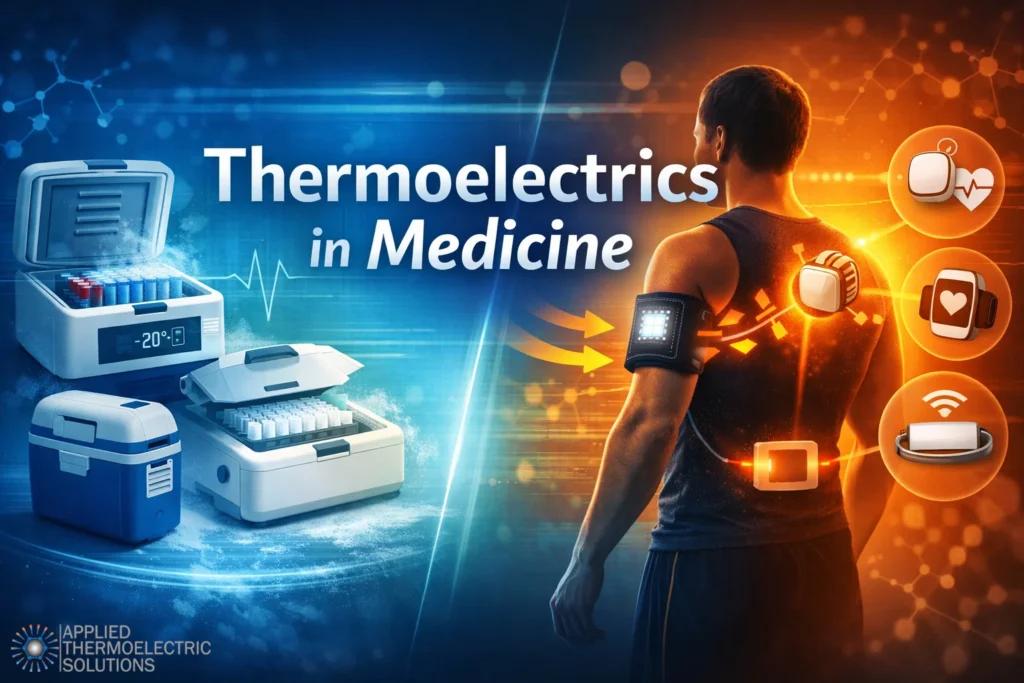
Medical device companies often face thermal challenges where size, reliability, power consumption, noise, temperature stability, and portability all matter.
In the right application, thermoelectric technology can provide a practical solid-state solution for cooling, heating, precision temperature control, and in some cases low-power energy harvesting.
Applied Thermoelectric Solutions helps engineering teams evaluate and develop thermoelectric systems for real products.
We are not a module seller. We help companies determine whether thermoelectrics are the right fit for the application and we design and build the full system around it.
This page provides an overview of thermoelectrics in the medical field, including commercial cooling and heating applications and emerging power-generation concepts for wearable and implantable medical devices.

What Are Thermoelectrics?
Thermoelectrics are based on the direct conversion between electrical energy and heat flow.
In one operating mode, electricity is used to move heat and create a temperature difference. This is the Peltier effect, which is used for cooling and heating.
In the opposite operating mode, a temperature difference and heat flow are used to generate electricity. This is the Seebeck effect, which is used in thermoelectric generators, or TEGs.
This direct energy conversion is one reason thermoelectrics can be attractive in medical products. They can support compact, electronically controlled, solid-state systems without compressors at the device level.

Thermoelectric Devices and Modules
Modern thermoelectric devices use semiconductor materials arranged into couples and modules. When used for cooling and heating, electrical current drives heat from one side of the device to the other. When used for power generation, a temperature difference across the device produces electrical output.
For medical device teams, the most important point is that performance is not determined by the module alone. It depends on the full system, including thermal interfaces, heat rejection, controls, electrical input, insulation, packaging, and operating conditions.
That system-level view is where ATS focuses. We help teams determine whether a thermoelectric concept can meet the actual product requirements, not just whether a module works in principle.

Why Thermoelectrics Can Be Attractive in Medical Devices
Thermoelectrics are not the right solution for every medical product, but they can be a strong fit when one or more of the following matter:
- Precise temperature control
- Compact size
- Solid-state reliability
- Cooling and heating in one device
- Below-ambient cooling
- Quiet operation
- Orientation flexibility
- Small-scale integration
These characteristics are especially relevant in medical devices and instruments where temperature stability, packaging constraints, portability, and low maintenance matter.

Medical Applications Overview
Medical Applications of Thermoelectrics
Medical applications of thermoelectrics generally fall into two primary categories for medical device teams. These are cooling, heating and temperature control, and power generation.
Cooling, Heating, and Temperature Control
This includes commercial products and research-stage concepts involving medical refrigeration, patient warming and cooling, PCR, and other temperature-sensitive instruments.
Power Generation
This area remains more research-oriented and focuses mainly on wearable and implantable medical devices using body-heat energy harvesting. Prototype capability and research interest have advanced significantly, but this is still less commercially mature than medical cooling and temperature control.

Commercial Medical Applications
The most established medical uses of thermoelectrics are in cooling, heating, and temperature-control applications. These are strong use cases when a product benefits from compact size, precise temperature control, reliability, reversible heating and cooling, and solid-state operation.
For medical product teams, the real challenge is not simply selecting a thermoelectric device. The challenge is designing the full system so it can meet performance targets under real packaging, power, ambient, and reliability constraints.

Medical Refrigeration and Portable Cold Storage
One established medical use of thermoelectrics is compact refrigeration. Medical refrigerators and portable cooling systems may benefit from thermoelectrics where reliability, precise temperature control, compact size, and scalability are important.
Examples include:
- vaccine storage
- medicine storage
- insulin storage
- temperature-sensitive experiments and samples
For a medical device or instrumentation company, the engineering question is not simply whether a thermoelectric module can create a temperature difference.
The real question is whether the complete system can meet the cooling load, ambient conditions, control requirements, power limits, size constraints, and product-development targets.
Applied Thermoelectric Solutions helps teams evaluate those questions early through feasibility studies, modeling, and prototype development.

Patient Cooling and Heating Applications
Thermoelectric systems can also be used to cool or heat liquids that circulate through wraps, blankets, or vests. They can also support direct-contact warming or cooling devices.
Examples include applications related to:
- hypoxic-ischemic encephalopathy
- therapeutic hypothermia
- low-grade tissue injuries
- localized warming or cooling for patient comfort
In these products, performance depends on the full system, not just the thermoelectric device. Fluid path design, heat exchangers, thermal interfaces, controls, insulation, and patient-contact hardware all affect whether the concept will work in practice.

PCR and Precision Temperature Control
Another important medical application is PCR, or polymerase chain reaction. PCR relies on repeated temperature changes to denature, anneal, and extend DNA, making controlled thermal cycling essential.
Thermoelectrics are well suited to this type of application because they can support:
- precise temperature control
- compact system architecture
- fast thermal response
- repeated temperature cycling
For developers of medical and laboratory instruments, this is an important example of thermoelectrics being used not just for refrigeration, but for high-value thermal management and temperature-control functions.

Medical Thermoelectric Cooling and Heating in Research
Beyond commercialized systems, the medical field continues to explore thermoelectric cooling and heating in areas such as:
- portable vaccine refrigeration
- portable medical coolers
- cryotherapy
- graft and tissue cooling
- UAV-based medical coolers
- temperature stabilization of medical laser sensors
- head cooling
- controlled injury cooling
This research highlights the breadth of possible medical use cases. It also reinforces an important point: a concept can be technically interesting without being commercially practical.
That is why ATS emphasizes feasibility, system modeling, and prototype validation before teams invest deeply in a thermoelectric product direction.

Power Generation Overview
In addition to cooling and heating, thermoelectric devices can also generate electricity from a temperature difference. In the medical field, this usually means using body heat as the energy source.
This area is still primarily research-oriented today, but it remains important because it could help support very low-power wearable or implantable medical devices.
Recent work in wearable thermoelectric generators shows stronger device performance, energy-management integration, and more practical prototype demonstrations than were common when this material was first developed.
Implantable thermoelectric power generation also remains an active research area, but it is still constrained by body thermal conditions, device geometry, safety, and realistic power output.
So while thermoelectric power generation is promising, it should generally be treated as a feasibility and design question rather than assumed to be a direct battery replacement.

Wearable Medical Devices and Thermoelectric Power Generation
Wearable sensors are one of the most active areas of interest for medical thermoelectric power generation.
Examples include:
- EEG systems
- ECG systems
- EMG systems
- pulse oximeters
- ambulatory blood pressure monitors
- skin-temperature sensors
- accelerometer-based monitoring devices
Potential benefits include reduced dependence on battery replacement or charging, support for low-power sensing concepts, and more continuous monitoring in some use cases.
At the same time, realistic performance depends heavily on the available thermal gradient, device geometry, thermal contact, electronics power demand, and the efficiency of the power-management system.
For most teams, wearable thermoelectric generation is best viewed as an emerging system opportunity with meaningful prototype progress, not yet as a mature off-the-shelf medical power category.

Implantable Medical Devices and Thermoelectric Power Generation
Implantable devices are another area of continuing interest for thermoelectric generation.
Examples include:
- pacemakers
- defibrillators
- drug pumps
- cochlear implants
- muscle stimulators
- neurological stimulators
- implanted sensors
- wireless real-time monitors
The long-term attraction is clear. If thermoelectric generation could reduce or delay battery replacement in some implanted devices, it could reduce patient burden and reduce the need for replacement procedures.
However, implantable applications remain extremely demanding. Available heat flow, biocompatibility, safety, long-term reliability, geometry, and realistic power output all create major engineering challenges.
For most teams, this remains an advanced research and feasibility topic rather than a commercially mature product category.

Medical Thermoelectric Power Generation Research
Research in this area has focused heavily on:
- wearable sensors
- implantable device power support
- low-power medical electronics
- flexible biomedical thermoelectric generators
- energy harvesting for medical devices
The key takeaway is that thermoelectric power generation in the medical field is technically important, but much less commercially mature than thermoelectric cooling and heating.
Recent work suggests stronger wearable prototypes and better integrated energy-management approaches, but medical body-heat power generation is still best approached as a system-level research and feasibility question.
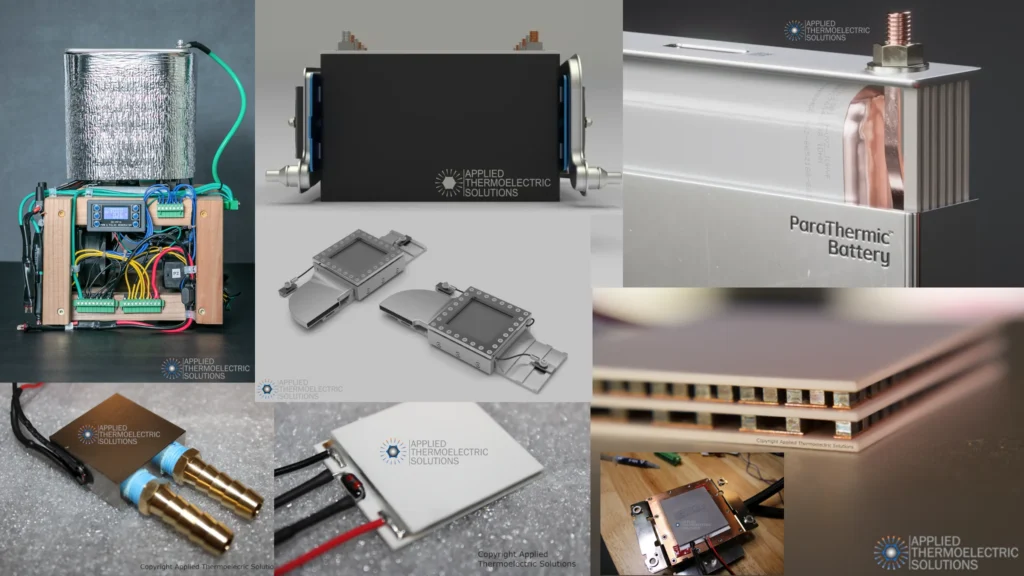
How ATS Helps Medical Device Teams
If your team is evaluating thermoelectrics for a medical application, ATS can help determine whether the concept is practical and how to move it toward a real product.
Early evaluation of whether a thermoelectric cooling, heating, or energy-harvesting approach is viable for the application.
Prediction of temperatures, heat flow, power requirements, transient response, and expected performance under realistic operating conditions.
Evaluation of hot-side heat rejection, controls, packaging, insulation, thermal interfaces, condensation risk, and overall integration.
Support for proof-of-concept hardware and thermoelectric system prototypes.
Comparison of model predictions with hardware results to reduce technical risk before deeper development.
Frequently Asked Question
What types of medical devices are a good fit for thermoelectric cooling?
Thermoelectric cooling can be a good fit for medical devices and instruments that need compact size, precise temperature control, quiet operation, solid-state reliability, or below-ambient cooling. Examples can include portable refrigeration, temperature-sensitive instruments, patient thermal-control devices, and PCR-related systems.
Can thermoelectrics provide both cooling and heating in a medical device?
Yes. One advantage of thermoelectric technology is that the same device can often provide both cooling and heating by reversing current direction. That can be useful in medical products that need controlled temperature changes or reversible thermal operation.
Are thermoelectrics practical for portable or battery-powered medical devices?
They can be, but the answer depends on the full system design. Power consumption, heat rejection, controls, insulation, duty cycle, and packaging all affect whether a thermoelectric approach is practical in a battery-powered medical product.
What medical applications are already commercialized versus still in research?
Thermoelectric cooling, heating, and temperature-control systems have clear commercial medical use cases today, including refrigeration and instrument thermal control. Medical thermoelectric power generation, especially body-heat-powered wearables and implantables, remains much more research- and prototype-oriented.
Can thermoelectric generators power wearable or implantable medical devices?
In some low-power cases, thermoelectric generators may support energy harvesting concepts for wearable or implantable devices, but this remains primarily a research area. Actual viability depends on thermal gradient, available heat flow, geometry, electronics power demand, and power-management efficiency.
How can Applied Thermoelectric Solutions help with a medical thermoelectric project?
Applied Thermoelectric Solutions helps medical device teams evaluate whether thermoelectrics are practical for the application and supports system development through feasibility studies, modeling, prototype development, and validation testing.

Closing
Thermoelectrics offer a broad set of capabilities that can be relevant to the medical field, from compact cooling and heating systems to emerging energy-harvesting concepts for wearables and implantables.
Some of these applications are already commercial. Others remain in research. In both cases, the most important question is not whether thermoelectrics are interesting in principle, but whether they can be engineered into a practical, reliable, and manufacturable system for your product.
If you are exploring a medical device that may benefit from solid-state cooling, heating, temperature control, or thermoelectric power generation, ATS can help you assess the opportunity and the limits early.
Resources
The references below provide background on thermoelectric cooling, heating, temperature control, and thermoelectric power generation in medical and biomedical applications.
Selected References
Cooling, Heating, and Temperature Control
- Chen, A., & Wright, P. K. (2012).
Medical Applications of Thermoelectrics - Ohara, B., Sitar, R., Soares, J., Novisoff, P., Nunez-Perez, A., & Lee, H. (2015).
Optimization Strategies for a Portable Thermoelectric Vaccine Refrigeration System in Developing Communities
Journal of Electronic Materials, 44(6), 1614–1626. - Mejia, N., Dedow, K., Nguy, L., Sullivan, P., Khoshnevis, S., & Diller, K. R. (2015).
An On-Site Thermoelectric Cooling Device for Cryotherapy and Control of Skin Blood Flow
Journal of Medical Devices, 9(4), 0445021–0445026. - Seo, J. H. (2015).
Medical chilling device designed for hypothermic hydration graft storage system: Design, thermohydrodynamic modeling, and preliminary testing
Journal of Mechanical Science and Technology, 29(2), 571–577. - Dobrovolsky, Y. (2015).
Thermostabilized photodiode for monitoring radiation of medical lasers
Semiconductor Physics, Quantum Electronics and Optoelectronics, 18, 443–447. - Anatychuk, L. I., Knyshov, G. V., Krykunov, K., Kobyliansky, R. R., Tyumentsev, V. A., & Moskalyk, I. A. (2016).
Thermoelectric Device ALTEC-7012 for Human Head Cooling
Nauka ta Innovacii, 12(5), 60–67.
Power Generation, Wearables, and Implantables
- Voss, J., Subbian, V., & Beyette, F. R. (2014).
Feasibility of energy harvesting techniques for wearable medical devices - Yang, Y., Dong Xu, G., & Liu, J. (2013).
A Prototype of an Implantable Thermoelectric Generator for Permanent Power Supply to Body Inside a Medical Device
Journal of Medical Devices, 8(1), 014507. - Stevenson, R. (2015).
Flexible Thermoelectric Generators for Biomedical Applications
Boise State University Theses and Dissertations. - Amar, A., Kouki, A., & Cao, H. (2015).
Power Approaches for Implantable Medical Devices
Sensors, 15(11), 28889. - Khan, Y., Ostfeld, A. E., Lochner, C. M., Pierre, A., & Arias, A. C. (2016).
Monitoring of Vital Signs with Flexible and Wearable Medical Devices
Advanced Materials, 28, 4373–4395. - Malathi, K. S. (2017).
Battery less thermo electric energy harvesting generator for implantable medical electronic devices
Biomed Research India.
Recent Context
More recent research suggests that wearable thermoelectric generators and implantable thermoelectric concepts have advanced significantly in design, integration, and prototype performance. At the same time, medical body-heat power generation remains more research- and prototype-oriented than thermoelectric cooling, heating, and temperature-control systems.
- Miao, L. et al. (2024).
Comfortable wearable thermoelectric generator with high performance
Nature Communications. - Rao, Y. et al. (2025).
Design of packaged thermoelectric generators for implantable medical devices in the human body
Energy. - Yang, S. et al. (2023).
Flexible thermoelectric generator and energy management electronics powered by body heat
Microsystems & Nanoengineering. - Proto, A. et al. (2024).
Wearable device for body heat energy harvesting in real-world conditions
Sensors and Actuators A: Physical.
Creative Commons Credits
Jean Peltier’s Photo by Unknown Author is licensed under CC BY-SA
Lord Kelvin’s Photo by Unknown Author is licensed under CC BY-SA
Thomas Seebeck’s Photo by Unknown Author is licensed under CC BY-SA
PCR Machine Photo by Unknown Author is licensed under CC BY-SA
Polymerase Chain Reaction Photo by Unknown Author is licensed under CC BY-SA
Electricity Photo by Unknown Author is modified and licensed under CC BY-SA
Lava Photo by Unknown Author is licensed under CC BY-SA
Thermometer images by Unknown Author is licensed under CC BY
Ice photo by Unknown Author is licensed under CC BY-SA
EEG Photo by Unknown Author is licensed under CC BY-SA
Pacemaker Photo by Unknown Author is licensed under CC BY-SA
Cochlear Implant Photo by Unknown Author is licensed under CC BY-SA
Links that May Interest You
- How Thermoelectric Generators Work
- How Thermoelectric Cooling Works
- ParaThermic® Battery Thermal Management Technology
- VoltaTherm® Battery Thermal Management System (BTMS)
- PowerBeam™ Wireless Power Transfer Technology
- Our Thermoelectric Cooling and Thermoelectric Generator Work
- Our Thermoelectric Generator and Thermoelectric Cooling Services
- Our Thermoelectric and Advanced Thermal Technology
- Solar Thermoelectric Generator Case Study
- Thermoelectric Cooling Prototype Case Study
- Battery Thermal Management | Breaking the Physical Heat Limit
6 Responses
Eventhough TEG is a semiconductor device, why v-i characteristics of the device is linear in nature?
Bijukumar,
The V-I curves are generated by holding the TEG at a constant temperature difference and varying the load resistance. The voltage drop across the load is a linear function of current and therefore you see the linear characteristic.
Although close, the curves are not completely linear. Even though the TEG is at a constant temperature difference, additional Joule heating of the thermoelements at higher currents does cause an internal difference in temperature from one current level to the next. This temperature difference and temperature dependent properties cause the non-linear behavior. If you are looking at data that is completely linear, chances are it is not from measured data. It was likely generated with a model that did not take into account the temperature dependent properties of the the semiconductor material.
Here is some insight as to what physics are needed to ideally model a thermoelectric generator.
https://thermoelectricsolutions.com/join-us-at-the-37th-annual-international-conference-on-thermoelectrics-ict-2018/
Hope this helps.
Alfred
Why the temperature dependent non-linear behaviour is not affecting the i-v characteristics of TEG?
See previous reply.
If you would like to discuss it further, please contact us to setup a consulting engagement, https://thermoelectricsolutions.com/contact/
Very good blog!!!
Thank you, Ciro, for your interest and comment.