Applied Thermoelectric Solutions LLC

VoltaTherm® Thermoelectric Battery Thermal Management System
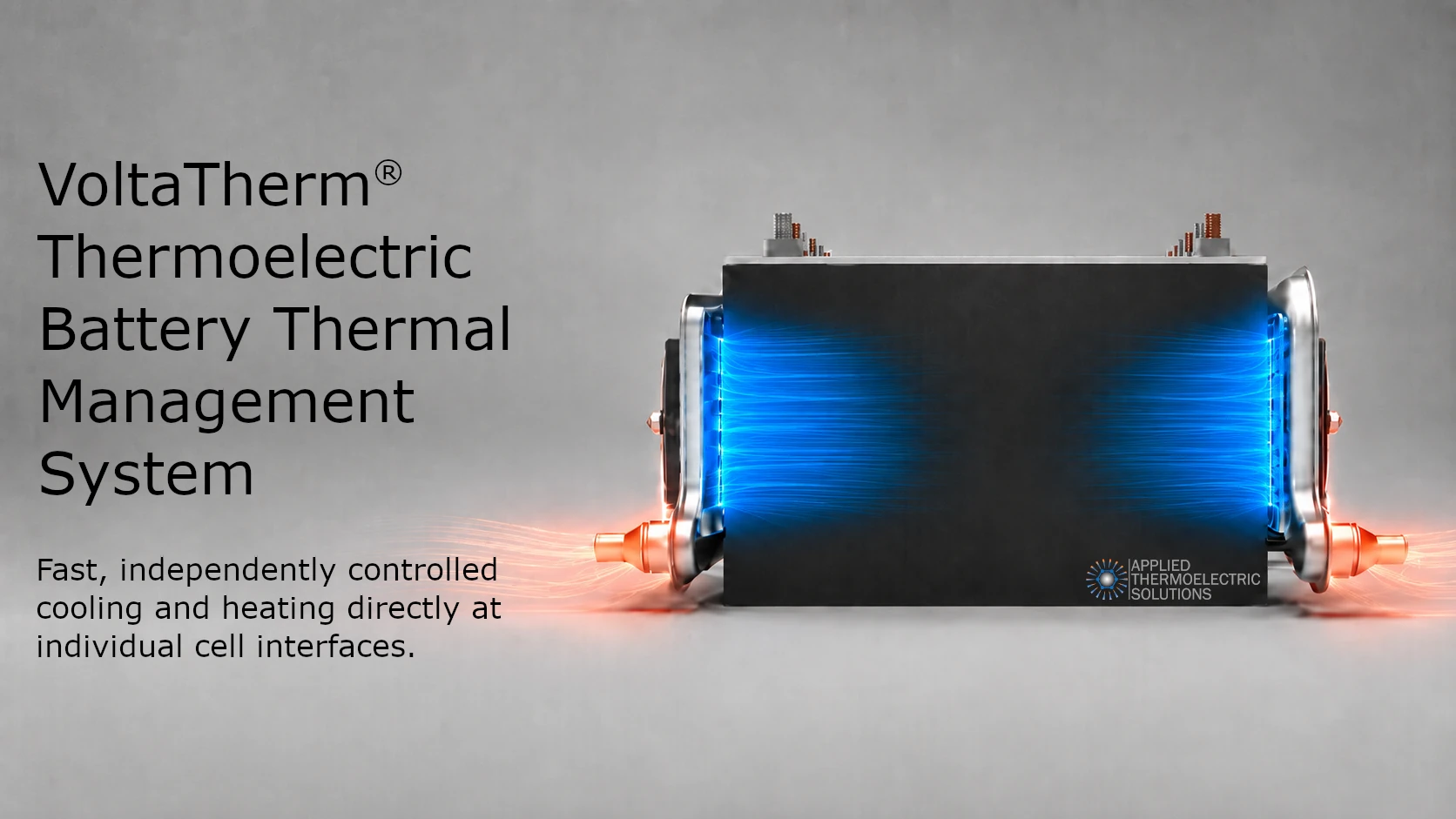
Fast, Individual-Cell Cooling and Heating for Advanced Battery Systems
VoltaTherm® is a compact, highly integrated thermoelectric battery thermal management system (BTMS) that cools and heats cells directly at their intended thermal-management interfaces.
Unlike systems that condition an entire battery pack or module as a shared thermal zone, VoltaTherm® is designed to provide true individual cell temperature control. Selected cells can be cooled, heated, or left unpowered according to their specific thermal requirements. Some cells can be cooled while others are heated, helping reduce cell-to-cell temperature differences as battery loads, ambient conditions, and cell behavior change.
Thermoelectric heat pumping begins changing as soon as the applied current changes. This allows VoltaTherm® to increase or decrease cooling rapidly in response to battery current, predicted heat generation, charging demand, temperature feedback, or an anticipated high-power event.
VoltaTherm® also provides cooling and heating from the same solid-state device, eliminates the need for an intermediate heat spreader between the cell and thermoelectric module, and can exchange heat with air, coolant, ambient conditions, waste heat, or another available thermal resource.
When combined with the ParaThermic® high-heat-transfer battery architecture, VoltaTherm® becomes part of a more complete low-resistance thermal pathway from the heat-generating regions inside the battery to the active thermal-management system.
VoltaTherm® at a Glance
- True individual cell temperature control
- Fast electronic cooling response
- Simultaneous cooling and heating of different cells
- Custom cooling or heating rates on per cell basis
- Direct cell coupling without an intermediate heat spreader
- Below-ambient cooling and battery heating with COP greater than 1
- Cooling and heating from the same solid-state device
- Compact, integrated architecture with flexible cell placement
- Further improved heat transfer and battery thermal response when paired with ParaThermic® batteries
How VoltaTherm® Works
1. Direct to cell heat transfer
Thermoelectric devices are positioned directly at the intended battery thermal-management interfaces, minimizing intermediate thermal resistance.
2. Electrically controlled cooling or heating
Electrical current determines the direction and magnitude of heat pumping. Reversing the current changes the same device from cooling to heating.
3. Heat exchange with the wider system
The opposite side rejects or absorbs heat through air, liquid coolant, HVAC, waste heat, or another application-specific thermal resource.
A Battery Pack Is Not One Thermal Zone

Battery thermal-management systems are often evaluated according to their ability to maintain an acceptable average pack temperature.
Average temperature is important, but it does not describe the complete thermal condition of a battery.
Cells within the same pack can experience different conditions because of:
- Edge versus interior placement
- Unequal airflow or coolant distribution
- Different thermal boundary conditions
- Manufacturing variation
- Differences in internal electrical resistance
- Cell aging
- Unequal heat generation
- Local electronics and balancing heat
- Differences in charge and discharge current
- Changing operating and ambient conditions
A battery pack can remain within its average temperature target while individual cells are hotter, colder, aging faster, or approaching an operating limit before the rest of the pack.
The hottest or coldest cell may limit:
- Charging rate
- Discharge power
- Regenerative braking
- Available capacity
- Battery life
- Pack performance
- Safety margins
Pack-level and module-level systems generally treat multiple cells as a shared thermal zone. They may control overall pack temperature effectively, but they cannot always direct heating or cooling to the particular cell that needs it most.
VoltaTherm® approaches battery temperature management as a distributed electrothermal-control problem.
Instead of applying the same thermal condition across an entire pack or module, thermal power can be directed to selected cells and surfaces according to changing battery requirements.
Learn more about battery thermal management methods and design considerations
What Is VoltaTherm®?
Thermal imaging of a thermoelectric module showing its hot and cold sides. Reversing the electrical current reverses the hot and cold sides; current reversal is not shown in this clip.
VoltaTherm® is a solid-state battery cooling and heating architecture based on thermoelectric heat pumps.
A thermoelectric module moves heat when electrical current passes through it. Reversing the direction of current reverses the direction of heat flow.
The same device can therefore:
- Remove heat from a battery during cooling
- Deliver heat to a battery during heating
- Increase or decrease thermal output electronically
- Transition between cooling and heating without separate cell-level systems
VoltaTherm® places thermoelectric modules directly at the intended cell thermal-management interface.
This eliminates the need for an intermediate heat spreader between the battery and thermoelectric module and minimizes avoidable external thermal resistance.
The modules can be controlled individually, depending on the needs of the battery:
- One cell can be cooled more strongly than another.
- A cold cell can be heated while surrounding cells remain unpowered.
- Some cells can be cooled while others are heated.
- Cooling can increase when battery current or predicted heat generation increases.
- The battery can be preconditioned before charging or high-power operation.
- Thermal reserve can be restored between repeated power events.
The thermoelectric devices themselves contain no moving mechanical parts, require no refrigerant, and generate no mechanical vibration.
How VoltaTherm® Cools a Battery

During cooling operation, the thermoelectric module absorbs heat at the cell interface and transports it to the opposite side of the device.
The heat-rejection system then removes:
- The battery heat absorbed by the thermoelectric module
- The electrical power consumed by the thermoelectric module
The cooling pathway is:
Battery interior → cell surface → VoltaTherm® thermoelectric module → heat-rejection system
Potential heat sinks include:
- Ambient or conditioned air
- Liquid coolant
- A dedicated heat exchanger
How VoltaTherm® Heats a Battery

During heating operation, the electrical current is reversed.
The thermoelectric module absorbs heat from the available source side and delivers that heat, together with its electrical input, to the battery.
The heating pathway is:
Available heat source + electrical input → VoltaTherm® thermoelectric module → battery cell
Because the thermoelectric module is a an electronic heat pump, its heating coefficient of performance can exceed 1.
A resistive heater is limited to approximately one unit of heat delivered for each unit of electrical power consumed at the heater. Thermoelectric heating delivers the electrical input plus heat absorbed from the source side.
This can reduce the stored electrical energy required for battery warm-up and preconditioning.
Fast Cooling Response to Changing Battery Loads
Battery heat generation can change rapidly during:
- Acceleration
- High-power discharge
- Regenerative braking
- DC fast charging
- Aircraft takeoff or climb
- Drone power bursts
- Industrial duty cycles
- Rapid changes in ambient or operating conditions
Consider a battery and cooling system initially operating at steady state. If battery current suddenly increases, the battery begins generating more heat.
VoltaTherm® can rapidly increase thermoelectric heat pumping by increasing the applied electrical current.
A commanded change in local cooling does not require the system to wait for:
- A compressor to increase speed
- Refrigerant pressures to reach a new condition
- A valve to reposition
- A pump to change flow
- A shared coolant loop to change temperature
- Conditioned fluid to propagate through the pack
- A shared air stream or fluid volume to reach a new bulk condition
This distinction remains important even though the battery temperature itself changes more slowly because of the battery’s thermal mass and internal thermal resistance.
Flexible Placement Can Improve Battery Thermal Response
Fast cooling-system response and fast battery thermal response are related but separate requirements.
The speed at which the battery interior responds depends on:
- Cell geometry
- Thermal mass
- Internal thermal resistance
- Directional thermal conductivity
- Cooling-surface location
- Active interface area
- Contact resistance
- Available cooling capacity
Increasing the actively controlled surface area can:
- Shorten internal heat-travel distances
- Reduce the thermal load on each interface
- Improve temperature uniformity
- Reduce dependence on a weak thermal-conduction direction
- Improve transient battery-temperature response
- Reduce the effective resistance between internal heat generation and active cooling
ParaThermic® battery technology goes further by reducing the internal thermal resistance of the battery itself.
Why Direct Thermoelectric Coupling Matters

The thermal resistance between the battery and thermoelectric module affects more than battery surface temperature.
For a given heat flow, greater thermal resistance requires a greater temperature difference.
If the battery-to-module thermal path has excessive resistance, the thermoelectric cold side must operate at a lower temperature to maintain the required battery-core temperature. This increases the temperature difference across the thermoelectric module.
A larger thermoelectric temperature difference can:
- Reduce available cooling capacity
- Increase electrical power consumption
- Reduce cooling coefficient of performance
- Increase heat-rejection requirements
- Increase sensitivity to ambient or coolant temperature
- Require more or larger thermoelectric modules
An intermediate heat spreader can introduce:
- Heat-spreader material resistance
- Battery-to-spreader contact resistance
- Spreader-to-thermoelectric contact resistance
- Additional thermal-path length
- Additional mass
- Additional packaging volume
- More components
- Additional manufacturing and assembly operations
VoltaTherm® places the thermoelectric module directly at the intended cell thermal-management interface.
This eliminates the intermediate heat spreader and its two associated contact interfaces.
For the same battery heat generation and target core temperature, reducing total thermal resistance allows the thermoelectric cold side to remain warmer. This reduces the temperature difference across the module and can improve cooling capacity, electrical efficiency, and heat-rejection performance.
Separate Thermal and High-Current Electrical Paths
In the illustrated VoltaTherm® architecture, thermoelectric heating and cooling are applied through the battery case or intended cell surface rather than through battery posts, bus bars, or other primary current-carrying components.
This separates the active thermal interface from the high-current electrical path.
Potential integration benefits include:
- Greater flexibility in positioning the thermal interface
- Reduced dependence on terminal and bus-bar geometry
- Easier separation of thermal and electrical design requirements
- Simplified electrical isolation
- Reduced interaction with the primary current path
- More direct individual-cell thermal control
- Simplified assembly compared with attaching the thermal system to battery interconnects
The exact interface depends on the battery geometry, electrical-isolation requirements, packaging, and application.
True Individual Cell Temperature Control

Cells within a battery pack do not always need the same thermal treatment.
An outside cell may lose more heat in cold weather, while an interior cell may retain more heat during charging. An older cell may produce more heat than a newer cell. A cell near electronics or another heat source may experience a different thermal boundary from a cell on the opposite side of the pack.
A shared cold plate, common air stream, refrigerant circuit, or immersion-fluid temperature cannot always correct each difference independently.
VoltaTherm® enables true individual cell temperature control.
The system can:
- Cool hotter cells without applying equal cooling to every cell
- Heat colder cells without heating the entire battery
- Apply different levels of cooling or heating to different cells
- Cool some cells while heating others
- Respond as local conditions change
- Reduce temperature differences among cells
Improved cell-to-cell temperature uniformity can help reduce differences in:
- Cell resistance
- Current sharing
- Charge acceptance
- Usable capacity
- Aging rate
- State-of-charge estimation
- The point at which a cell reaches a voltage or temperature limit
This can help prevent the hottest, coldest, or most degraded cell from prematurely limiting the complete battery pack.
Optional Management of Cell-to-Cell Thermal Cross-Talk
Independently controlled thermoelectric devices provide the active basis for individual cell temperature control.
When greater thermal independence is needed, VoltaTherm® can also use optional thermally insulating carriers, dividers, gaps, or other design methods to reduce thermal cross-talk between neighboring cells.
These features are not required in every VoltaTherm® design.
The appropriate amount of cell-to-cell thermal isolation depends on:
- Cell geometry
- Spacing
- Thermal-control objectives
- Desired lateral heat spreading
- Packaging requirements
- Cell heat generation
- Safety strategy
- Manufacturing and assembly requirements
Some applications may benefit from stronger thermal isolation. Others may benefit from allowing controlled heat transfer between adjacent cells.
The architecture can be adapted accordingly.
Integrated Control and Temperature Sensing
Local VoltaTherm® control electronics can adjust the magnitude and direction of thermoelectric heat pumping at individual cells or thermal zones.
The control system may coordinate:
- Thermoelectric voltage and current
- Thermoelectric polarity
- Cell-temperature targets
- Battery current and predicted heat generation
- Battery charging and discharging
- Heat-rejection-side temperature
- Air or coolant flow
- Operating and safety limits
Temperature information can come from:
- Dedicated cell sensors
- Heat-rejection-system sensors
- Battery operating models
- Estimated heat generation
- Battery-management-system data
- Electrical measurements from the thermoelectric devices
A thermoelectric device can also produce a Seebeck voltage when a temperature difference exists across it. Depending on the selected control architecture, this electrical behavior may provide additional information about thermal conditions.
The final sensing and control strategy should be developed around the required accuracy, response time, redundancy, safety, and system architecture.
Supporting the Battery Management System Through Electrothermal Control
The battery management system must continue to monitor voltage, current, temperature, state of charge, state of health, and operating limits.
VoltaTherm® does not replace these functions. It gives the battery management system an additional means of correcting physical conditions that contribute to cell divergence.
Passive electrical balancing removes excess energy from higher-voltage cells by dissipating it as heat. Active balancing can redistribute energy but requires additional converters, controls, and components.
Individual-cell thermal control offers a complementary method.
By reducing temperature-driven differences among cells, VoltaTherm® may help cells remain better matched over time.
Potential benefits include:
- Reduced passive-balancing energy loss
- Reduced balancing-related heat
- Better usable pack capacity
- More consistent cell operating conditions
- Reduced differences in cell aging
- Improved pack utilization
- Fewer cells prematurely reaching operating limits
The objective is not simply to reduce the power consumed by BMS electronics.
The larger opportunity is coordinated electrothermal control in which electrical and thermal energy are directed where they provide the greatest effect on battery performance, life, and usable capacity.
VoltaTherm® BTMS and ParaThermic® Batteries Improve Opposite Sides of the Thermal Pathway
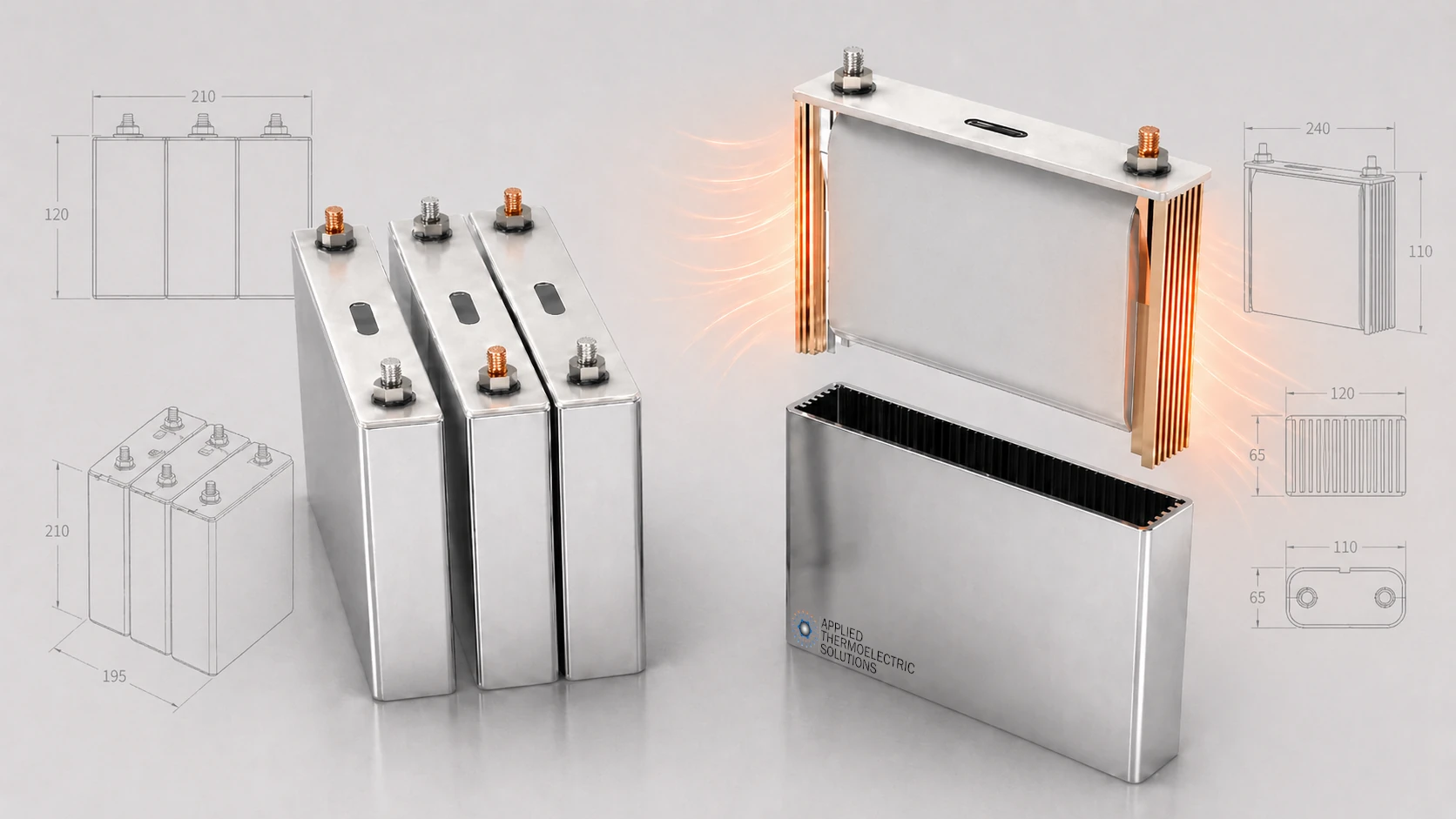
VoltaTherm® battery thermal management system and ParaThermic® batteries solve complementary parts of the battery thermal-management problem.
ParaThermic® Improves the Internal Battery Path
ParaThermic® is a low-internal-thermal-resistance, high-heat-transfer battery architecture.
In a conventional layered or wound battery, heat generated in interior regions may need to pass through multiple intervening electrode, separator, electrolyte, and structural layers before reaching an externally cooled surface.
This creates a relatively serial thermal path in which heat from deeper regions must pass through neighboring layers before reaching the battery case.
ParaThermic® creates more direct thermally conductive pathways from multiple internal electrode regions toward the external battery interface.
This allows heat from different internal regions to move toward the thermal-management system through more parallel thermal paths rather than relying only on serial heat transfer through adjacent battery layers.
The result is lower internal thermal resistance between the heat-generating regions and the external thermal-management interface.
This can:
- Increase heat-transfer capability
- Reduce core-to-surface temperature differences
- Improve internal temperature uniformity
- Reduce the likelihood of localized internal hotspots
- Improve battery thermal response
- Reduce the surface-temperature reduction required to control the battery core
Explore the ParaThermic® high-heat-transfer battery architecture
VoltaTherm® Improves the External Active Thermal Path
VoltaTherm® places the active thermoelectric device directly at the intended cell interface.
It reduces avoidable resistance between the battery surface and the active cooling or heating system.
Fast Thermal Actuation Meets Faster Internal Heat Transfer
Together, the technologies create the following pathway:
Battery heat-generating region → ParaThermic® low-resistance internal pathways → direct VoltaTherm® thermoelectric interface → heat-rejection system
In cooling mode, ParaThermic® batteries improve heat transfer from internal heat-generating regions to the battery surface, while VoltaTherm® actively pumps that heat to the heat-rejection system, where it can be released to the environment.
VoltaTherm® can respond rapidly when battery heat generation changes.
ParaThermic® helps the battery interior transfer that heat more rapidly to the actively controlled thermoelectric interface.
Is VoltaTherm® the Right Fit for Your Battery System?
Every battery application places different priorities on cooling, heating, response time, temperature uniformity, energy consumption, packaging, reliability, cost, and system integration.
VoltaTherm® may provide significant value when an application benefits from capabilities such as:
- Fast cooling response to changing battery loads
- Individual-cell or zonal cooling and heating
- Simultaneously heating some cells while cooling others
- Direct, low-resistance thermoelectric coupling
- Cooling below ambient or enclosure temperature
- Battery heating with a coefficient of performance greater than 1
- Compact, distributed thermal control
- Solid-state operation at the cell interface
- Integration with air, coolant, HVAC, ambient conditions, or waste heat
- Flexible placement on one or more cell surfaces
- Improved cell-to-cell temperature uniformity
- Application-level packaging and energy-density opportunities
- Compatibility with ParaThermic® high-heat-transfer batteries
- Integration with other battery cooling and heat-transfer technologies
The decision should be based on the complete system rather than a single metric such as cooling coefficient of performance, heat flux, pack-level energy density, or component cost.
A complete evaluation may consider:
- Battery heat generation and duty cycle
- Transient and steady-state cooling requirements
- Heating and preconditioning requirements
- Cell geometry and internal thermal resistance
- Required cooling-system response
- Required battery thermal response
- Individual-cell and zonal-control requirements
- Available heat sources and heat sinks
- Electrical energy use over the operating cycle
- Cell-to-cell temperature uniformity
- Battery life and usable capacity
- Supporting equipment inside and outside the battery pack
- Complete system mass and volume
- Manufacturing and assembly requirements
- Reliability, maintenance, and service
- Application-level energy density and packaging efficiency
VoltaTherm® can provide the primary active battery thermal-management system or operate as part of a hybrid architecture.
The appropriate design depends on which combination produces the greatest complete-system value for the application.
Applied Thermoelectric Solutions can evaluate the battery, operating requirements, available thermal resources, and competing system architectures to determine where thermoelectric cooling and heating provide the greatest technical and commercial advantage.
Integrated Thermal and Energy Management
VoltaTherm® can be integrated into a larger product, vehicle, aircraft, equipment, or facility energy-management strategy.
Batteries and occupied or controlled environments often operate within overlapping temperature ranges. This creates opportunities to exchange thermal energy rather than conditioning and rejecting heat from each subsystem independently.
Using Conditioned Air for Battery Cooling
When air has already been cooled for passengers, equipment, electronics, or an enclosure, an available exhaust or return stream may provide a lower-temperature heat sink for the thermoelectric modules.
Lowering the VoltaTherm® heat-rejection-side temperature can:
- Increase cooling capacity
- Improve cooling coefficient of performance
- Reduce thermoelectric electrical power
- Improve high-ambient performance
- Reduce the required module area or count
The greatest benefit occurs when conditioned air is already available and would otherwise be exhausted or underutilized.
Recovering Heat for Battery Heating
During cold operation, VoltaTherm® can absorb heat from a warmer air, coolant, component, or waste stream and pump it into the battery.
Potential sources include:
- Cabin or enclosure exhaust
- Motor heat
- Inverter heat
- Electronics heat
- Equipment waste heat
- Facility air
- Vehicle coolant
- Aircraft environmental-control-system air
This can provide more battery heat per unit of electrical input than resistive heating.
Applying Energy Where It Creates the Most Value
The objective is not always to minimize the power consumption of each component independently.
A better complete-system result may come from:
- Recovering heat that would otherwise be rejected
- Cooling only the cells that require active cooling
- Heating only the cells limiting power or charge acceptance
- Responding to heat generation before temperatures rise substantially
- Preconditioning before a known high-power event
- Coordinating battery thermal control with other system loads
- Reducing temperature-driven cell divergence
- Avoiding unnecessary conditioning of the complete battery enclosure
VoltaTherm® provides a controllable thermal interface that can participate in this broader energy-management strategy.
Key Thermoelectric Battery Cooling and Heating Benefits
Battery Performance and Control
Improved Temperature Uniformity
Individual-cell cooling and heating can address local temperature differences more directly than a system that treats multiple cells as one thermal zone.
Better Pack Utilization
Reducing thermal differences can help prevent one hot, cold, or degraded cell from limiting the usable performance of the complete battery.
Potentially Longer Battery Life
More uniform temperatures and reduced time at undesirable temperatures can reduce uneven degradation.
Improved Charging and High-Power Performance
Fast response, direct coupling, for batteries experiencing rapidly changing charging or discharge loads.
Reduced Temperature-Driven Cell Divergence
Maintaining more consistent thermal conditions can help cells remain better matched over the operating life of the battery.
Thermal Control
Fast Cooling Response
Thermoelectric heat pumping changes rapidly when current changes.
Individual-Cell and Zonal Control
Thermal power can be directed to selected cells and regions.
Simultaneous Cooling and Heating
Some cells can be cooled while others are heated.
Precise Proportional Output
Cooling and heating can be continuously adjusted rather than limited to simple on-and-off operation.
Below-Ambient Cooling
VoltaTherm® can actively maintain a cell interface below the temperature of the local air or enclosure.
Energy Management
Energy-Efficient Battery Heating With COP Greater Than 1
Thermoelectric heating pumps available heat into the battery in addition to delivering electrical input. This allows VoltaTherm® to provide more than one unit of battery heating for each unit of electrical energy consumed, reducing heating energy compared with resistive heaters.
In cold climates, battery heating may be required during preconditioning, warm-up, charging, and continued operation to offset heat loss to the surroundings. Reducing that ongoing heating demand preserves more stored battery energy for propulsion or other useful work, helping extend vehicle range, flight time, or equipment operating time.
Selective Thermal Conditioning
Energy can be directed to the cells that require it rather than automatically conditioning the complete battery.
Waste-Heat Recovery
Available heat from motors, electronics, cabins, enclosures, equipment, or other subsystems can be used for battery heating.
Potential Reduction in Balancing Losses
Improved thermal matching may reduce temperature-driven divergence, passive-balancing energy loss, and balancing-related heat.
Integration With Available Thermal Resources
The system can exchange heat with air, coolant, ambient conditions, or existing thermal loops.
Packaging and Integration
Direct Cell Coupling
VoltaTherm® eliminates the intermediate heat spreader between the cell interface and thermoelectric module.
Cooling and Heating From One Device
One solid-state component provides both functions.
Compact, Highly Integrated Architecture
Distributed thermoelectric devices can reduce the need for bulky centralized components at the cell interface.
Flexible Interface Placement
Modules can be positioned on one or more cell surfaces according to cell geometry and thermal requirements.
Solid-State Operation
The thermoelectric modules contain no moving mechanical parts and generate no module-level vibration or mechanical noise.
DC Operation
VoltaTherm® integrates naturally with battery-powered systems through appropriately designed DC power electronics.
Evaluate Energy Density at the Complete Application Level
Battery thermal-management architectures are often compared according to pack-level energy density, or how much cell capacity fits within a defined battery-pack enclosure.
That comparison may be incomplete when competing systems require different amounts of supporting equipment elsewhere in the product, platform, facility, or larger system.
A battery thermal-management architecture can affect the space and mass required for:
- Cold plates
- Manifolds
- Pumps
- Valves
- Coolant
- Refrigerant lines
- Compressors
- Separate battery heaters
- Ducting
- Heat exchangers
- Power electronics
- Service clearances
- Remote component placement
- Structural and protective components
VoltaTherm® may require space at the cell interface, but its compact, distributed architecture may reduce or eliminate other thermal-management components or allow batteries to occupy spaces that would otherwise be difficult to serve.
The complete comparison should consider:
- Cell and module energy density
- Pack-level energy density
- Total installed battery capacity
- Thermal-system volume inside and outside the pack
- Complete system mass
- Packaging flexibility
- Usable space within the application
- Service and installation requirements
- Usable battery energy across the operating-temperature range
A system with a lower local cell-packing fraction can still provide greater application-level energy storage if its complete thermal-management architecture uses less supporting space or enables better use of the available volume.
Potential VoltaTherm® Applications
Different applications may value different combinations of VoltaTherm® capabilities.
Electric Vehicles, Hybrids, and DC Fast Charging
For developers evaluating an electric vehicle battery thermal management system with thermoelectric cooling, potential VoltaTherm® benefits include:
- Individual-cell control
- Fast cooling response
- Efficient cold-weather heating
- Improved temperature uniformity
- HVAC and waste-heat integration
- Dynamic-load management
- Application-level energy-density opportunities
As an EV battery cooling system, VoltaTherm® can respond to acceleration, regenerative braking, fast charging, and changing ambient conditions.
DC fast-charging systems can use battery current and expected heat generation to increase cooling before a large temperature rise develops.
Hybrid batteries can benefit from rapid response to repeated acceleration, assist, and regenerative-braking events.
Commercial Vehicles, Rail, and Off-Road Equipment
These applications often combine:
- Long operating hours
- High battery utilization
- Repeated power transients
- Wide ambient-temperature ranges
- Strong battery-life and reliability requirements
VoltaTherm® can provide distributed or zonal control, efficient heating, rapid response, and integration with available thermal resources.
Aircraft, eVTOL, Drones, and Space Systems
Potential advantages include:
- Fast response to takeoff, climb, hover, or payload loads
- Application-level mass and packaging efficiency
- Efficient battery heating in cold environments (more efficent than electric heater)
- Orientation-independent thermoelectric operation
- Precise thermal control
- Solid-state actuation
- Thermal recovery between power bursts
VoltaTherm® can precondition batteries before high-power operation and remove accumulated heat between transient events.
Grid Storage, UPS, Telecom, and Backup Power
Large stationary battery systems can experience uneven temperature conditions across racks, modules, or cabinets.
Potential benefits include:
- Zonal temperature control
- Improved battery life
- Better system readiness
- Selective cooling and heating
- Reduced standby energy use
- Integration with facility air or liquid systems
- Improved pack utilization
Thermoelectrics can provide either primary thermal control or a distributed correction layer within a broader thermal system.
Micromobility, Portable Electronics, Medical Devices, and Power Tools
Smaller battery systems may have thermal loads and packaging volumes for which compressor-based refrigeration hardware is impractical.
Potential benefits include:
- Compact scaling
- Precise proportional control
- Fast transient response
- Low noise and vibration
- Cooling and heating from the same device
- Direct DC operation
- Flexible integration in small or sealed products
VoltaTherm® can be adapted as a lithium-ion battery cooling system for applications ranging from small portable products to high-value mobile equipment.
Robotics, Industrial Systems, Marine, and Defense
These applications may value:
- Rugged distributed thermal control
- Wide-temperature operation
- Fast response to dynamic loads
- Solid-state actuation
- Flexible interface placement
- Integration with available air, water, coolant, or waste heat
- Reduced centralized plumbing and packaging complexity
Application requirements determine which advantages provide the greatest complete-system value.
VoltaTherm® Assembly Architecture
VoltaTherm® integrates the thermoelectric devices, electrical connections, control electronics, battery support structure, and heat-rejection interface into a compact assembly.
In one patented implementation:
- Thermoelectric devices slide into openings in a circuit board.
- The circuit board positions and mechanically retains the devices.
- Electrical connectors engage the thermoelectric devices as they are installed.
- The circuit board can also support control circuitry.
- A radiator or heat-rejection component contacts the opposite sides of the thermoelectric devices.
- A compression structure applies force through the assembly to maintain thermal contact with the batteries.
This integrated approach can reduce:
- Separate wiring
- Individual brackets
- Intermediate heat spreaders
- Separate cell-level heaters
- Unnecessary thermal interfaces
- Part count
- Assembly operations
- Packaging volume
The compression structure can also help maintain relatively consistent interface pressure across multiple thermoelectric modules and battery cells.
The VoltaTherm® architecture is designed to integrate mechanical support, electrical connection, thermoelectric control, and heat rejection into a compact assembly. The exact configuration can be adapted to cell geometry, heat load, battery voltage, required thermal response, electrical-isolation requirements, control strategy, and the available heat-rejection system.
Development, Modeling, and Validation
VoltaTherm® is a technology platform that can be adapted to the requirements of a specific battery and application.
Development can include:
- Battery thermal-load definition
- Thermal-resistance-network modeling
- Transient battery simulation
- Thermoelectric module design and selection
- Module current and voltage optimization
- Battery-management-system coordination
- Optional cell-to-cell thermal-isolation analysis
- Heat-rejection-system design
- Power-electronics design
- Electrical isolation
- Condensation analysis
- Structural and packaging integration
- Interface-pressure analysis
- Prototype design and engineering
- Prototype fabrication and assembly
- Instrumentation
- Thermal and electrical testing
- Performance validation
- Design refinement
- Production and licensing support
Performance should be evaluated across the expected operating map, including:
- Battery heat generation
- Ambient temperature
- Cell target temperature
- Heat-source and heat-sink temperatures
- Thermoelectric temperature lift
- Module current
- Cooling and heating duty cycle
- Transient load profile
- Parasitic power
- Heat-rejection capacity
- Battery aging
- Cell variation
- Application-level packaging and mass
This determines whether VoltaTherm® should provide the primary battery thermal-management system, individual-cell correction within a hybrid architecture, or operate with ParaThermic® as part of a complete low-resistance thermal system.
Technology and Licensing Opportunities
VoltaTherm® is available for feasibility evaluation, application development, prototype engineering, system integration, and licensing.
Applied Thermoelectric Solutions works with:
- Automotive OEMs
- Battery manufacturers
- Battery-pack developers
- Thermal-system suppliers
- Aircraft and eVTOL developers
- Drone and autonomous-system developers
- Grid-storage and backup-power companies
- Medical and portable-product developers
- Industrial-equipment companies
- Research organizations
Applied Thermoelectric Solutions can help determine:
- Whether thermoelectric battery thermal management fits the application
- Which VoltaTherm® advantages create the greatest value
- Whether individual-cell or zonal control is justified
- Whether cell-to-cell thermal isolation would provide value
- How quickly the system must respond
- Where thermoelectric interfaces should be placed
- How the devices should be electrically connected and controlled
- How interface pressure should be maintained
- How air, coolant, ambient conditions, or waste heat can be used
- Whether ParaThermic® batteries can improve the complete thermal pathway
- What prototype and validation work is required
- How the technology could be integrated and licensed
Evaluate VoltaTherm® for Your Battery System
VoltaTherm® provides more than battery cooling.
It is a distributed electrothermal-control architecture designed to:
- Respond rapidly to changing battery heat generation
- Cool and heat individual cells
- Reduce avoidable thermal resistance
- Improve temperature uniformity
- Use available thermal resources
- Support coordinated battery and system energy management
- Integrate control, electrical connection, mechanical support, and heat rejection
- Improve complete-system packaging and integration
Combined with ParaThermic® batteries, it can address both the internal battery thermal path and the external active thermal-management path.
Applied Thermoelectric Solutions works with battery developers, OEMs, equipment companies, thermal-system suppliers, and research organizations to evaluate applications, model performance, build and test prototypes, support integration, and license the technology.
Frequently Asked VoltaTherm® Thermoelectric Battery Thermal Management System (BTMS) Questions
What is a thermoelectric battery thermal management system?
A thermoelectric battery thermal management system uses electrically powered thermoelectric devices to move heat into or away from a battery.
Reversing the electrical current reverses the direction of heat flow, allowing the same device to provide both battery cooling and heating.
Does VoltaTherm® require ParaThermic® batteries?
No. VoltaTherm® can be adapted to conventional battery cells that provide an appropriate thermal-management interface.
ParaThermic® can further improve the combined system by reducing the internal thermal resistance between the battery’s heat-generating regions and the VoltaTherm® interface.
Does individual-cell control require insulating dividers?
No. Individual thermoelectric devices can be controlled independently without requiring physical dividers between every cell.
Thermally insulating carriers, dividers, gaps, or other methods may be used when reducing cell-to-cell thermal cross-talk provides an advantage. The appropriate design depends on cell geometry, desired thermal behavior, packaging, and application requirements.
How quickly can VoltaTherm® respond?
Thermoelectric heat pumping begins changing as soon as the applied electrical current changes.
The resulting battery-temperature response also depends on thermal mass, internal thermal resistance, interface area, module placement, and available cooling or heating capacity.
Can VoltaTherm® heat and cool at the same time?
Different thermoelectric modules can operate independently. One cell can be heated while another is cooled when the controls and external thermal interfaces are designed for that operation.
Does VoltaTherm® replace the battery management system?
No. The battery management system continues to provide monitoring, protection, estimation, and electrical control.
VoltaTherm® adds individual-cell thermal actuation that can be coordinated with those functions.
Could VoltaTherm® reduce electrical cell balancing?
Reducing temperature-driven differences in cell resistance, current sharing, capacity, and aging may help cells remain better matched.
This can potentially reduce passive-balancing losses and balancing-related heat while improving usable pack capacity.
Does the complete system have no moving parts?
The thermoelectric modules themselves have no moving mechanical parts.
The complete heat-rejection architecture may use a fan, pump, coolant loop, or another component depending on the application.
Can VoltaTherm® cool below ambient temperature?
Yes. Thermoelectric heat pumping can maintain the battery interface below the local ambient or enclosure temperature when the complete system provides adequate heat rejection.
Why can thermoelectric battery heating exceed a COP of 1?
The thermoelectric module absorbs heat from the source side and moves it into the battery.
The heat delivered to the battery includes both the absorbed heat and the module’s electrical input, allowing heating coefficient of performance to exceed 1.
Is VoltaTherm® only for electric vehicles?
No. Potential applications include hybrids, fast-charging systems, commercial vehicles, aircraft, eVTOL, drones, spacecraft, stationary storage, telecom systems, medical equipment, robotics, power tools, industrial systems, marine equipment, and other battery-powered products.
Is VoltaTherm® available for licensing?
Yes. Applied Thermoelectric Solutions can support feasibility evaluation, modeling, prototype development, testing, validation, integration, and licensing discussions.
Links that May Interest You
- Custom Thermoelectric Solutions
- Thermoelectric Design and Simulation Services
- Thermoelectric System Development
- Our Thermoelectric Cooling and Generator Work
- Thermoelectric Cooling Prototype Case Study
- Solar Thermoelectric Generator Case Study
- How Thermoelectric Cooling Works
- How Thermoelectric Generators Work
- ParaThermic® Battery Thermal Management Technology
- VoltaTherm® Battery Thermal Management System (BTMS)
- PowerBeam™ Wireless Power Transfer Technology
- Battery Thermal Management | After Immersion Cooling