Applied Thermoelectric Solutions TEG Modeling Paper Receives Editor’s Choice Recognition
Originally published April 4, 2019 · Updated August 9, 2026
A thermoelectric generator modeling paper authored by Alfred Piggott of Applied Thermoelectric Solutions was recognized as an Editor’s Choice article by the Journal of Electronic Materials.
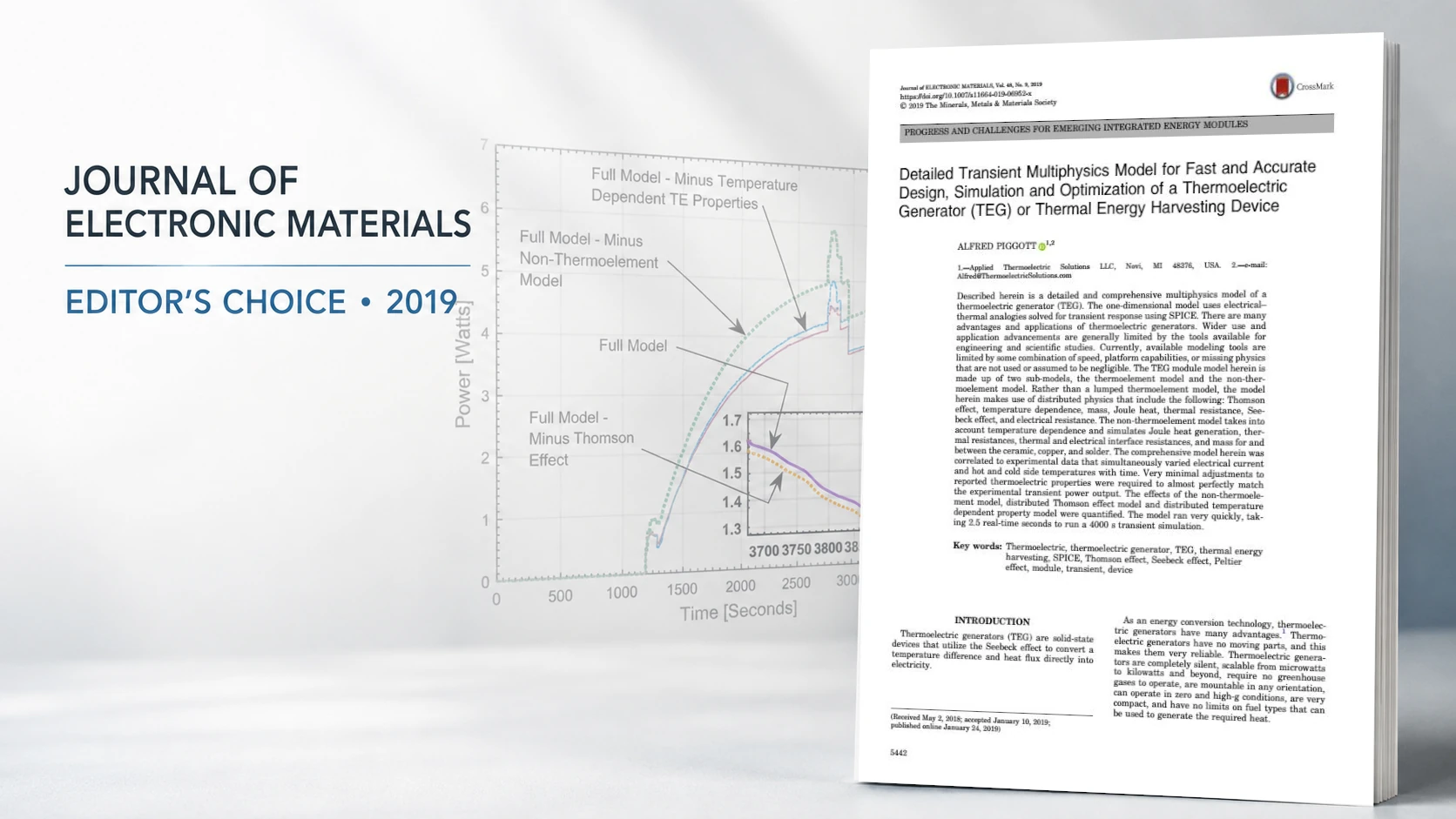
The peer-reviewed paper, “Detailed Transient Multiphysics Model for Fast and Accurate Design, Simulation and Optimization of a Thermoelectric Generator (TEG) or Thermal Energy Harvesting Device,” was published in the Journal of Electronic Materials in 2019.
Journal of Electronic Materials Editor’s Choice
Editor’s Choice is a selective recognition within the Journal of Electronic Materials. The journal states that fewer than 5% of the articles it publishes each year are awarded Editor’s Choice.
The Minerals, Metals & Materials Society (TMS) describes Editor’s Choice as a distinct honor. TMS notes that Editor’s Choice articles are distinguished not only by high-quality writing, but also by attributes that may include outstanding science, innovative methods, impactful outputs, historical significance, or broad interest to the journal’s readership.
The Applied Thermoelectric Solutions TEG modeling paper is included in the journal’s official collection of Editor’s Choice articles.
Publication and Recognition
Recognition: Editor’s Choice Article
Journal: Journal of Electronic Materials
Paper: Detailed Transient Multiphysics Model for Fast and Accurate Design, Simulation and Optimization of a Thermoelectric Generator (TEG) or Thermal Energy Harvesting Device
Author: Alfred Piggott
Affiliation: Applied Thermoelectric Solutions LLC
Published: January 24, 2019
Volume: 48, pages 5442–5452
DOI: 10.1007/s11664-019-06952-x
About the Recognized TEG Modeling Work
The research presented a detailed transient multiphysics model developed to support the design, simulation, and optimization of thermoelectric generators and thermal energy-harvesting devices.
The model uses electrical-thermal analogies and SPICE to simulate transient thermoelectric behavior while accounting for important physical effects including temperature-dependent material properties, thermoelectric effects, Joule heating, thermal and electrical resistance, interface resistance, heat transfer, and thermal mass.
The modeling approach was correlated with experimental measurements under changing electrical current and hot- and cold-side temperatures. The published study also demonstrated the model’s computational speed, with a 4,000-second transient simulation completed in approximately 2.5 seconds.
The combination of detailed multiphysics representation and computational speed was intended to make the model practical for thermoelectric system design and optimization rather than limiting its use to analysis of a single operating point.
A Foundation for Applied Thermoelectric Solutions’ Engineering Work
The publication documents technical modeling work developed through Applied Thermoelectric Solutions and provides an early example of the company’s physics-based approach to thermoelectric engineering.
Thermoelectric system performance depends on more than the characteristics of the thermoelectric module itself. Heat transfer, electrical loading, materials, geometry, thermal and electrical interfaces, operating conditions, and transient behavior can all influence the performance of the complete system.
The modeling and simulation approach documented in this publication continues to inform Applied Thermoelectric Solutions’ work in thermoelectric cooling, power generation, thermal management, energy harvesting, and system development.
Developing a Thermoelectric System?
Applied Thermoelectric Solutions provides thermoelectric engineering, modeling, simulation, design, and R&D support for applications requiring integrated thermal and electrical system development.
Links that May Interest You
- Custom Thermoelectric Solutions
- Thermoelectric Design and Simulation Services
- Thermoelectric System Development
- Our Thermoelectric Cooling and Generator Work
- Thermoelectric Cooling Prototype Case Study
- Solar Thermoelectric Generator Case Study
- How Thermoelectric Cooling Works
- How Thermoelectric Generators Work
- ParaThermic® Battery Thermal Management Technology
- VoltaTherm® Battery Thermal Management System (BTMS)
- PowerBeam™ Wireless Power Transfer Technology
- Battery Thermal Management | After Immersion Cooling