Thermoelectric Battery Thermal Management Patent Explained
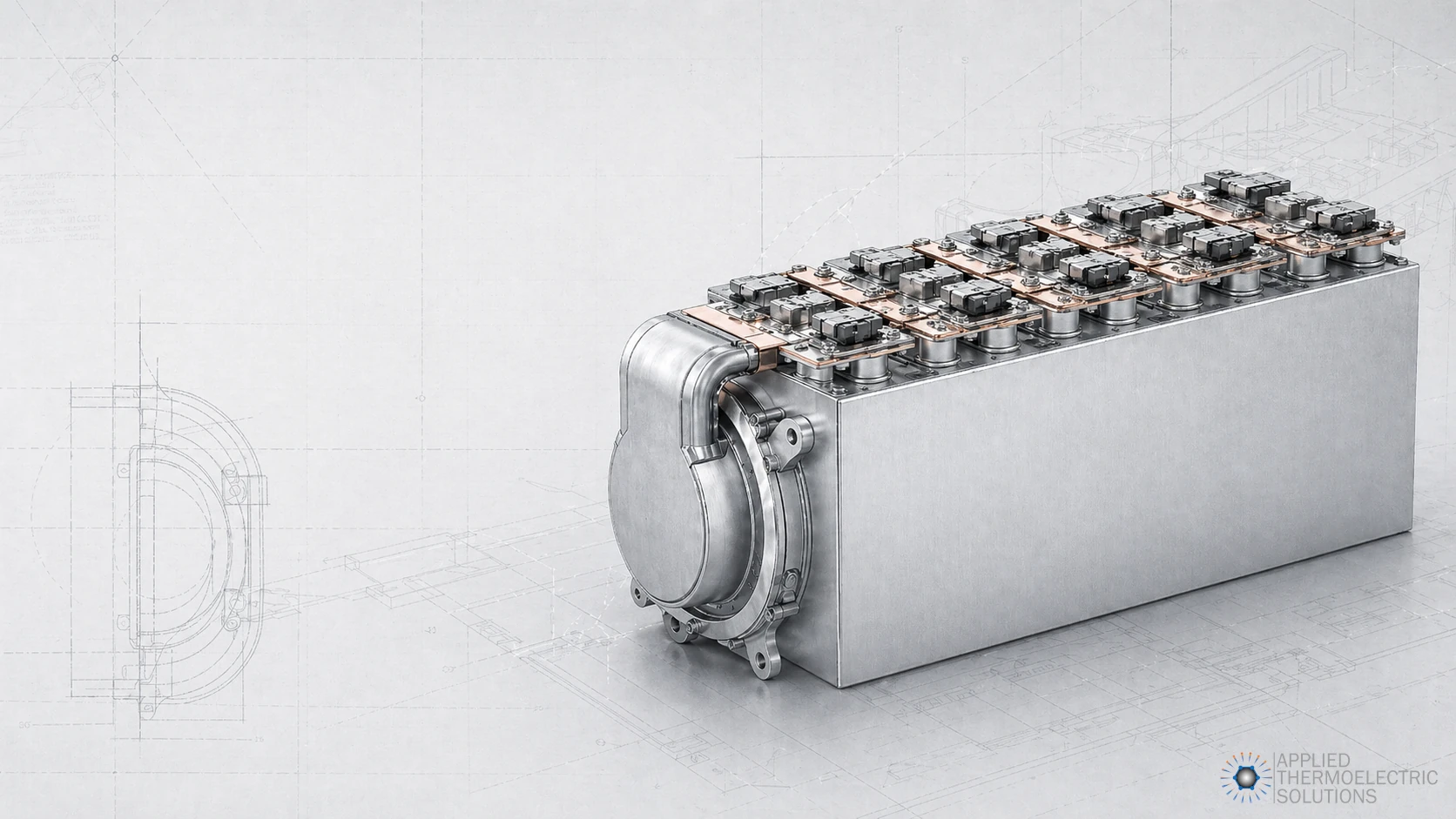
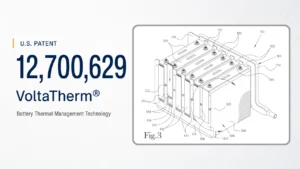
This page discusses an earlier thermoelectric battery thermal management patent developed by Alfred Piggott, Founder and CTO of Applied Thermoelectric Solutions, while working at a leading global developer and supplier of automotive thermoelectric and thermal-management systems. In the battery embodiment discussed here, the patented concept used thermoelectric devices mounted on each battery bus bar to provide solid-state battery heating and cooling through the pack’s electrical interconnect structure.
The design created a heat-transfer path through the battery bus bars, terminals, and electrical conductors. Because each thermoelectric device acted through a bus-bar connection between adjacent batteries, the system provided localized cell-pair heating and cooling rather than true individual cell temperature control.
This patent is included here as technical background relevant to battery thermal management, thermoelectric cooling, battery pack thermal design, solid-state battery cooling, and thermoelectric system integration. Later work by Applied Thermoelectric Solutions, including ParaThermic® high-heat-transfer battery architecture and VoltaTherm® solid-state lithium-ion battery thermal management, is discussed further below to clarify how those newer technologies differ from this earlier bus-bar-mounted thermoelectric approach.
Patent Overview
The patented system uses thermoelectric cooling and heating devices mounted on each battery bus bar. In this configuration, the thermoelectric devices are integrated directly with the electrical interconnect structure of the battery pack. The bus bars, terminals, and current-carrying conductors become part of the thermal pathway between the batteries and the thermoelectric devices.
The central idea is that electrical conductors can be used for more than carrying current. In the battery embodiment discussed here, the bus bars and terminals also help move heat between the battery cells and the thermoelectric devices. This allows the thermal management system to be integrated into the pack structure rather than added only as an external cold plate, air duct, or enclosure-level cooling system.
Because each thermoelectric device is mounted on a bus bar that connects adjacent batteries, the system provides localized cell-pair heating and cooling. This is an important distinction. The patent does not describe true individual cell temperature control. Instead, each thermoelectric device influences the pair of neighboring cells connected through the shared bus-bar structure.
The design was intended to provide compact, solid-state battery temperature control while reducing the need for liquid or refrigerant lines routed through the battery pack. It also reflects a system-level architecture that combines thermoelectric devices, bus bars, air movement, thermal management components, and battery management functions into a compact pack-level assembly.
NREL Presentation Context
This thermoelectric bus-bar cooling concept was also shown in a 2014 National Renewable Energy Laboratory presentation on battery lifetime modeling and control. In a slide on sub-ambient standby cooling topologies, NREL listed chilled liquid, air, refrigerant evaporative plates, and thermoelectrics as possible approaches. The slide identified the subject patent example as a “TE device on busbars” and showed it in the context of HEV battery life extension relative to a 10-year target life.
That presentation context is useful because it places the patented design within a broader battery thermal management discussion. It also shows that thermoelectric battery cooling was being evaluated alongside other active cooling approaches, not merely as a standalone component concept.
How the Thermoelectric Battery Cooling Concept Works
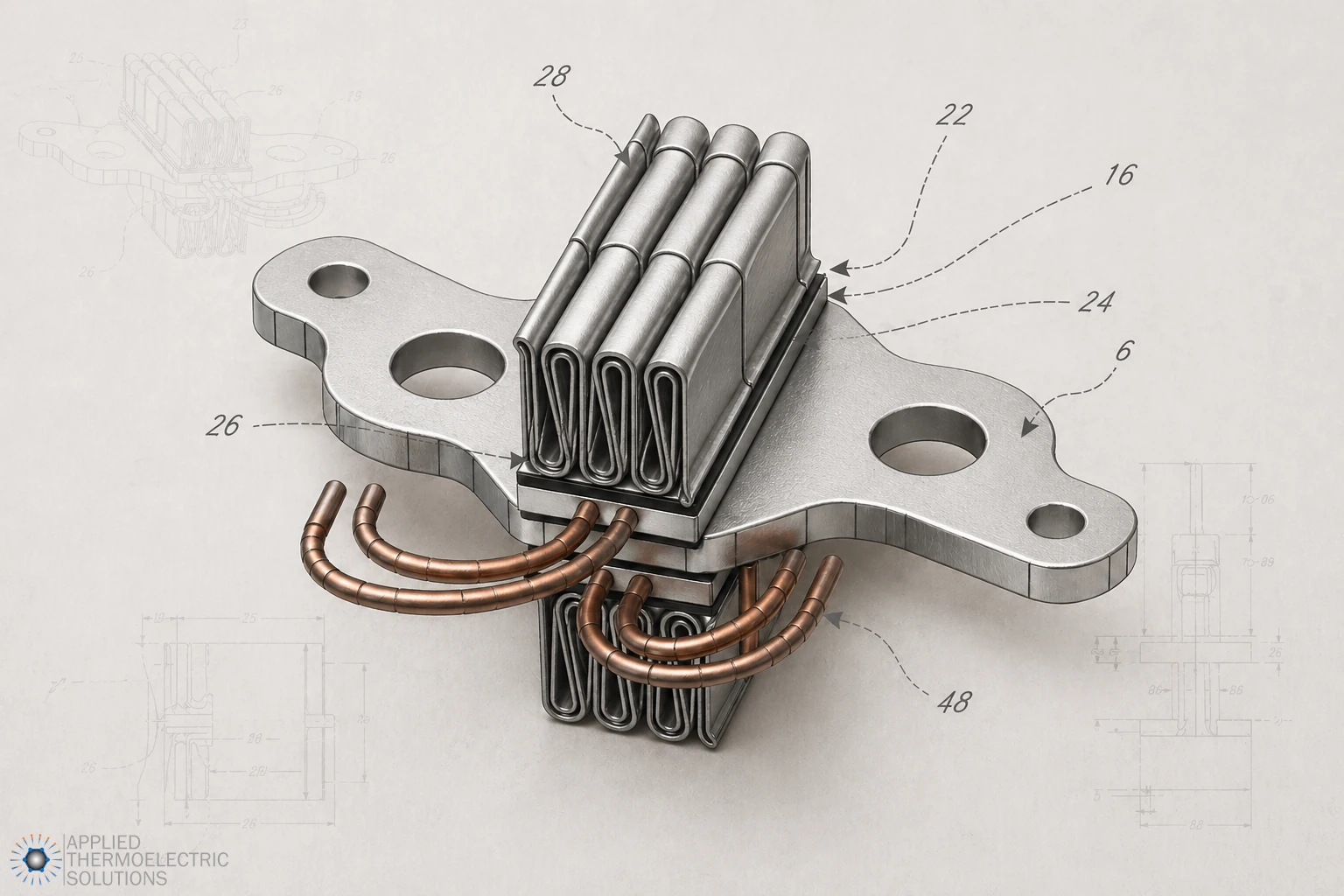
In the patented battery embodiment, each thermoelectric device is mounted on a battery bus bar. The main side of the thermoelectric device is thermally coupled to the bus bar and battery conductor. The waste side rejects heat to an external heat-removal path, such as an air duct, blower, liquid loop, heat exchanger, or other waste heat removal system.
When operated in cooling mode, the thermoelectric device pumps heat away from the bus-bar region. When operated in heating mode, the heat-pumping direction can be reversed. This allows the same solid-state device type to support both battery cooling and battery warming.
The key feature is the use of the battery electrical interconnect system as part of the thermal pathway. Instead of treating the bus bars only as electrical components, the design uses them as a route for thermal energy transfer between the batteries and the thermoelectric devices.
This differs from conventional pack cooling approaches that rely only on cold plates, air cooling, liquid loops, refrigerant systems, or external enclosure cooling. The patented concept explored a more integrated architecture in which thermoelectrics, bus bars, terminals, airflow, controls, and battery management functions were combined into one pack-level thermal system.
Technical Features Described in the Patent
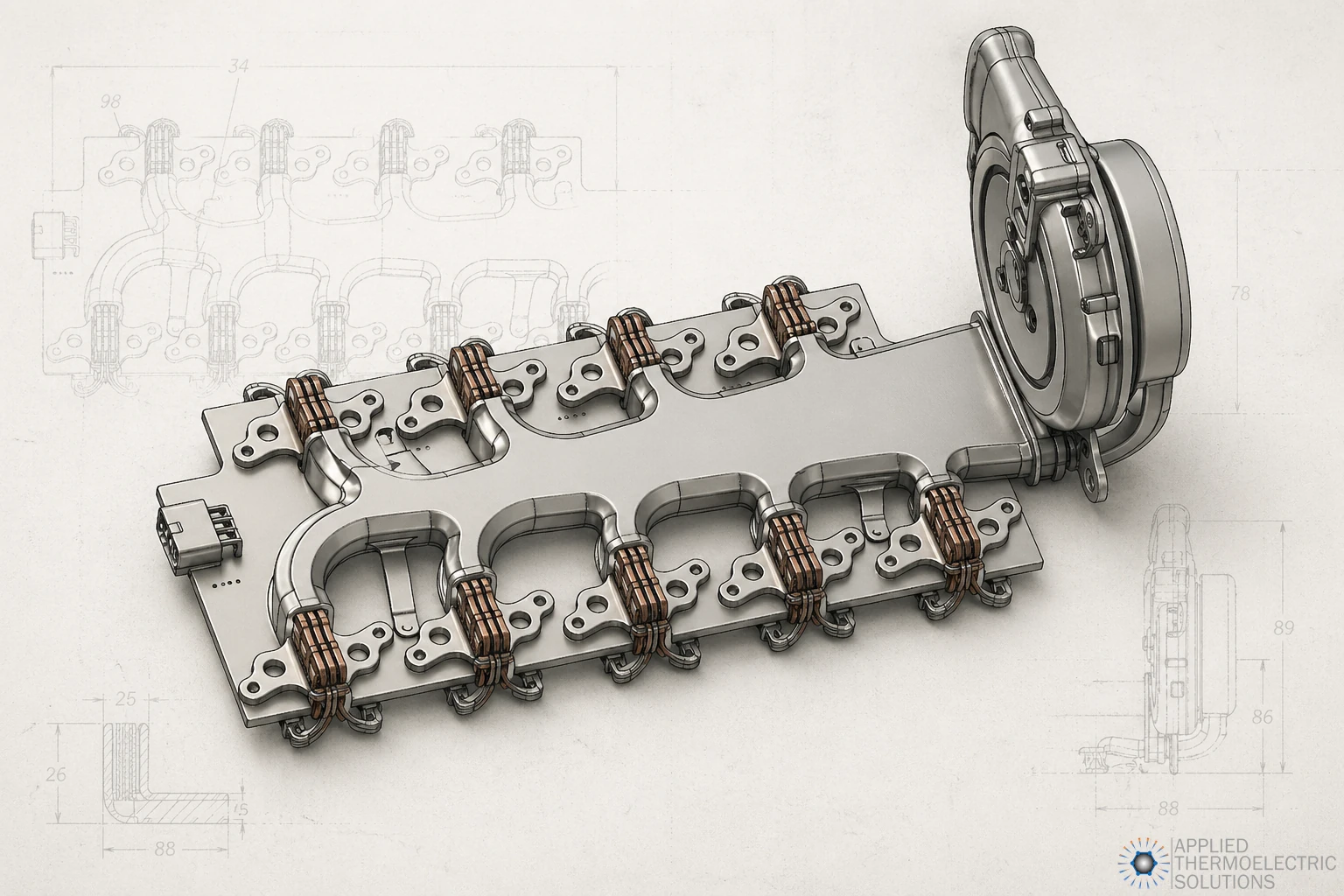
The patent describes several important battery thermal management features:
- Thermoelectric devices mounted on each battery bus bar
- Heat-transfer paths through battery bus bars, terminals, and electrical interconnects
- Use of current-carrying conductors as thermal pathways between the battery and thermoelectric devices
- Localized heating and cooling at the cell-pair level
- Integration of battery management, thermoelectric management, air movement, bus bars, and thermal components
- Polarity control for switching between heating and cooling modes
- Bidirectional solid-state temperature control using thermoelectric devices
- Waste-side heat rejection through air, liquid, or another heat-removal system
- Optional integration with a printed circuit substrate for controls, power connections, sensors, and assembly simplification
- Compact battery pack architecture without liquid or refrigerant lines routed through the pack
- Potential to heat some pack regions while cooling others, depending on battery conditions
- Quiet operation without a compressor-based refrigeration system
Technical Limitations and Later Advancements
Although the patented concept is technically interesting, the thermal resistance from the thermoelectric device to the battery cell core is relatively high. In this earlier architecture, heat must move through the bus bar, terminal structure, and internal cell pathways before strongly affecting the temperature of the cell core. That indirect path limits how much thermal benefit the system can deliver, especially in applications with high heat generation, fast charging, tight temperature limits, or demanding performance requirements.
That limitation does not make the patent unimportant. The patent demonstrates an early system-level idea: integrate thermoelectrics into the battery pack structure and use electrical conductors as part of the thermal pathway. However, the bus-bar-mounted approach is still constrained by the thermal resistance between the cell core and the bus-bar region.
Applied Thermoelectric Solutions has since developed newer battery thermal management technologies that address different parts of this problem more directly. ParaThermic® high-heat-transfer battery architecture addresses the battery-side thermal bottleneck by reducing internal thermal resistance. VoltaTherm® solid-state lithium-ion battery thermal management addresses the system-side challenge by providing compact, active, solid-state heating and cooling with true individual cell temperature control.
Relationship to ParaThermic® and VoltaTherm®
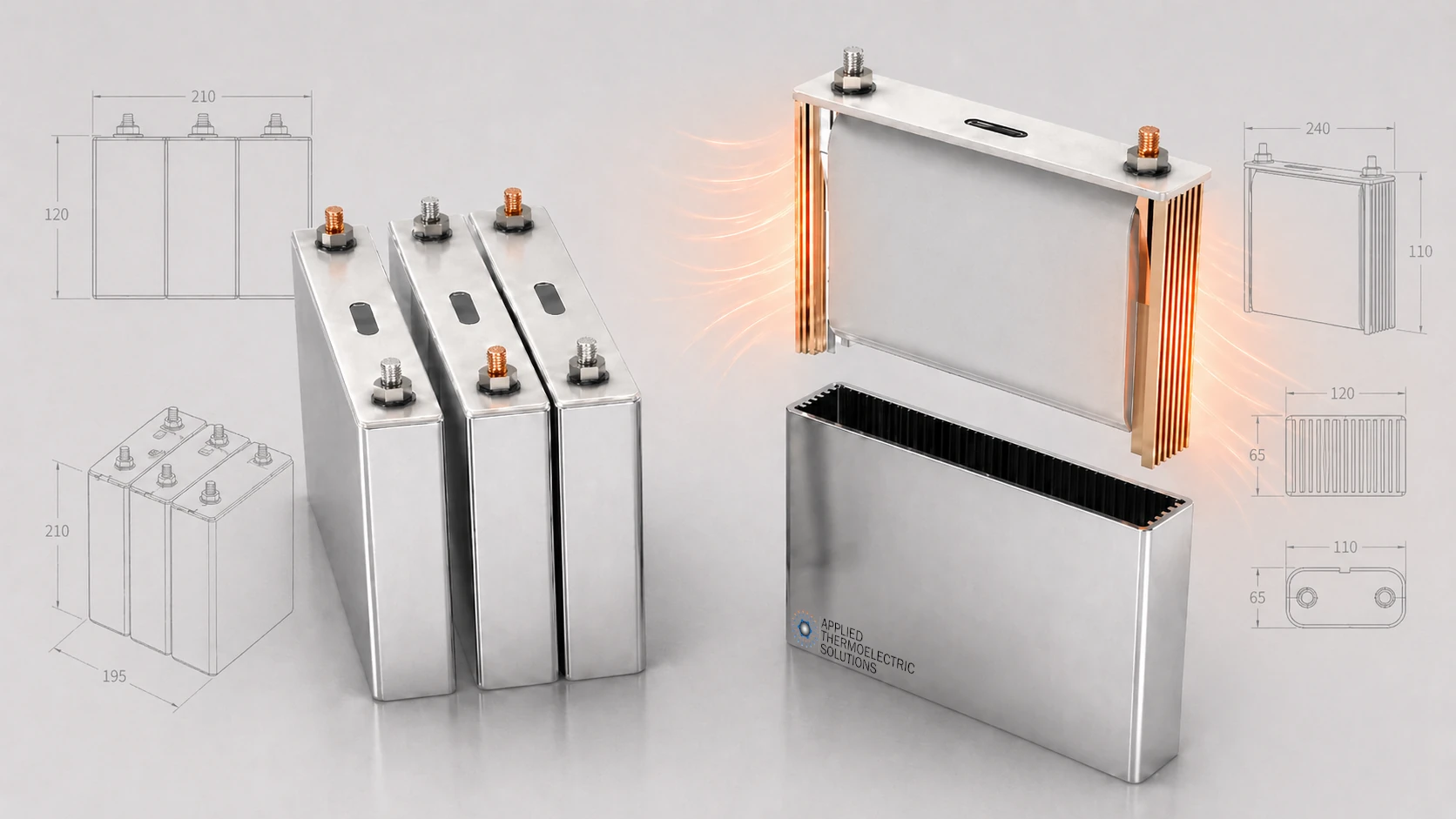
The earlier bus-bar-mounted thermoelectric patent, ParaThermic® architecture, and VoltaTherm® technology all relate to battery thermal management, but they are not equivalent technologies. They address different parts of the thermal problem.
The earlier patent places thermoelectric devices on each battery bus bar and uses the bus bars, terminals, and electrical interconnects as part of the heat-transfer path. This creates a compact solid-state architecture for localized cell-pair heating and cooling. However, the heat path to the cell core remains relatively indirect and high in thermal resistance, which limits thermoelectric cooling performance. It also does not provide true individual cell temperature control because each thermoelectric device influences the pair of cells connected through the shared bus-bar structure.
ParaThermic® battery technology addresses the battery-side thermal bottleneck. It is a low-thermal-resistance, high-heat-transfer battery architecture designed to move heat from the cell interior to the thermal management interface much more effectively. Instead of simply applying more cooling to the outside of the cell, ParaThermic® battery architecture changes how easily heat can move from the battery core to the surface where it can be removed by the cooling system.
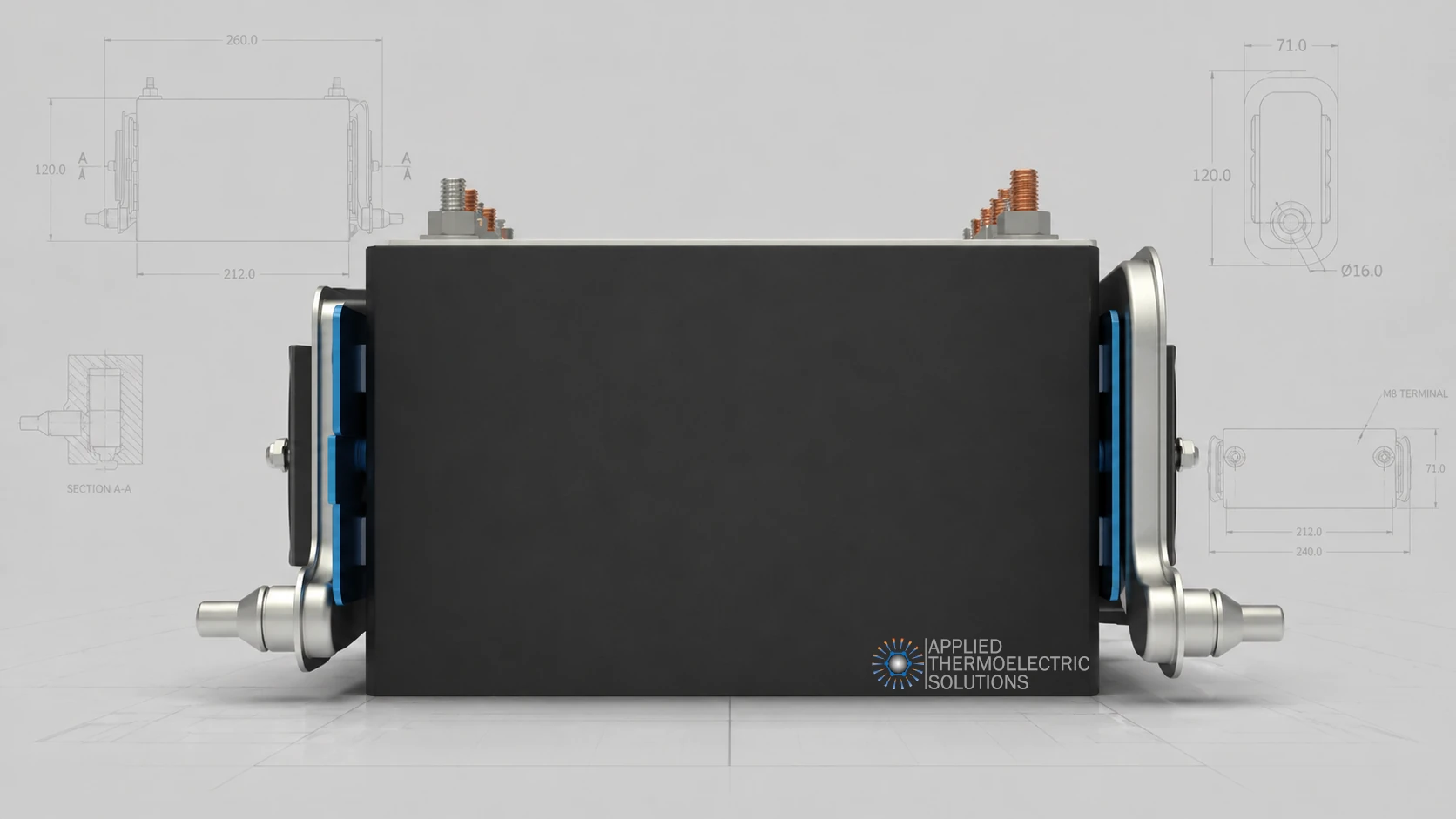
VoltaTherm® addresses the thermal-management-system side of the problem. It is a compact, highly integrated, easy-to-assemble, solid-state battery thermal management system. VoltaTherm® uses thermoelectric heating and cooling to provide active temperature control without the complexity and bulk of compressor-based refrigeration or refrigerant lines routed through the battery pack.
VoltaTherm® is therefore distinct from the earlier bus-bar-mounted thermoelectric patent. In a VoltaTherm® system, some batteries can be actively cooled while others are actively heated at the same time, substantially reducing temperature variation across the battery pack. This is different from the earlier patent approach, where each thermoelectric device acts through a shared bus bar and influences a pair of adjacent cells.
Used together, ParaThermic® and VoltaTherm® technologies are complementary. ParaThermic® architecture reduces the battery’s internal thermal resistance so heat can move out of the cell with a smaller cooling-induced internal temperature gradient. VoltaTherm® provides a highly integrated and compact solid-state system for adding or removing heat at the cell surface.
This distinction matters. A thermal management system can only remove heat effectively if the battery can deliver that heat to the interface where the cooling system connects to the cell. ParaThermic® technology improves the battery-side heat-transfer path, while VoltaTherm® provides an integrated solid-state method for heating and cooling individual cells.
Why Individual Cell Temperature Control Matters
Battery packs do not behave as one perfectly uniform thermal mass. Cells at the outside of a module, cells in the interior, cells near bus bars, cells near cooling interfaces, and cells exposed to different airflow or heat-rejection paths can all experience different thermal boundary conditions.
The cells also may not generate identical heat. Small differences in internal resistance, aging, state of charge, and current distribution can become more important during fast charging, high-power discharge, or cold-weather operation. As a result, one cell may need more cooling while another cell may need less cooling, or even active heating during cold-weather conditioning.
This matters because temperature uniformity affects battery life, usable power, charging capability, safety margin, and pack balancing. NREL has summarized USABC battery thermal management guidance as targeting pack temperature uniformity of less than 3 °C, which shows how tight the thermal-balancing problem can become in advanced electric-vehicle battery systems.
A pack-level or shared-region thermal management system can lower average battery temperature, but it may not correct local hot and cold cells without overcooling some cells or undercooling others. The earlier bus-bar-mounted thermoelectric patent was an important step because it moved solid-state heating and cooling into the battery pack and provided localized cell-pair-level control. However, each thermoelectric device acted through a shared bus-bar connection and influenced two adjacent cells rather than one isolated cell.
VoltaTherm® advances this idea by enabling true individual cell temperature control. That means the thermal management system can add or remove heat at the cell level, helping reduce cell-to-cell temperature variation more directly than a system that treats the whole pack, module, or cell pair as one shared thermal zone.
Comparison of the Patent, ParaThermic®, and VoltaTherm®
| Technology | Primary role | What it improves | Control level | Key distinction |
|---|---|---|---|---|
| Earlier bus-bar-mounted thermoelectric patent | Thermoelectric battery heating and cooling through bus-bar-mounted TECs | Uses electrical interconnects as part of the thermal pathway | Localized cell-pair control | Early solid-state architecture, but the path to the cell core remains relatively indirect |
| ParaThermic® | High-heat-transfer battery architecture | Reduces battery-side thermal resistance from the cell interior to the thermal management interface | Battery architecture improvement | Improves how easily heat moves out of the battery itself |
| VoltaTherm® | Compact solid-state BTMS | Provides active thermoelectric heating and cooling at the system level | True individual cell temperature control | Enables some cells to be cooled while others are heated simultaneously |
Need to Compare Battery Thermal Management Architectures?
Applied Thermoelectric Solutions helps companies evaluate battery thermal concepts, heat-transfer paths, thermoelectric integration, and system-level tradeoffs before committing to a design direction.
Why This Patent Still Matters
This patent remains useful as an example of early system-level thinking in thermoelectric battery thermal management. Rather than treating thermoelectric devices as external add-on components, the design integrated them with the pack’s electrical and thermal structure.
That idea still matters. Battery thermal management performance is not determined only by whether a system uses liquid cooling, air cooling, immersion cooling, thermoelectric cooling, or another method. It is also determined by the full thermal pathway from the heat-generating regions inside the cells to the external heat rejection system.
The bus-bar-mounted approach may still be useful in applications where compact solid-state heating and cooling, localized pack conditioning, or refrigerant-free thermal control are more important than maximum heat-removal performance. However, battery heat-removal requirements are increasing. For demanding battery thermal management applications, reducing the thermal resistance to the cell core and enabling more direct cell-level control are usually more important challenges.
Relationship to Modern Battery Thermal Management
Modern battery thermal management systems may use liquid cooling, air cooling, immersion cooling, phase-change materials, heat pipes, thermoelectric devices, refrigerant cooling, or hybrid architectures. Each method has advantages and limitations.
For electric vehicles, stationary energy storage, aerospace systems, defense applications, and specialty battery systems, the best solution depends on more than cooling capacity alone. Engineers must consider cell format, heat-generation rate, fast-charging requirements, cold-weather operation, allowable temperature gradients, safety margins, manufacturability, controls, service life, and the complete heat-transfer path.
This patent is one example of a solid-state battery thermal management architecture that addressed the battery pack as an integrated electrical and thermal system. That system-level thinking remains important for advanced battery thermal management design today.
Related Work by Applied Thermoelectric Solutions
Applied Thermoelectric Solutions supports battery thermal management and thermoelectric system development through modeling, design, simulation, prototype support, and system-level engineering.
Our work focuses on understanding the complete thermal pathway, including heat generation, thermal resistance, temperature limits, packaging constraints, controls, and integration with the larger system. For battery applications, this can include evaluating cooling methods, improving heat-transfer paths, analyzing battery thermal performance, and supporting advanced battery thermal management concepts.
Applied Thermoelectric Solutions also develops advanced battery thermal management concepts including ParaThermic® high-heat-transfer battery architecture and VoltaTherm® solid-state lithium-ion battery thermal management.
ParaThermic® architecture focuses on the battery-side heat-transfer limitation by reducing internal thermal resistance. VoltaTherm® focuses on compact solid-state system integration for active battery heating and cooling with true individual cell temperature control. Together, they reflect a broader strategy: improve both the battery’s ability to move heat within the cell and the thermal management system’s ability to deliver or remove the needed heat with greater precision at the cell surface.
Related patent background pages describe other thermoelectric battery thermal management concepts developed by Alfred Piggott during his earlier work at a leading automotive thermoelectric and thermal-management systems supplier. One used pyrolytic graphite heat spreaders, resistive heating, and thermoelectric devices, while another used heat spreaders to create a lower-resistance thermal path between battery hotspots and the active heating and cooling system.
Need Help Evaluating a Battery Thermal Management Concept?
Battery thermal management performance depends on more than selecting a cooling method. The full heat-transfer path, internal thermal resistance, cell format, packaging constraints, controls, manufacturability, and operating environment all affect whether a battery thermal management system can meet its goals.
Applied Thermoelectric Solutions helps companies evaluate battery thermal architectures, thermoelectric cooling concepts, solid-state thermal management systems, and advanced heat-transfer approaches for demanding applications.
Frequently Asked Questions
Is this an Applied Thermoelectric Solutions patent?
No. This patent was developed by Alfred Piggott, founder and CTO of Applied Thermoelectric Solutions, while working at a leading global developer and supplier of automotive thermoelectric and thermal-management systems. It is included here as background showing earlier technical work in thermoelectric battery thermal management, solid-state battery cooling, and battery thermal system integration.
Does this patent describe individual cell temperature control?
No. Because the thermoelectric devices are mounted on bus-bar connections between adjacent batteries, each device affects two batteries rather than controlling one isolated cell independently. A more accurate description is localized cell-pair heating and cooling.
Are the thermoelectric devices near the bus bars or on the bus bars?
In this patented design, the thermoelectric devices are mounted on each battery bus bar. The bus bars, battery terminals, and electrical interconnects become part of the heat-transfer path between the thermoelectric devices and the batteries.
Why does the patent use the bus bars as part of the thermal path?
Battery bus bars and electrical conductors can have relatively high thermal conductivity because they are designed to carry significant current. The patent uses this property by treating the electrical interconnect structure as both an electrical path and a thermal path.
Does thermoelectric battery cooling require liquid cooling?
No. This patented concept was designed to provide battery heating and cooling without routing liquid or refrigerant lines through the battery pack. Other battery thermal management systems may still use liquid cooling, immersion cooling, air cooling, refrigerant cooling, or hybrid methods depending on the application.
Why use thermoelectric devices in a battery thermal management system?
Thermoelectric devices can provide compact, solid-state heating and cooling with no compressor and no refrigerant. They can also reverse heat-pumping direction by reversing current polarity. Their usefulness depends on the battery heat load, temperature requirements, available power, packaging constraints, thermal resistance, controls, and system design.
How does this earlier patent compare with ParaThermic® and VoltaTherm® technology?
This earlier patent uses thermoelectric devices mounted on each battery bus bar, creating a heat-transfer path through the bus bars, terminals, and electrical interconnects. That approach provides compact localized heating and cooling, but the thermal resistance path to the battery cell core can be relatively high. It also provides cell-pair-level thermal control rather than true individual cell control.
ParaThermic® and VoltaTherm® technology were developed later to address different parts of the battery thermal management problem. ParaThermic® batteries reduce the battery-side thermal resistance so heat can move more easily from the cell interior to the thermal management interface. VoltaTherm® provides compact solid-state active heating and cooling with true individual cell temperature control, allowing some batteries to be cooled while others are heated simultaneously.
What is the difference between ParaThermic® and VoltaTherm®?
ParaThermic® is a low-thermal-resistance, high-heat-transfer battery architecture. It improves the battery itself by reducing the internal thermal resistance between the heat-generating regions of the cell and the thermal management interface.
ParaThermic® architecture is a low-thermal-resistance, high-heat-transfer battery architecture. It improves the battery itself by reducing the internal thermal resistance between the heat-generating regions of the cell and the battery thermal management system interface with the cell.
VoltaTherm® is a compact, highly integrated, easy-to-assemble, solid-state battery thermal management system. It improves the system side by providing active thermoelectric heating and cooling with true individual cell temperature control.
Does ParaThermic® technology require thermoelectric cooling?
No. ParaThermic® technology is a high-heat-transfer battery cell architecture, not a specific cooling method. It is designed to help heat move more easily from the cell core to the cell surface while minimizing the cooling-induced internal temperature gradient that can be detrimental to battery performance and life.
Because ParaThermic® improves the battery-side heat-transfer path, it can work with many cooling technologies, including air cooling, liquid cooling, refrigerant cooling, phase-change materials, thermoelectric cooling, immersion cooling, two-phase cooling, jet impingement, and other battery thermal management approaches.
How does this relate to modern battery thermal management?
The patent illustrates a system-level approach to battery thermal management, where the heat-transfer path, bus-bar structure, terminals, controls, and thermal components are considered together. That type of thinking remains relevant for modern battery pack design, even when the final cooling method is liquid cooling, air cooling, immersion cooling, thermoelectric cooling, refrigerant cooling, or a hybrid approach.
Why is individual cell temperature control important in battery thermal management?
Individual cell temperature control matters because cells in a battery pack do not always generate heat at the same rate or experience the same thermal boundary conditions. Edge cells, interior cells, aged cells, high-resistance cells, and cells near different cooling paths may need different amounts of heating or cooling. True individual cell temperature control can help reduce cell-to-cell temperature variation more directly than pack-level or cell-pair-level control.
Solid-State Thermoelectric Battery Thermal Management Patent PDF Download
Links that May Interest You
- Custom Thermoelectric Solutions
- Thermoelectric Design and Simulation Services
- Thermoelectric System Development
- Our Thermoelectric Cooling and Generator Work
- Thermoelectric Cooling Prototype Case Study
- Solar Thermoelectric Generator Case Study
- How Thermoelectric Cooling Works
- How Thermoelectric Generators Work
- ParaThermic® Battery Thermal Management Technology
- VoltaTherm® Battery Thermal Management System (BTMS)
- PowerBeam™ Wireless Power Transfer Technology
- Battery Thermal Management | After Immersion Cooling