Applied Thermoelectric Solutions LLC

Thermoelectric Companies, Manufacturers, and Suppliers for Peltier Cooling, TEC Modules, and TEG Systems
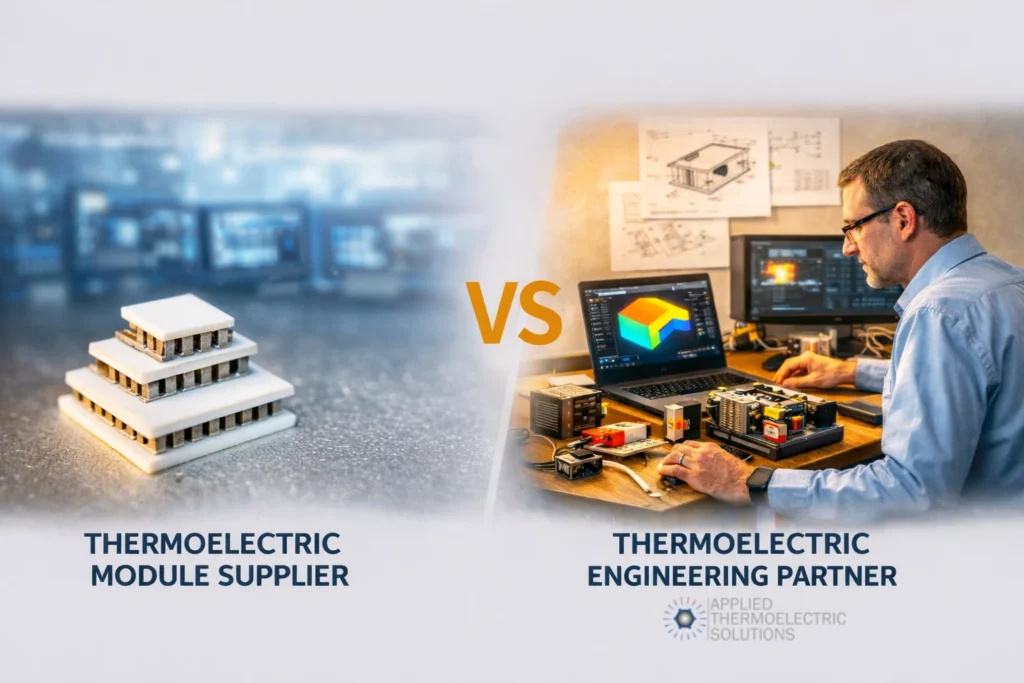
If you are researching thermoelectric companies, thermoelectric manufacturers, thermoelectric suppliers, Peltier manufacturers, or thermoelectric generator companies, this page provides a practical starting point for understanding the thermoelectric supplier landscape.
The thermoelectric market includes several different types of companies. Some focus on standard thermoelectric modules or stocked components. Others specialize in thermoelectric generators (TEGs), thermoelectric coolers, integrated thermal assemblies, or finished products. Some companies serve narrow application areas, while others provide broader engineering and development support.
Choosing the right thermoelectric company depends on what you actually need. In some cases, an off-the-shelf TEC module or standard thermal assembly is enough. In other cases, the real challenge is determining whether thermoelectrics are the right fit, how a system should be designed, how heat rejection and controls should be handled, and how to reduce development risk before significant time and money are spent.
Need Help Choosing the Right Thermoelectric Approach?
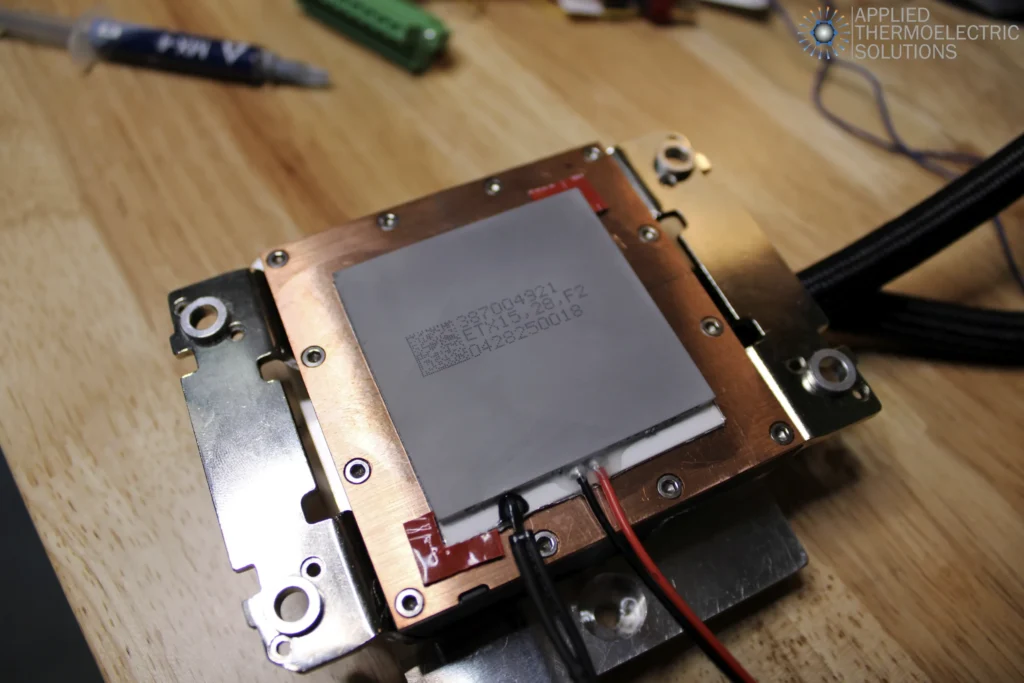
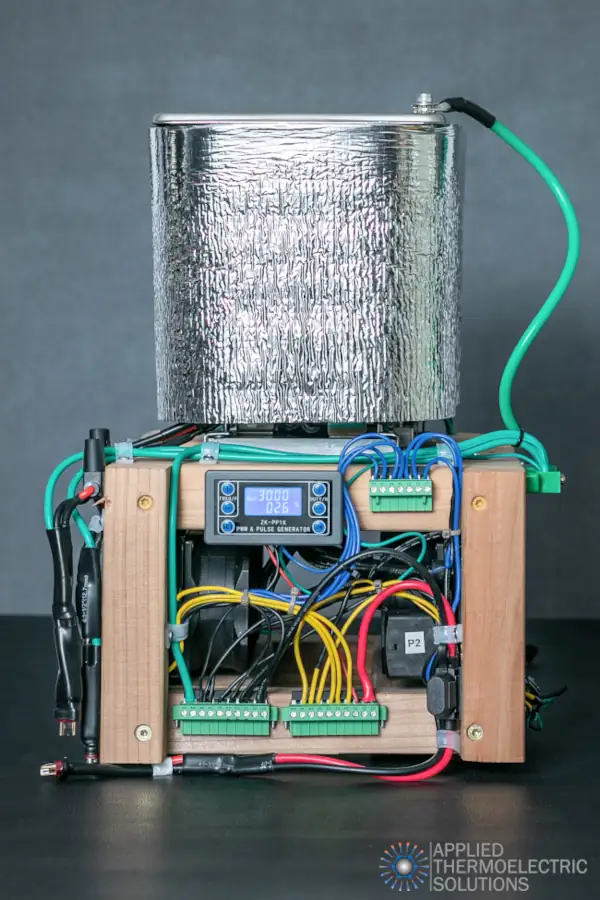
Applied Thermoelectric Solutions provides technical, engineering, and consulting services for thermoelectric cooling and thermoelectric power generation.
We help clients evaluate feasibility, reduce development risk, and determine the most effective path from concept to prototype.
How to Choose the Right Type of Thermoelectric Company
Not every thermoelectric project needs the same kind of partner.
You may need a thermoelectric manufacturer or supplier if:
- you need standard thermoelectric modules or stocked components
- your application is relatively simple
- you already know your thermal and electrical requirements
- your main need is sourcing rather than development support
- you are selecting from existing product lines
You may need a thermoelectric engineering partner if:
- you are still evaluating feasibility
- you need help determining whether thermoelectrics are the right fit
- you need optimization, modeling, simulation, or prototype support
- you need to balance thermal, mechanical, electrical, acoustic, packaging, and cost constraints
- you are developing a custom product or application
- you are not yet sure which architecture, supplier path, or system approach makes the most sense
- you are not getting the cooling, heating, or power-generation performance you expected
For many projects, selecting a module supplier is only one part of the problem. Product success often depends on system architecture, heat rejection strategy, controls, packaging, interfaces, manufacturability, reliability, and realistic performance expectations.
Applied Thermoelectric Solutions: An Engineering Partner, Not Just a Product Source
Many thermoelectric companies focus on selling standard modules, assemblies, or branded products. Applied Thermoelectric Solutions is different. We work as an engineering partner for organizations that need help evaluating, designing, and developing thermoelectric technology for real applications.
Applied Thermoelectric Solutions is not simply built around a standard product catalog. We help clients determine what is most likely to work at the system level, reduce technical risk early, and support the development of custom thermoelectric products and systems for customer applications.
Why Applied Thermoelectric Solutions Stands Out
Not limited to a standard product catalog
Many thermoelectric manufacturers and suppliers are closely tied to their own modules, assemblies, or finished products. Applied Thermoelectric Solutions is different. We are not primarily focused on selling a fixed catalog of standard thermoelectric products. That gives us greater flexibility to help clients pursue the right technical path for the application rather than simply steering them toward an existing product line.
Modeling before costly trial-and-error prototyping
ATS uses physics-based modeling and simulation to evaluate feasibility, estimate performance limits, and reduce technical uncertainty before expensive prototype cycles. This can lower development cost, reduce wasted iteration, and help clients make better decisions earlier in the process.
Custom development for customer products and applications
Some companies offer custom variants of their existing products. ATS goes further by helping clients develop custom thermoelectric systems and product concepts built around the customer’s actual application, requirements, and constraints.
Research depth combined with practical engineering
Published research and practical product development experience are a powerful combination. ATS brings together technical depth, first-principles analysis, proprietary development work, and hands-on engineering support for real-world thermoelectric cooling and power-generation challenges.
System-level thinking, not just part selection
A successful thermoelectric product depends on more than choosing a module. ATS helps address the broader system problem, including heat flow, interfaces, heat rejection, power and controls, packaging, and real integration constraints.
Broader cross-application thermoelectric perspective
Many thermoelectric companies focus on a narrow set of products or application areas. Applied Thermoelectric Solutions works across a broader range of thermoelectric cooling and thermoelectric generator challenges. That broader perspective can be valuable when a problem is complex, unusual, multidisciplinary, or does not fit neatly into a standard product category.
How Applied Thermoelectric Solutions Differs From Other Thermoelectric Companies
| Capability or focus | Many thermoelectric companies | Applied Thermoelectric Solutions |
|---|---|---|
| Standard modules, assemblies, or branded products | Often a major part of the business | Not the main focus |
| Help deciding whether thermoelectrics are the right fit | Sometimes limited | Core strength |
| Modeling and simulation before prototyping | Offered by some firms | Core strength |
| Vendor-neutral engineering guidance | Less common | Important differentiator |
| Custom development for customer applications | Sometimes offered, often tied to product lines | Core strength |
| System-level product development thinking | Varies widely | Core strength |
| Research depth combined with practical engineering | Less common in combination | Strong differentiator |
| Cross-application thermoelectric perspective | Often narrower by product or niche | Strong differentiator |
Thermoelectric Companies, Manufacturers, and Suppliers by Category
Below is a general market overview of thermoelectric companies, Peltier manufacturers, thermoelectric module suppliers, thermoelectric generator companies, and related organizations.
Thermoelectric Companies, Engineering Providers, and System Developers
- Applied Thermoelectric Solutions LLC
- Acal BFI
- Adcol Electronic
- ADV Engineering
- Align Sourcing
- Analog Technologies
- Bentek Systems
- Cidete Ingenieros SL
- Innoveco
- Merit Technology Group
- Thermalforce
Thermoelectric Module Manufacturers and Suppliers
- Alflex Technologies
- AMS Technologies
- Asia Inno
- Beijing Huimao Cooling Co., Ltd.
- BTS Europe
- CUI
- Custom Thermoelectric Inc.
- Crystal LTD.
- European Thermodynamics
- Everredtronics Ltd.
- Ferrotec Corporation
- Guang Dong Fuxin Electronic
- Hangzhou Aurin Cooling
- Hebei IT
- Hicooltec Electronic
- Hui Mao
- Interm
- Kryotherm
- Laird Tech Inc.
- II-VI Marlow
- INB Thermoelectric
- ISA Impex
- Newmark International
- OTE International
- P&N Tech
- Qinhuangdao Fulianjing
- Quick Cool
- RFI Corp.
- RMT LTD
- S&PF Modul
- Taicang TE Cooler
- TE Technology, Inc.
- TEC Microsystems
- Thermal Electronics
- Thermion Company
- Thermix
- Thermonamic Electronics
- Tybang Electronics
- UWE Electronic
- Wellen Tech
- WeTEC
- Z-MAX
Thermoelectric Generator Companies and Related Suppliers
- Ambient Micro
- Ecogen
- Gentherm Global Power
- Green TEG AG
- Hi-Z Technology, Inc.
- Kelk Ltd.
- Perpetua Power
- TECTEG
- TEGEOS
- TEGPRO Thermoelectric Generator
- Termo-Gen AB
Thermoelectric Cooling and Product Companies
- Gentherm
- Micropelt GmbH
- Phononic
- Sheetak
- Yamaha
When a Supplier List Is Not Enough
A supplier list can help identify thermoelectric manufacturers and suppliers, but it does not tell you which approach is most likely to succeed for your application.
A successful thermoelectric project often depends on questions such as:
- Is thermoelectric cooling or power generation the right fit?
- What heat load, temperatures, and constraints define the system?
- Is the performance target realistic?
- How should the hot side and cold side be designed?
- What packaging or power constraints will affect system performance?
- Is a standard product sufficient, or is custom development needed?
- Which supplier category is most relevant for the project?
- What development path reduces technical risk and wasted prototyping time?
If your project involves those kinds of questions, working with an experienced thermoelectric engineering partner can save significant time and development cost.
Need Help Moving Your Thermoelectric Project Forward?

If you need help evaluating feasibility, selecting the right supplier path, or solving thermoelectric system design challenges, Applied Thermoelectric Solutions can help.
- reduce technical risk before prototyping
- solve difficult integration challenges
- move from concept to prototype with a clearer plan
Professional Thermoelectric Society
- International Thermoelectric Society
Universities and Research Institutions Working in Thermoelectrics
- Caltech
- Michigan State University
- Northwestern University
- University of Glasgow
- University of Maryland
- Western Michigan University
Frequently Asked Questions about Thermoelectric Companies, Suppliers and Manufacturers
What is the difference between a thermoelectric supplier and a thermoelectric engineering partner?
A thermoelectric supplier typically focuses on selling thermoelectric modules or standard products at volume. In many cases, a supplier asks a few application questions and recommends a part to try. While that can be fine for simple situations, it often leads to disappointing results when real system-level requirements are more complex.
A thermoelectric engineering partner takes a different approach. Instead of starting with a part, they start with your goals, constraints, and performance requirements. They use tools such as modeling and simulation to design a thermoelectric solution that is more likely to work for the actual application.
In short, a supplier helps you buy a part. An engineering partner helps you solve the problem.
When is an off-the-shelf thermoelectric module enough?
An off-the-shelf thermoelectric module may be enough when the application is simple, the performance target is modest, and there is sufficient time and budget for experimentation.
However, when results matter, timelines are limited, budgets are constrained, or trial-and-error is not practical, working with a thermoelectric engineering partner is often the better path. In those cases, success usually depends on system design, not just module selection.
When is custom thermoelectric development needed?
Custom thermoelectric development is needed whenever existing products cannot get close enough to meeting the required performance, acoustic, cost, packaging, reliability, or other system-level requirements.
It is often the right path when a product must be optimized around a specific application rather than adapted around a standard off-the-shelf part.
How do I choose the right thermoelectric company for my application?
The right thermoelectric company depends on what you need.
If the application is simple and there is room for experimentation, a standard module supplier may be enough. But if project success is important, it is often better to work with a thermoelectric engineering partner.
In general, it is wise to look for a partner that:
- is not tied to only the modules it manufactures
- uses modeling and simulation to reduce cost, time, and risk
- can engineer custom system-level solutions when needed
- understands both practical engineering and the broader thermoelectric research landscape
- has experience across a broad range of products and applications
That combination can improve the odds of finding a solution that not only works, but also helps differentiate the final product.
Does Applied Thermoelectric Solutions sell standard thermoelectric modules?
No. Applied Thermoelectric Solutions is an engineering partner, not a commodity module seller.
ATS works with modules from a broad range of suppliers so the solution can be selected based on the needs of the product and application. This broader supplier flexibility can help improve outcomes while also supporting lower cost and better overall system fit.
Can thermoelectric modeling and simulation reduce development cost?
Yes. Thermoelectric modeling and simulation make it possible to estimate how a product will perform before building and testing physical prototypes.
Once a model has been created, many design variants and operating conditions can be evaluated in a fraction of the time required to build and test real hardware. This can significantly reduce development cost, shorten timelines, and lower technical risk.
Related Thermoelectric Resources
- Custom Thermoelectric Solutions
- Thermoelectric Design and Simulation Services
- Thermoelectric System Development
- Our Thermoelectric Cooling and Generator Work
- Thermoelectric Cooling Prototype Case Study
- Solar Thermoelectric Generator Case Study
- How Thermoelectric Cooling Works
- How Thermoelectric Generators Work
- ParaThermic® Battery Thermal Management Technology
- VoltaTherm® Battery Thermal Management System (BTMS)
- PowerBeam™ Wireless Power Transfer Technology
- Battery Thermal Management | After Immersion Cooling