Thermoelectric Cooling Through Electrical Conductors: Patent Background
Electrical conductors are normally designed around current capacity, voltage drop, mechanical connection, and electrical reliability. In some applications, however, those same conductors can also become part of the thermal-management system.
This page reviews an earlier patent developed by Alfred Piggott, founder and CTO of Applied Thermoelectric Solutions, and other inventors while he was working at Gentherm. The patent explored using terminals, electrodes, leads, bus bars, and other current-carrying conductors as thermal pathways between temperature-sensitive regions of electrical devices and thermoelectric heating or cooling modules.
The central idea was to use a conductor for two functions:
- Carry electrical current to or from the device
- Transfer heat between the device and a thermoelectric module
This approach can provide a more direct thermal path to an internal hotspot or temperature-sensitive region that may be difficult to reach through the exterior housing.
Its success, however, depends on more than attaching a thermoelectric module to a wire or terminal. The electrical conductor, thermal path, thermoelectric device, interfaces, controls, packaging, and waste-side heat rejection must be designed and integrated as one complete system.
Patent Overview
Many electrical devices contain internal regions that generate heat or must remain within a specific temperature range.
Examples can include:
- Power semiconductors
- Transistors and IGBTs
- Power amplifiers
- Inverters and converters
- Transformers
- Motors and generators
- High-power LEDs
- Lasers
- Batteries
- Sensors
- Other high-current electrical devices
The temperature-sensitive region may be buried inside the assembly, surrounded by electrical insulation, enclosed by a housing, or connected to the exterior mainly through electrical leads and terminals.
In those cases, the external housing may not provide the shortest or lowest-resistance thermal path to the region that requires temperature control.
The patented concept used an existing electrical conductor as part of the thermal pathway. A thermoelectric device could be coupled directly or indirectly to the conductor, allowing heat to move between the temperature-sensitive region and the thermoelectric module.
In cooling mode, the thermoelectric device pumps heat away from the electrical device. In heating mode, reversing current direction reverses the direction of heat pumping.
How an Electrical Conductor Can Also Transfer Heat
Most electrical conductors are made from materials with relatively high thermal conductivity, such as copper or aluminum.
That means a lead, terminal, electrode, bus bar, or other conductor can carry both:
- Electrical current
- Thermal energy
The amount of heat transferred through the conductor depends on:
- Conductor material
- Length
- Cross-sectional area
- Temperature difference
- Thermal contact resistance
- Geometry
- Connection to surrounding structures
- Heat generated within the conductor itself
A short, thick conductor generally has lower electrical resistance and lower thermal resistance than a long, thin conductor made from the same material.
This creates an important design opportunity. A conductor sized to carry substantial current may already provide a relatively conductive thermal path to an internal device region.
If a thermoelectric module is coupled to that conductor at the right location, the conductor can transfer heat between the module and the region requiring temperature control.
Why Conductor-Based Cooling Can Improve the Thermal Path
Heat generated inside an electrical device flows through all available thermal paths.
Some of those paths may pass through:
- Semiconductor packaging
- Dielectric materials
- Encapsulants
- Structural components
- Housings
- Mounting interfaces
- Electrical terminals and leads
If the exterior housing is separated from the hotspot by high-resistance materials, attaching a cooling device to the outside of the enclosure may not cool the internal region efficiently.
An electrical lead or terminal may provide a more direct path because it can be physically connected to the current-carrying or heat-generating region inside the device.
Using that conductor as part of the cooling path can:
- Reduce the effective thermal resistance to the hotspot
- Increase heat flow toward the thermoelectric module
- Reduce the temperature rise at the temperature-sensitive region
- Improve thermal response
- Reduce the cold-side temperature required from the thermoelectric module
- Simplify packaging in some applications
The conductor does not become the only heat-transfer path. Heat continues to flow through every available path according to the associated thermal resistances and temperature gradients.
The benefit comes from adding or improving a relatively low-resistance path between the temperature-sensitive region and the active thermal-management system.
Direct and Indirect Thermoelectric Coupling
The thermoelectric module can be connected to the conductor in different ways.
Direct coupling
The thermoelectric module is mounted directly against the conductor or terminal.
Potential advantages include:
- Shorter thermal path
- Fewer intermediate components
- Lower interface resistance
- Compact packaging
- Faster thermal response
Direct coupling may require electrical isolation if the thermoelectric module or attached heat-rejection structure cannot share the conductor’s electrical potential.
Indirect coupling
An intermediate thermal component connects the conductor to the thermoelectric module.
This can help with:
- Electrical isolation
- Mechanical packaging
- Module positioning
- Load distribution
- Thermal expansion
- Assembly and serviceability
However, every added material layer and interface introduces additional thermal resistance.
The preferred architecture depends on whether the thermoelectric device can be located directly at the intended thermal interface without creating electrical, mechanical, manufacturing, or reliability problems.
Why Thermal Resistance Affects Thermoelectric Performance
The thermal resistance between the temperature-sensitive region and the thermoelectric cold side affects the operating point of the entire thermoelectric system.
For a given heat flow, the temperature drop across a thermal path increases as thermal resistance increases.
If the path between the electrical device and the thermoelectric module has high thermal resistance, the thermoelectric cold side must operate at a lower temperature to maintain the internal device region at its target temperature.
This increases the temperature difference across the thermoelectric module.
A larger thermoelectric temperature difference generally:
- Reduces available cooling capacity
- Increases electrical power consumption
- Lowers coefficient of performance
- Increases the hot-side heat-rejection requirement
- Makes the system more sensitive to ambient temperature
- Places greater demands on the heat sink or coolant system
A well-designed conductor path can reduce this penalty by lowering the temperature drop between the internal temperature-sensitive region and the thermoelectric module.
The goal is not merely to make the conductor cold. The goal is to reduce the complete thermal resistance between the heat source and the thermoelectric cold side.
The Parasitic Heat-Leak Tradeoff
The same conductor that creates a useful thermal path toward the electrical device can also create an unwanted thermal path away from it.
For example, a cooled terminal may also be connected to:
- External wiring
- A connector
- A bus bar
- A circuit board
- A power supply
- A chassis
- Ambient surroundings
Some cooling can therefore be lost through the external portion of the conductor instead of being delivered only to the intended temperature-sensitive region.
This creates a competition between two thermal paths:
- A useful path between the thermoelectric module and the target region
- A parasitic path between the thermoelectric module and external hardware
The system works best when the useful path has lower thermal resistance than the unwanted path.
Design methods for reducing parasitic heat leakage can include:
- Selecting the thermoelectric attachment location carefully
- Reducing conductor length between the module and target region
- Increasing useful-path cross-sectional area
- Reducing unnecessary external conductor cross section
- Using thermal isolation features where electrically practical
- Controlling contact area
- Managing connector and cable geometry
- Separating the heat-rejection structure from the cooled conductor
- Modeling the complete thermal-resistance network
This is one reason conductor-based thermoelectric cooling must be evaluated at the system level.
A conductor geometry that is excellent electrically may not be optimal thermally. Likewise, a geometry that minimizes heat leakage may create excessive electrical resistance, voltage drop, current density, or resistive heat generation.
The design must balance both functions.
Electrical and Thermal Design Tradeoffs
Electrical and thermal resistance often move in the same direction for a metallic conductor.
Increasing conductor cross-sectional area tends to reduce:
- Electrical resistance
- Resistive heating
- Thermal resistance
Reducing conductor length has similar effects.
This can be beneficial when the conductor links the thermoelectric module to the target region. However, it can be detrimental when the same conductor continues past the cooled region and creates an unwanted heat leak.
Important tradeoffs include:
- Electrical resistance versus thermal isolation
- Current capacity versus parasitic heat transfer
- Conductor stiffness versus thermal expansion
- Compact packaging versus serviceability
- Electrical isolation versus thermal interface resistance
- Mechanical reliability versus thermal contact pressure
- Cooling performance versus condensation risk
The best design is not necessarily the conductor with the highest thermal conductivity.
It is the conductor geometry and system architecture that direct the greatest useful heat flow toward the thermoelectric module while limiting unwanted heat flow elsewhere.
Thermoelectric Cooling of Power Electronics
Power electronics are a natural application for conductor-based thermal management because high-current terminals and bus structures often connect directly to heat-generating semiconductor devices.
Possible applications include:
- IGBT modules
- MOSFET assemblies
- Power converters
- Inverters
- Motor drives
- High-current switching equipment
- Power amplifiers
- Rectifiers
- High-power DC systems
In many of these systems, the semiconductor package is connected to copper conductors with substantial cross-sectional area.
A thermoelectric module coupled to the correct part of that conductor may provide localized cooling closer to the internal heat source than an enclosure-mounted cooling system.
Whether this is beneficial depends on:
- Device heat generation
- Duty cycle
- Junction-to-terminal thermal resistance
- Junction-to-case thermal resistance
- Conductor geometry
- Module placement
- Maximum allowable junction temperature
- Available electrical power
- Ambient conditions
- Hot-side heat rejection
Conductor-based cooling should therefore be compared with conventional baseplate, cold-plate, air-cooling, and liquid-cooling approaches rather than assumed to be superior in every application.
Lasers, LEDs, and Optical Devices
Lasers and high-power LEDs can be sensitive to temperature because temperature affects:
- Optical output
- Wavelength
- Efficiency
- Lifetime
- Dimensional stability
- Calibration
- Spectral performance
Electrical leads or electrodes may provide direct access to regions near the active device.
In compact systems, a conductor-based thermoelectric path may allow localized heating or cooling without requiring the thermoelectric module to occupy the same surface used for optical alignment, mounting, or heat spreading.
The approach may be especially useful when:
- The active region is difficult to reach
- Packaging space is limited
- Bidirectional heating and cooling are required
- Precise temperature control matters more than maximum bulk cooling capacity
- The device operates intermittently
- Localized control can reduce the need to condition the entire enclosure
Motors, Transformers, and Other Wound Electrical Devices
Motors, transformers, inductors, and wound electrical devices contain electrically active regions that may be difficult to cool directly.
Terminals, winding leads, and conductors can provide thermal paths from internal regions toward the exterior.
A thermoelectric system could potentially use these conductors to:
- Assist localized cooling
- Support cold-weather warm-up
- Stabilize sensor or winding temperature
- Reduce temperature variation
- Manage intermittent high-load conditions
However, the conductor path must be evaluated against other heat-transfer paths through laminations, insulation, housings, oil, coolant, and airflow.
For high-heat-load devices, thermoelectric cooling may be most useful for localized control, temperature trimming, or transient conditions rather than as the sole bulk heat-rejection method.
Battery Applications and the Later Bus-Bar Concept
Batteries are one application of the broader conductor-based thermal-management principle.
Battery terminals and bus bars carry current and also conduct heat. This makes them potential pathways for heating or cooling selected cells or cell groups.
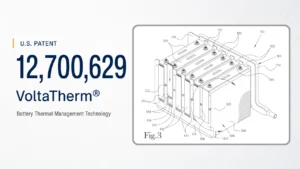
A later bus-bar-mounted thermoelectric battery thermal management patent applied this principle more specifically by placing thermoelectric devices on the electrical interconnects between adjacent batteries.
That configuration provided localized cell-pair heating and cooling through the bus bars, terminals, and electrical connections.
The broader electrical-device patent established the idea that a current-carrying conductor could become part of the thermal path. The later battery implementation applied that concept to a specific battery pack architecture.
Related link:
Controls and Temperature Sensing
The usefulness of localized thermoelectric cooling depends heavily on sensing and control.
Possible control inputs include:
- Device temperature
- Conductor temperature
- Ambient temperature
- Electrical current
- Voltage
- Power dissipation
- Duty cycle
- Operating mode
- Predicted thermal load
- Maximum allowable temperature
- Condensation conditions
A controller can adjust thermoelectric current to:
- Maintain a target temperature
- Limit peak temperature
- Reduce temperature gradients
- Preheat a device before operation
- Provide additional cooling during high-load events
- Reduce power when cooling demand is low
- Reverse heat-pumping direction when heating is required
In some systems, feed-forward control based on electrical load can improve response because the controller can anticipate heat generation before the temperature sensor registers the full temperature increase.
The thermoelectric device should not be controlled independently from the rest of the system. The hot-side heat sink, fans, pumps, electrical load, thermal interfaces, and condensation limits all affect the safe operating range.
Waste-Side Heat Rejection
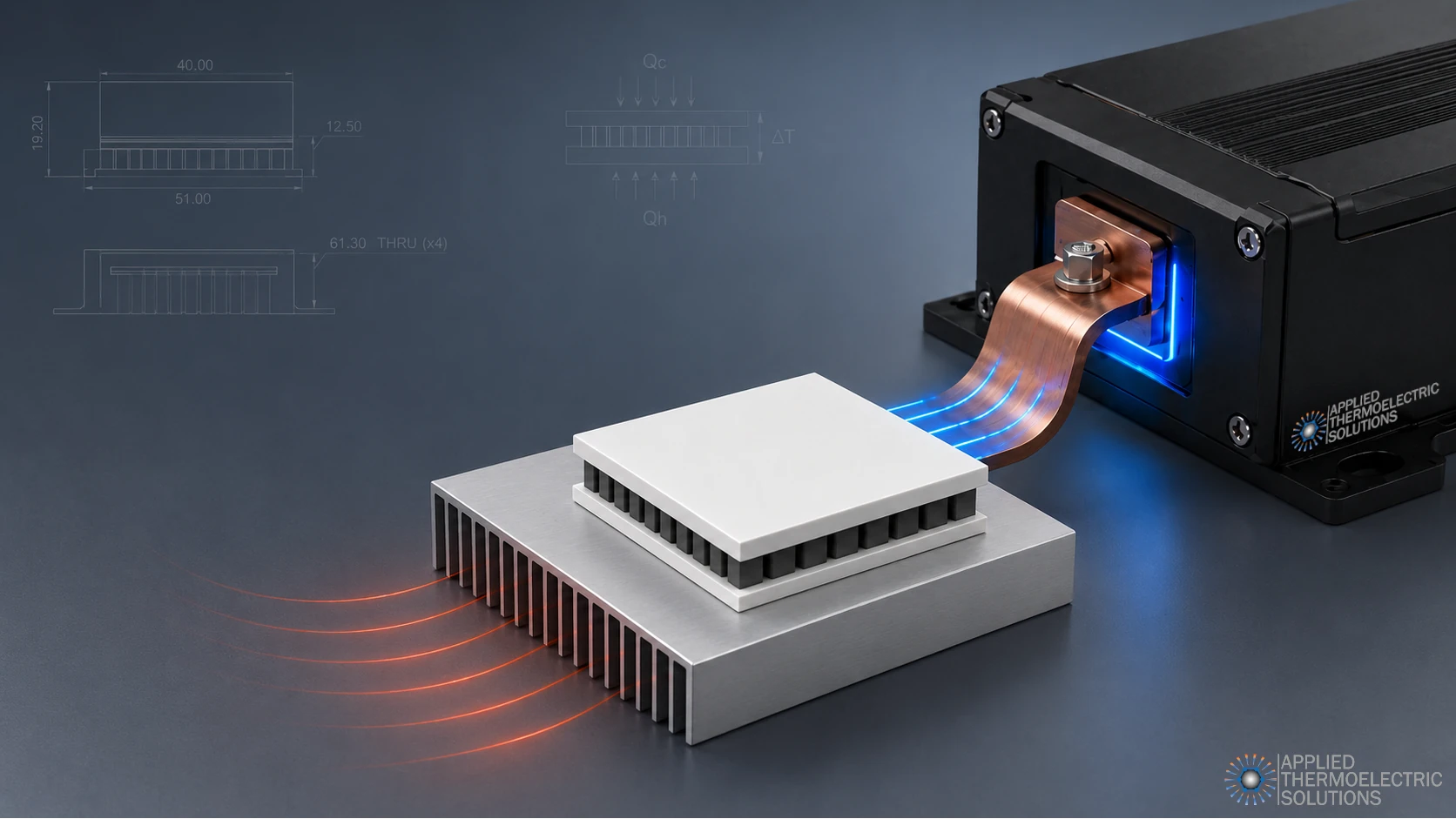
A thermoelectric device does not eliminate heat. It moves heat from one side to the other.
The hot side must reject:
- Heat pumped from the electrical device
- Electrical power consumed by the thermoelectric module
The total hot-side heat load is therefore greater than the cooling load alone.
Waste-side heat rejection may use:
- Natural convection
- Forced-air heat sinks
- Liquid cooling
- Refrigerant cooling
- Chassis conduction
- Heat pipes
- Vapor chambers
- Remote radiators
- Other thermal-management systems
A poorly designed hot side increases the thermoelectric temperature difference, reduces cooling capacity, increases power consumption, and lowers COP.
In many thermoelectric applications, waste-side heat rejection is the dominant system constraint.
When Conductor-Based Thermoelectric Cooling Makes Sense
This approach is most promising when:
- A conductor provides direct access to a temperature-sensitive region
- Conventional surface cooling has a high-resistance path to the hotspot
- Localized temperature control is more important than bulk cooling
- Bidirectional heating and cooling are valuable
- Packaging space is constrained
- A compressor or refrigerant system is undesirable
- The operating load is intermittent or variable
- The electrical and thermal functions can be integrated without excessive complexity
It may be less attractive when:
- The conductor creates a large parasitic heat leak
- The heat load is too high for practical thermoelectric cooling
- A conventional cold plate already provides a low-resistance path
- Electrical isolation requirements add excessive thermal resistance
- Available power is limited
- Waste-side heat rejection is inadequate
- Condensation cannot be controlled
- Reliability requirements prohibit the added interfaces
A feasibility study should compare conductor-based cooling with other architectures before hardware is selected.
Relevance to Current Applied Thermoelectric Solutions Work
The principles explored in this earlier patent remain relevant to the thermoelectric engineering work led by Alfred Piggott at Applied Thermoelectric Solutions.
Applied Thermoelectric Solutions evaluates the complete path between the heat-generating region and the final heat-rejection system, including:
- Internal device thermal resistance
- Electrical conductor geometry
- Useful and parasitic thermal paths
- Thermoelectric module placement
- Thermal interface resistance
- Electrical isolation
- Power electronics
- Temperature sensing
- Control strategy
- Mechanical integration
- Condensation risk
- Waste-side heat rejection
- System efficiency
This work can support applications involving:
- Electronics hotspot cooling
- Power electronics
- Lasers and optical systems
- Electrical enclosures
- Battery systems
- Motors and generators
- Laboratory instruments
- Medical and scientific devices
- Custom thermoelectric assemblies
The key question is not simply whether a thermoelectric module can cool an electrical device.
The more useful question is:
Can the thermoelectric device be connected to the temperature-sensitive region through a sufficiently low-resistance thermal path while limiting parasitic heat leakage and maintaining practical power consumption?
Thermoelectric Engineering Support
Applied Thermoelectric Solutions helps companies evaluate, design, model, prototype, test, and validate thermoelectric cooling, heating, and temperature-control systems.
Our work can include:
- Thermoelectric feasibility studies
- Thermal-resistance-network modeling
- Conductor-based cooling analysis
- Electronics hotspot evaluation
- Thermoelectric module selection
- Cold-side and hot-side thermal design
- Thermal interface analysis
- Power and COP prediction
- Heat-sink and liquid-cooling evaluation
- Electrical isolation strategy
- Control-system development
- Prototype design and engineering
- Prototype fabrication and assembly
- Instrumentation and testing
- Performance validation
- Design refinement based on test results
- Custom Thermoelectric Solutions
Evaluating Thermoelectric Cooling for an Electrical Device?
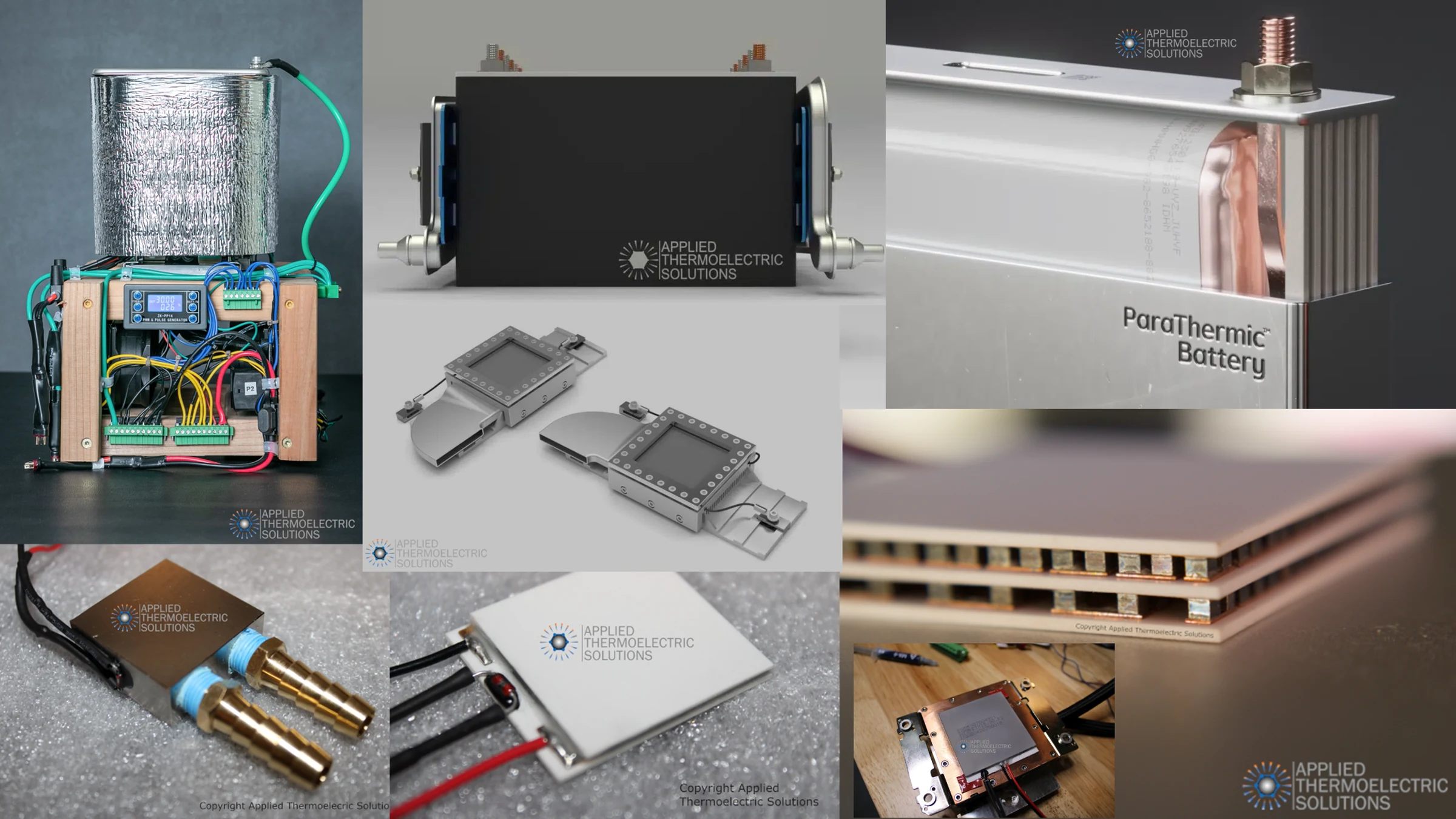
Applied Thermoelectric Solutions can help determine whether conductor-based cooling, direct device cooling, enclosure cooling, or another architecture provides the best technical path.
Patent PDF
The patent PDF is provided below as technical background showing earlier work by Alfred Piggott, founder and CTO of Applied Thermoelectric Solutions, in thermoelectric cooling, conductor-based heat transfer, electrical-device thermal management, and system integration.
The patent was developed by Alfred Piggott and other inventors while he was working at Gentherm.
Frequently Asked Thermoelectrics for Electrical Conductor Questions
How can an electrical conductor also act as a thermal pathway?
Metals such as copper and aluminum conduct both electricity and heat. A terminal, lead, electrode, or bus bar can therefore carry electrical current while also transferring thermal energy between an internal device region and a thermoelectric module.
Why cool an electrical terminal or lead?
A terminal or lead may connect more directly to an internal hotspot than the external housing does. Cooling the conductor can create a lower-resistance thermal path to the temperature-sensitive region, depending on the device construction.
Does cooling the conductor guarantee that the device hotspot will be cooled?
No. Cooling effectiveness depends on the thermal resistance between the hotspot and conductor, the resistance between the conductor and thermoelectric module, and the competing heat-transfer paths within the device.
Can external wiring create an unwanted heat leak?
Yes. The conductor may transfer cooling toward the target region, but it may also transfer heat to or from external cables, connectors, circuit boards, or other hardware. This parasitic path must be included in the thermal analysis.
Why does conductor thermal resistance matter to thermoelectric performance?
A high resistance between the target region and thermoelectric module requires the module’s cold side to operate at a lower temperature. This increases the temperature difference across the module, reduces cooling capacity, increases power consumption, lowers COP, and increases hot-side heat rejection.
What types of electrical devices could use this approach?
Potential applications include power electronics, IGBTs, MOSFETs, inverters, power amplifiers, motors, transformers, lasers, LEDs, batteries, sensors, and other devices where conductors provide thermal access to a temperature-sensitive region.
Does this concept apply only to batteries?
No. We support thermoelectric cooling, heating, temperature control, and power-generation applications. We also work on related thermal management problems where thermoelectrics may be part of a broader system solution.
How is this different from attaching a thermoelectric module to a housing?
Housing-mounted cooling removes heat through the device enclosure. Conductor-based cooling uses an electrical lead, terminal, electrode, or bus structure that may provide a more direct path to the internal heat source. The better approach depends on the thermal resistance of each path.
Does conductor-based thermoelectric cooling eliminate the need for a heat sink?
No. Heat pumped from the electrical device, plus the electrical power consumed by the thermoelectric module, must be rejected from the module’s hot side.
Is direct coupling better than using an intermediate thermal component?
Direct coupling usually minimizes material and interface resistance. However, an intermediate component may be necessary for electrical isolation, mechanical packaging, load distribution, or assembly. The complete system must be evaluated.
How does this relate to the bus-bar-mounted battery cooling patent?
The broader electrical-device patent explored using current-carrying conductors as thermal pathways. The later battery patent applied the principle specifically to battery bus bars and provided localized heating and cooling of adjacent cell pairs.
Is this an Applied Thermoelectric Solutions patent?
The patent was developed by Alfred Piggott, founder and CTO of Applied Thermoelectric Solutions, and other inventors while he was working at Gentherm. It is included here to document Alfred Piggott’s earlier technical work and its relevance to current thermoelectric system design, prototype development, testing, and integration.
Links that May Interest You
- Custom Thermoelectric Solutions
- Thermoelectric Design and Simulation Services
- Thermoelectric System Development
- Our Thermoelectric Cooling and Generator Work
- Thermoelectric Cooling Prototype Case Study
- Solar Thermoelectric Generator Case Study
- How Thermoelectric Cooling Works
- How Thermoelectric Generators Work
- ParaThermic® Battery Thermal Management Technology
- VoltaTherm® Battery Thermal Management System (BTMS)
- PowerBeam™ Wireless Power Transfer Technology
- Battery Thermal Management | After Immersion Cooling