Foundational Research in Transient Thermoelectric Supercooling
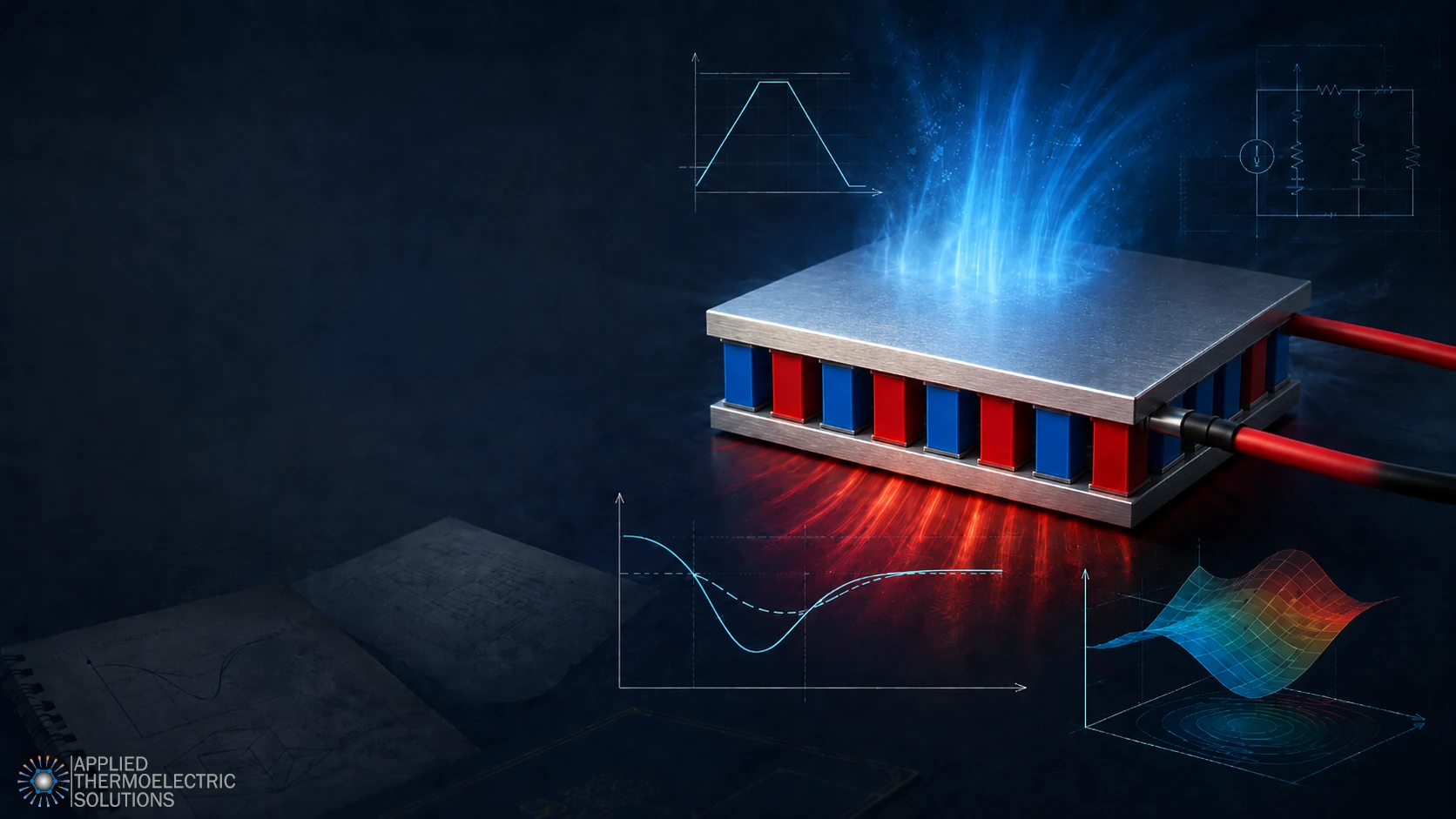
The research investigated whether carefully designed electrical current pulses could improve the short-duration cooling performance of a thermoelectric device. It used SPICE-based electrical-thermal analogy models to study pulse height, pulse duration, transient advantage, transient penalty, cooling capacity, electrical power consumption, COP, thermal interfaces, heat spreading, internal heat generation, and repeated pulse operation.
This work was completed at Michigan Technological University and preceded two later peer-reviewed publications on isosceles current-pulse optimization and pulse cooling of a heat-generating object.
Research Objective and Scope
The goal of the research was to determine whether optimized transient pulse operation could improve the cooling capacity or efficiency of a thermoelectric device.
A current pulse can temporarily increase Peltier cooling at the cold-side junction. However, the pulse also increases Joule heat generation inside the thermoelectric elements. Peltier cooling begins quickly, while the Joule heat takes more time to diffuse through the device.
This difference in thermal response can create a short period of additional cooling followed by a delayed temperature rise. The research examined whether the useful transient cooling benefit could be increased relative to the subsequent thermal penalty.
Two primary models were developed:
- A standalone thermoelectric couple without an attached object to be cooled
- A system model that included a full thermoelectric module, heat spreader, thermal interfaces, insulation, and a heat-generating mass
This second model made it possible to evaluate pulse cooling as a complete thermal system rather than as an isolated thermoelectric element.
SPICE-Based Electrical-Thermal Modeling
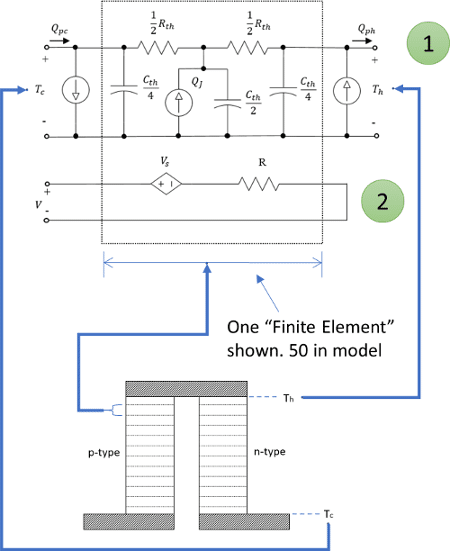
The models were developed using electrical-thermal analogies and solved as transient networks in SPICE.
In the analogy:
- Temperature is represented by voltage
- Heat flow is represented by electrical current
- Thermal resistance is represented by electrical resistance
- Thermal capacitance is represented by electrical capacitance
- Peltier cooling and heating are represented by controlled heat sources
- Joule heating is distributed through the thermoelectric elements
The thermoelectric elements, heat spreader, heat-generating mass, insulation, and interfaces were divided into distributed thermal networks. This allowed the models to calculate how temperature and heat flow changed throughout the pulse and recovery period.
The system model included effects that are often left out of simplified thermoelectric calculations, including thermal-interface resistance, heat-spreader conductivity, mass thermal properties, internal heat generation, and temperature distribution within the thermoelectric elements.
Response-Surface Optimization of Isosceles Current Pulses
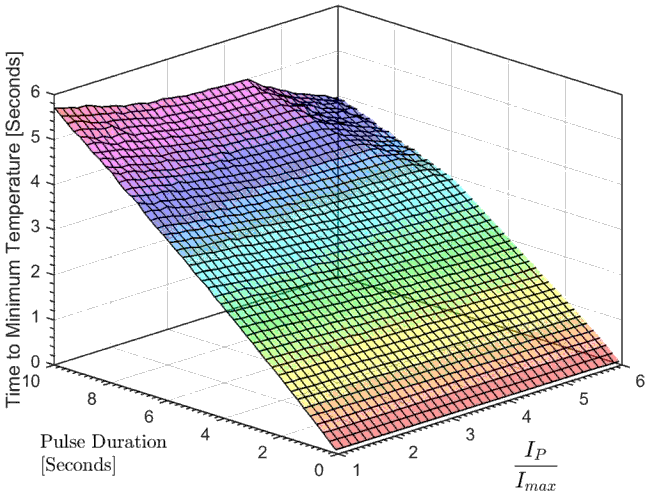
The first part of the research examined isosceles triangular current pulses applied to a thermoelectric couple.
Pulse height and pulse on-time were varied to determine how they affected:
- Time to minimum temperature
- Minimum cold-side temperature
- Holding time below the steady-state temperature
- Maximum post-pulse temperature
- Transient advantage
- Transient penalty
- Net transient advantage
Net transient advantage was defined as the useful cooling advantage during the pulse minus the subsequent thermal penalty.
Response surfaces were generated to show how pulse height and pulse duration interacted. This provided a more systematic method of selecting a pulse than evaluating a small number of individual operating points.
The results demonstrated that the pulse producing the lowest instantaneous temperature was not necessarily the pulse producing the best overall transient result. Pulse height and duration had to be considered together.
Modeling Pulse Cooling of a Heat-Generating Mass

The optimized pulse conditions were then applied to a more realistic system containing a thermoelectric module attached to a heat-generating mass.
This model included:
- A commercial-scale thermoelectric module
- Ceramic substrates and metallic interconnects
- A heat spreader
- Thermal-interface materials
- A heat-generating object
- Insulation
- Convective boundary conditions
The model evaluated the response of the cooled mass along with heat absorbed at the cold side, electrical input power, COP, temperature distribution, and post-pulse recovery.
This was important because the cold-side temperature of an unloaded thermoelectric couple does not fully describe how pulse cooling will perform when attached to a real object.
System Variables Evaluated
The thesis investigated how transient pulse-cooling performance changed with:
- Pulse height
- Pulse duration
- Starting current
- Cold-side interface resistance
- Heat-spreader-to-mass interface resistance
- Thermal effusivity of the cooled mass
- Heat-spreader thermal conductivity
- Internal heat generation
- Temperature distribution within the thermoelectric elements
- Time between repeated pulses
- Continuous pulsing
- Pull-down of the cooled mass over multiple pulses
These studies showed that pulse cooling is a system-level problem. The thermoelectric module, interfaces, heat spreader, cooled object, heat generation, and pulse timing all affect whether a current pulse provides a useful result.
Principal Research Findings
The research found that optimized current pulses could improve some aspects of short-duration cooling, but that the result depended strongly on the comparison condition and performance metric.
Key findings included:
- Pulse height and pulse duration could be selected using response surfaces to maximize net transient advantage.
- Net heat absorption over a complete pulse event could exceed steady operation at the current producing maximum temperature difference.
- Net heat absorption over the complete pulse event did not exceed steady operation at the current producing maximum cooling capacity.
- Cooling capacity could temporarily exceed the maximum steady-state cooling rate during the early part of the pulse.
- COP was generally reduced during transient pulse operation because cooling capacity and input power responded over different timescales.
- Thermal interfaces, heat-spreader properties, mass properties, internal heat generation, and pulse spacing significantly affected system performance.
- Some interface effects were counterintuitive, demonstrating why transient system modeling is necessary before selecting hardware or operating conditions.
The results did not show that current pulses universally improve thermoelectric performance. Instead, they identified the conditions under which pulse cooling can provide a useful short-duration cooling benefit and the tradeoffs that accompany that benefit.
From Thesis Research to Peer-Reviewed Publications
The thesis provided the modeling and research foundation for two later peer-reviewed papers.
Peltier Supercooling with Isosceles Current Pulses: A Response Surface Perspective
This paper focused on pulse height, pulse duration, response-surface analysis, and identification of operating regions that improve net transient cooling.
Peltier Supercooling with Isosceles Current Pulses: Cooling an Object with Internal Heat Generation
This paper extended the analysis to a more realistic system containing a thermoelectric module, interfaces, a heat spreader, and a heat-generating object. It evaluated cooling capacity, power consumption, COP, and system response during pulse operation.
Current Engineering Relevance

The underlying engineering problem remains relevant wherever a system experiences short-duration heat loads, localized hot spots, rapid thermal events, or brief periods requiring additional cooling.
Potential applications include semiconductor hot spots, laser and photonics systems, sensors, pulsed electronics, high-performance computing hardware, diagnostic equipment, and other systems where the timing of the cooling response matters.
Current engineering evaluation should go beyond simply reproducing the pulse conditions used in the thesis. A practical design must account for the selected thermoelectric module, hot-side heat rejection, solder-temperature limits, thermal interfaces, cooled object, power supply, control system, reliability requirements, and actual heat-load profile.
For a broader explanation of the physics, applications, practical constraints, and current system-level design approach, see:
Full Thesis Archive
Transient Thermoelectric Supercooling: Isosceles Current Pulses from a Response Surface Perspective and the Performance Effects of Pulse Cooling a Heat Generating Mass
Alfred J. Piggott III
Master of Science in Mechanical Engineering
Michigan Technological University
The full thesis contains the model development, electrical-thermal analogy circuits, response surfaces, system-model results, parametric studies, temperature distributions, continuous-pulse analysis, conclusions, and recommendations for future research.
Thermoelectric Modeling and Engineering Support
Applied Thermoelectric Solutions provides model-based thermoelectric engineering for cooling, heating, and power-generation systems.
For transient cooling applications, this can include evaluation of pulse-current strategies, thermoelectric module behavior, thermal mass, interface resistance, heat spreading, hot-side temperature, solder limits, heat rejection, control requirements, and post-pulse recovery.
The purpose of this work is not simply to apply more current to a thermoelectric module. It is to determine whether transient operation can provide the required cooling response without exceeding the practical limits of the module or surrounding system.
Frequently Asked transient thermoelectric supercooling questions
What is transient thermoelectric supercooling?
Transient thermoelectric supercooling is a temporary temperature reduction produced by applying a controlled current pulse to a thermoelectric cooler. The pulse can briefly increase Peltier cooling before additional Joule heat diffuses through the thermoelectric elements and affects the cold sid
What was the purpose of this research?
The research investigated whether pulse height and pulse duration could be selected to improve useful short-duration thermoelectric cooling. It also examined how pulse cooling performs when the thermoelectric module is connected to a heat-generating object, thermal interfaces, and a heat spreader.
How was the thermoelectric system modeled?
The research used SPICE-based electrical-thermal analogies. Temperature was represented by voltage, heat flow by electrical current, thermal resistance by electrical resistance, and thermal capacitance by electrical capacitance. Distributed networks were used to model heat movement through the thermoelectric elements and surrounding system over time.
What were the main findings?
The research found that current pulses can temporarily increase cooling capacity and reduce cold-side temperature, but the result depends strongly on pulse height, pulse duration, thermal interfaces, heat spreading, thermal mass, and the comparison condition. Pulse cooling generally required more electrical power and did not consistently improve COP.
How did this thesis lead to later published research?
The thesis provided the modeling and analysis foundation for two later peer-reviewed papers. One focused on response-surface optimization of isosceles current pulses, and the other examined pulse cooling of a heat-generating object, including cooling capacity, electrical power, and COP.
Is this research still relevant to current thermoelectric system design?
Yes. The same transient modeling principles apply to systems with short-duration heat loads, localized hot spots, rapid thermal events, or brief peak cooling requirements. Modern application studies should also include the specific module, thermal interfaces, heat rejection system, temperature limits, control strategy, and actual heat-load profile.
Links that May Interest You
- Custom Thermoelectric Solutions
- Thermoelectric Design and Simulation Services
- Thermoelectric System Development
- Our Thermoelectric Cooling and Generator Work
- Thermoelectric Cooling Prototype Case Study
- Solar Thermoelectric Generator Case Study
- How Thermoelectric Cooling Works
- How Thermoelectric Generators Work
- ParaThermic® Battery Thermal Management Technology
- VoltaTherm® Battery Thermal Management System (BTMS)
- PowerBeam™ Wireless Power Transfer Technology
- Battery Thermal Management | After Immersion Cooling