
Applied Thermoelectric Solutions Peltier Supercooling Research Presented at the International Conference on Thermoelectrics
ORAL PRESENTATION · ICT 2017 · PASADENA, CALIFORNIA
Originally published June 27, 2017 · Updated August 10, 2026
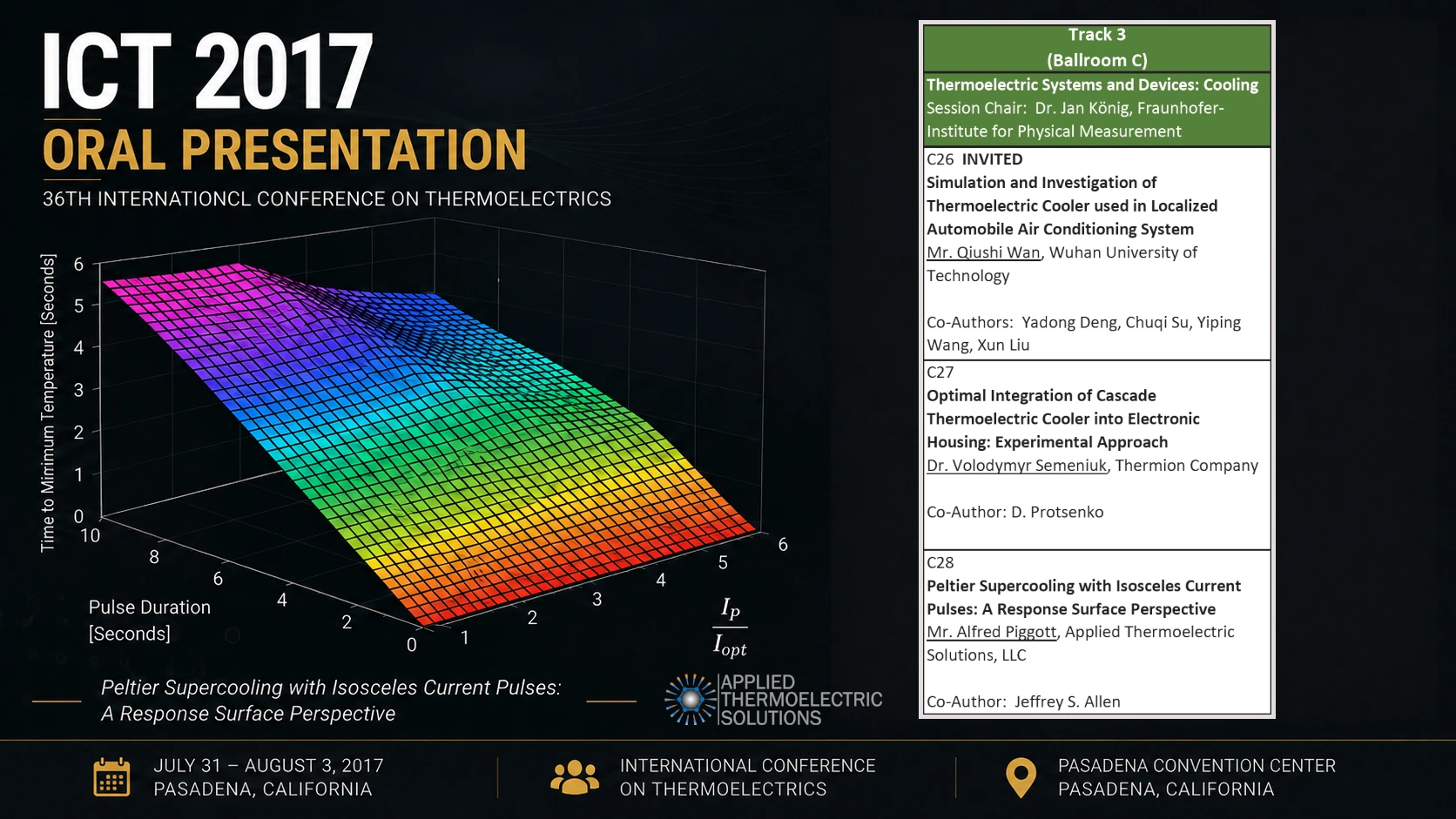
Applied Thermoelectric Solutions’ research on transient Peltier supercooling was presented at the 36th International Conference on Thermoelectrics (ICT 2017) in Pasadena, California.
Alfred Piggott of Applied Thermoelectric Solutions delivered the work as an oral presentation in the conference’s Thermoelectric Systems and Devices: Cooling session. The official ICT 2017 program identifies Piggott’s affiliation as Applied Thermoelectric Solutions, LLC and lists Jeffrey S. Allen as co-author.
ICT 2017 Oral Presentation
Conference: 36th International Conference on Thermoelectrics
Location: Pasadena, California
Conference dates: July 31–August 3, 2017
Presentation date: August 1, 2017
Presentation time: 2:45–3:00 p.m.
Session: Thermoelectric Systems and Devices: Cooling
Presentation format: Oral Presentation
Program: C28
Presenter: Alfred Piggott
Affiliation: Applied Thermoelectric Solutions, LLC
Co-author: Jeffrey S. Allen
Presentation: Peltier Supercooling with Isosceles Current Pulses: A Response Surface Perspective
The official program places the presentation in Track 3, Ballroom C, as part of the conference’s dedicated thermoelectric cooling session.
About the International Conference on Thermoelectrics
The International Conference on Thermoelectrics (ICT) is an international meeting focused specifically on thermoelectric science and technology.
The 2017 conference program organized its technical sessions around thermoelectric materials and Thermoelectric Systems and Devices, including optimization, cooling, device design and fabrication, device development and validation, modules, interfaces, applications, and novel device concepts.
What Applied Thermoelectric Solutions Presented
The presentation examined Peltier supercooling using shaped electrical-current pulses.
Peltier supercooling creates a transient operating condition in which a thermoelectric cooler can temporarily produce cooling behavior beyond its steady-state response. The research investigated how the magnitude and duration of an isosceles current pulse affected transient cooling performance.
Rather than evaluating only a single operating point, the work used a response-surface approach to examine the interaction between current-pulse height and duration. This provided a systematic method for identifying operating regions that produced the most useful transient cooling response.
The work illustrates how electrical-thermal modeling and optimization can be used to investigate thermoelectric behavior that is not fully captured by steady-state module specifications.
Peer-Reviewed Research Behind the Presentation
The ICT presentation was based on the peer-reviewed paper:
“Peltier Supercooling with Isosceles Current Pulses: A Response Surface Perspective.”
Published in the ECS Journal of Solid State Science and Technology, the research used electrical-thermal modeling and response-surface analysis to examine how current-pulse magnitude and duration affected transient Peltier cooling.
Continuing the Peltier Supercooling Research
The ICT 2017 presentation was part of a broader investigation into transient thermoelectric cooling.
Later in 2017, Applied Thermoelectric Solutions presented related work examining Peltier supercooling of an object with internal heat generation at the 232nd Electrochemical Society Meeting. That work extended the analysis toward system-level behavior, including heat transfer, electrical power, coefficient of performance, thermal interfaces, and transient operation.
A Documented Example of Transient Thermoelectric Modeling
The ICT 2017 presentation provides a documented example of Applied Thermoelectric Solutions’ work in transient thermoelectric modeling, simulation, and optimization.
Thermoelectric systems can behave differently during transient operation than under steady-state conditions. Modeling interactions among electrical current, Peltier cooling, Joule heating, thermal mass, heat transfer, interfaces, and operating time can help identify design opportunities that would be difficult to evaluate from steady-state specifications alone.
Applied Thermoelectric Solutions uses physics-based modeling and system-level engineering to evaluate thermoelectric cooling, heating, power generation, thermal management, and R&D applications.
Developing a Thermoelectric System?
Applied Thermoelectric Solutions provides thermoelectric modeling, simulation, design, engineering, and R&D support for organizations developing thermoelectric and thermal-management systems.
Links that May Interest You
- Custom Thermoelectric Solutions
- Thermoelectric Design and Simulation Services
- Thermoelectric System Development
- Our Thermoelectric Cooling and Generator Work
- Thermoelectric Cooling Prototype Case Study
- Solar Thermoelectric Generator Case Study
- How Thermoelectric Cooling Works
- How Thermoelectric Generators Work
- ParaThermic® Battery Thermal Management Technology
- VoltaTherm® Battery Thermal Management System (BTMS)
- PowerBeam™ Wireless Power Transfer Technology
- Battery Thermal Management | After Immersion Cooling
4 Responses
Nice
Thank you!
Nice
Thank you!